Saturday, 4 March 2023

Above the Clouds in the Cairngorms


Late February saw the start of the first prolonged period of high pressure this winter. The strong winds of recent weeks died away, the temperatures dropped, the hills froze. A night out in the snow called.

On the ascent I was surprised at the amount of fresh snow high up. I’d expected less. Drifting in the wind meant in places it was soft and deep while in others it had been blown away and only thin icy old snow remained from earlier falls. None of the latter were quite extensive enough for crampons though I did consider donning them a few times. Mostly I could boulder hop the iciest sections. 


The rocks and boulders were decorated with forst and snow patterns, fingers of white splayed across the warm brown granite. 


Having left fairly late the western sky was darkening and turning orange as I reached the summit of Cairn Gorm, the sun a searing white ball about to set over the frozen mountains.

The light fading and the cold increasing I dropped down to a shallow corrie and found a flat spot for camp. The snow here was quite thin and I was able to shovel most of it away and pitch on almost clear ground. I left the tent door wide open so I could lie and gaze at the stars and the moon.


I woke to see a band of orange on the eastern horizon above a sea of cloud filling the flatlands beyond the mountains. The temperature was -5.5°C but I was warm in my down sleeping bag and jacket and soon had hot coffee. There was a trickle of water in the nearby stream, just enough to fill my bottles. Knowing the water would freeze overnight I’d filled my pot before going to sleep. Sure enough it was solid ice but after a few minutes on the stove it had turned to boiling water.


As the sun appeared and the light strengthened I wandered along the edge of the deep Loch Avon basin gazing down at the dark water, edged and patched with ice, and across to snowy hills. To the east the cloud was rising and slowly winding up Glen Avon.


The sun was high by the time I returned to camp for more coffee and a slow packing up. It was not a day to hurry. The first other people appeared, two skiers descending a wide strip of unbroken snow. I reckoned they must have carried their skis a fair way.


I ambled up to the crest of Stob Coire an t-Sneachda to see a vast sea of cloud filling Glenmore and Strathspey.  Up here the sun was strong, the views stretching out endlessly. Down there the air would be grey and the world enclosed. Looking back I could see the mist much closer now. Maybe here would be enveloped soon.


But not yet. Back on the summit of Cairn Gorm the sun was bright. I shared the summit with others enjoying the views, the alpine blue sky, the mountain majesty, the grandness of the Cairngorms.


That mist was still creeping upwards though, from both sides now. A line of walkers heading upwards were backed by a boiling wall of cloud. 


I wasn’t far below the summit when the air grew hazy and damp, the sun thin and pale. Soon visibility was less than a hundred metres. The world had changed. Boulders loomed up like huge cliffs only to shrink as I reached them. At times I wasn’t quite sure if the ground in front went up or down. If there’s been more snow it would have been a white-out, but I could see rocks and then heather and patches of grass.

I came out of the mist to a cold car park under a grey sky. Time for Aviemore and a café. 


Saturday, 25 February 2023

Signalling in an emergency in the hills: low tech and high tech devices.


Browsing the internet this morning I came across two items in quick succession both to do with signalling in case of an emergency on the hills. There was a huge contrast between them, one being about a very simple and low-tech device, the other a highly complex and very hi-tech one. Reading them set me thinking about emergency signalling devices and what I carry and why.

The first piece was about whistles on ukhillwalking.com by Dan Bailey with input from Mountain Rescue expert David ‘Heavy’ Whalley, who points out that earlier this month a person missing for three days on the Isle of Skye was located by the sound of his whistle. The second piece was in The Guardian and was about a new low-cost device that will allow a smartphone to send texts via satellite.

Low-cost is a relative term of course. You can buy a safety whistle for £3. The Defy Satellite link costs £99 on its own and £149 when bundled with 30 messages a month and an SOS assistance service for the first year, which is much less than other devices that do something similar. There is a button for sending an SOS message but for any other messages you need to link it to a smartphone. Regardless of cost both devices could be lifesavers in the hills.

The Defy Satellite link comes from Motorola, who make the Defy rugged smartphone I reviewed in 2021.

After the whistle the next cheapest signalling device is a torch or headlamp. The light from one of these can be seen from very long distances, far further than the loudest whistle is likely to carry.

With whistle or headlamp the Alpine Distress Signal should be used to call for help - six blasts or flashes repeated every other minute. If responding it’s three blasts or flashes every second minute. And when you receive a response don’t stop signalling as locating your exact position may be difficult.

Whistles should be loud to be effective. Many rucksacks come with whistles built into the chest strap. I’ve tried a few of these and they’re a bit feeble. A standalone whistle is better. Mine weighs all of 10 grams so it’s not exactly a burden to carry.


I’ve carried a whistle and a torch or headlamp ever since I started hillwalking. They’ve been recommended safety items for many decades. I’ve never needed to use the whistle but it’s always to hand. The headlamp is used regularly anyway. The smartphone became part of my kit back in 2010, a satellite communicator much more recently. I currently have, and like, the Garmin inReach Mini, which I reviewed last year. At £350 plus subscription it’s much more expensive than the Defy Satellite link but it also does much more (tracking, GPS location and navigation, email) and can be used as a standalone device as well as with a smartphone.

I’ve ended up then with four signalling devices, all with different advantages. The basics are the whistle and headlamp. These should be in everyone’s kit (and easily accessible). Smartphones are now common but not everyone has one or wants to carry one. Satellite communicators are the latest devices. I’ve had one the last five years.

Some people argue that having such a device detracts from the feeling of remoteness in the hills. I haven’t found it so but would still carry one if I did, not for myself but for the peace of mind of my family. Before mobile phones they accepted that I was sometimes out of touch for days, even weeks, at a time and they had no real idea of where I was. But now smartphones and satellite communicators exist they like to hear from me regularly, even if it's just a simple ‘all Ok’.

Friday, 24 February 2023

Conversation with Andrew Terrill and Alex Roddie now online

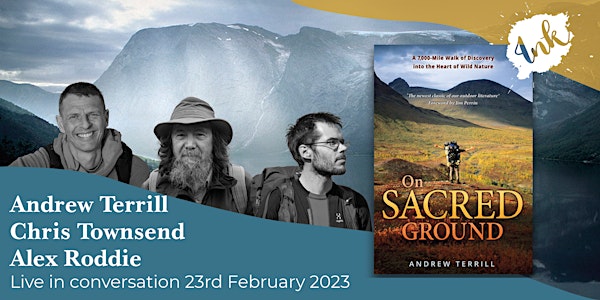
 On Sacred Ground live with Andrew Terrill, Chris Townsend and Alex Roddie

The above conversation is now online here.

It was an enjoyable discussion covering a host of topics. Ran a little over time but could have gone on for much longer!

Thanks to Tim at Adventurous Ink for organising and hosting it.

Wednesday, 22 February 2023

A Look At The April Issue Of The Great Outdoors


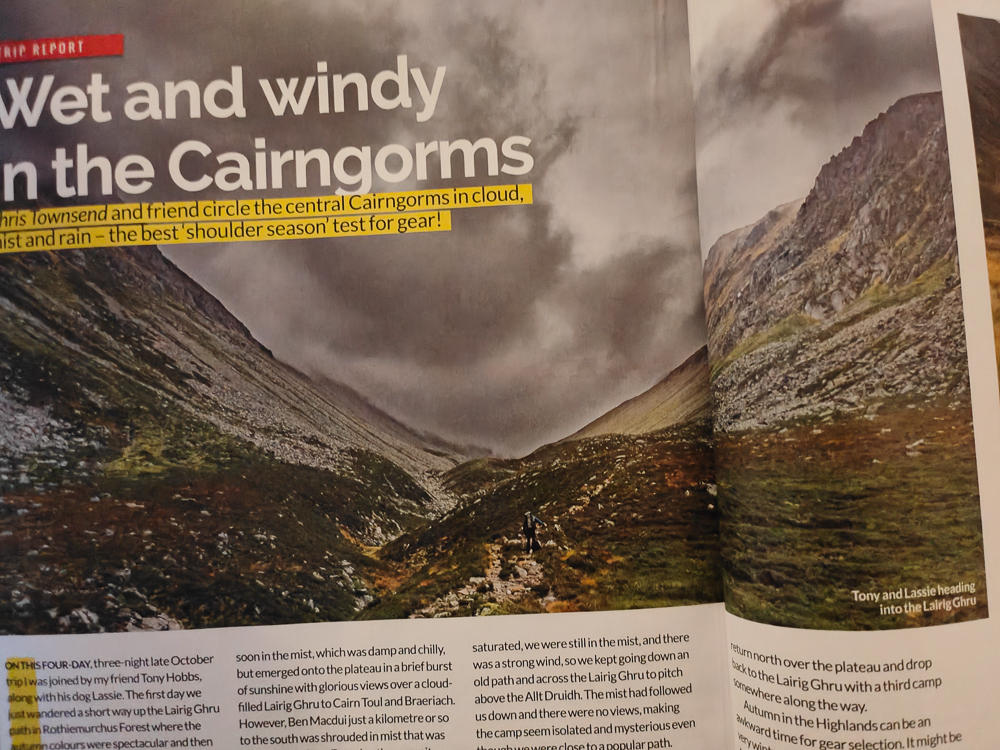
The April issue of The Great Outdoors is out now. In it I have a trip and gear feature on a four day wet and windy Cairngorms trip last October plus a review of three men's daypacks. In the same piece Fiona Russell reviews three women's ones. Fiona also reviews four pairs of 3-season women's boots while Peter Macfarlane reviews four men's pairs. Elsewhere in the gear pages James Forrest gives advice on using personal locator beacons and satellite communicators and looks at five models.

The magazine opens with a wonderful photo of the last sunlight on the Scafells and the Wasdale screes by Ben Cannon. This picture was taken on a walk with TGO editor Carey Davies and in his feature on the venture Carey finds out if you can go for a walk in the Lakes and not pass a single other walker. 

Also in the big features Ryan Simpson describes the Mournes in Northern Ireland in an article packed with his superb photographs. Over in Wales Andrew Galloway explores the Carneddau in winter. Away from the hills ecologist Katy Ellis takes a long walk on the surprisingly wild coast of East Anglia. Far over the North Sea Jilly Sherlock describes a wonderful-sounding challenging ski tour in the Swedish Arctic. 

In shorter pieces campaigner Jon Moses looks at the Right to Roam movement in England in the aftermath of the Dartmoor willd camping affair and six outdoor enthusiasts share what Dartmoor means to them. Carey Davies looks at concerns raised over crowdsourced data used by popular hiking apps. Alex Roddie reviews Jenny Tough's Solo: What Running Across Mountains Taught Me About Life. In his Mountain Portrait Jim Perrin describes the Twelve Bens of Connemara. On her walk round the UK coast Emma Schroeder ponders the phenomena of 'desire paths'.

The Wild Walks pages sees Ian Battersby walking the chaotic coastline from Yesnaby Cliffs to Stromness on Orkney, Craig Weldon walking The Brack and Cnoc Coinnich in the Arrochar Alps, and Ronald Turnbull going from High Doat to Dale head in the Lake District. Also in the Lakes Norman Hadley ascends the SSW ridge of  Red Screes SSW, while over in the Pennines James Forrest explores Nine Standards Rigg. A little further south Vivienne Crow links Arant Haw and Winder in the Howgill Fells. In Wales Andrew Galloway walks to Carnedd y Filiast from Llyn Celyn and Roger Butler takes a rollercoaster route over Y Garth and Allt yDdinas in Powys. Down in southern England Fiona Barltrop hikes the Hampshire 'highlands' and over in Northern Ireland Peter Wilson does the Annalong Round in the Mourne mountains. 


Tuesday, 21 February 2023

Online chat with Andrew Terrill and Alex Roddie this Thursday

On Sacred Ground live with Andrew Terrill, Chris Townsend and Alex Roddie 

This Thursday at 8pm I'll be talking about long-distance walking with fellow outdoor writers and long-distance walkers Andrew Terrill and  @alex_roddie@mastodon.scot along with Tim Frenneaux +and the Adventurous Ink book club. It's a free Zoom conversation and open to all. 

If you'd like join us here's the link.

eventbrite.co.uk/e/on-sacred-g