Friday, 8 September 2023

Cairngorm Heatwave

My camp with Meall a' Bhuachaille in the background (which I couldn't see from the tent)

Early September’s very hot weather called for a night in the hills but not for a big walk in the heat. I decided that a wander round the long northern ridge of Cairn Gorm would be ideal. It’s a favourite place that’s very accessible yet very quiet (no Munros or Corbetts!) On this trip I met a few walkers heading back from An Lochan Uaine near the start and no-one else. On the second day I did see some tiny figures heading up the path to the summit of Cairn Gorm. I didn’t join them, preferring solitude.

To avoid the hottest part of the day I didn’t set off until late afternoon on the path through the forest to An Lochan Uaine and Ryvoan Pass and then onto the path that leads to the Lairig and Laoigh and Bynack More. I wasn’t going to either of those though and soon left the path for the secretive twisting little glen leading into An Garbh-choire (the rough corrie – there are quite a few with this name in the Highlands).

Once off the path my pace dropped dramatically and the effort of walking increased similarly. The way into the corrie is rough itself, a mass of deep heather and dense grassy tussocks. I’d noted the arduous terrain on my last visit here back in 2017 (see this post) but I hadn’t remembered just how tough the going was. The heat didn’t help. Even though the sun was low enough that I was in the shade the air in the narrow glen was still and stifling.

Eag a' Gharbh-choire. I went up the slope on the left.

On my previous visit I’d stayed in the heart of the corrie and clambered up the centre of the stony ravine called the Eag a’ Gharbh-choire (Notch of the Rough Corrie). This time I decided to climb the side, high above the rocks. I’m not sure it was any easier.

Evening light

Beyond the Eag a’ Gharbh-choire I reached a shallow flat boggy area with a trickle of a burn running through it. I camped at the end of this before the next climb, a pleasant site if rather bumpy. A breeze kept away the midges. The low sun was turning the hills golden brown. I watched it set over shining Loch Morlich, leaving a sky streaked with orange. A fine night to be in the hills.

Loch Morlich after sunset

During the night I woke feeling chilly and zipped up my half-open sleeping bag. The temperature was 4.7°C. The tent flysheet was wet with condensation and dew. The wind had dropped.

Watching the sunshine approach

Waking again at dawn I watched the sun slowly creeping down the hillside towards me. I have done this so many times. Lying in my sleeping bag waiting for the warmth to reach me always feels wonderful. There were some midges around so I lit mosquito coils in the porch then sat back and drank my morning coffee while waiting for the bright sunlight to reach me.

They vanished as soon as the sun hit the tent. Within minutes the temperature was 25°C and I was outside, the tent suddenly feeling stuffy and oppressive.

Stac na h-Iolaire

From camp I climbed past craggy Stac na h-Iolaire and up the long Sron a’ Cha-no ridge. The heat felt like it was bouncing off the pale granite and I was soon drenched in sweat. With no need to hurry I stopped often for water and to sit and watch the astonishing blue of the sky and the magnificent hills. Bynack More looked impressive across Strath Nethy.

Bynack More

My last stop was at an unnamed little rocky top with a spot height of 1028 metres. That would be the high point of the walk. Far below the green forest looked cool and inviting. I wanted to be down in the shade of the trees.

Sron a' Cha-no

It took a while to reach them, down the long shoulder of Coire Laogh Mor and then a little-used narrow and boggy path below the Coire na Ciste car park.

In the forest

The forest was cooler than the open exposed hillside but I stayed hot as walking through thick high heather and grassy tussocks that hid the path, which came and went, was strenuous. The soft light filtering through the trees was welcome after the harsh brightness of the hills though. The complexity of this natural woodland was a joy too, so different from the rigid ranks of plantations. This is a real forest.

Soon the walk was over. I hadn’t gone far but in the heat it was enough. It had been another wonderful Cairngorms trip.

Sunday, 3 September 2023

A Look At The October Issue Of The Great Outdoors

In the latest issue of The Great Outdoors I have quite a bit of gear stuff. There's a big feature on the gear I used on a two-week trip in Knoydart last May plus reviews of the Built To Send U1 daypack, three items from  Peak Design - the Leash, Capture clip, and Aluminium Travel Tripod-, and the BAM Summit Durlston Adventure Trousers.

Also in the gear pages Fiona Russell and Peter Macfarlane test four all-season waterproof jackets each. Peter Macfarlane also tries six insulated flasks and Alex Roddie reviews the Suunto Vertical Titanium Solar GPS watch.

Alex Roddie also looks at staying dry when hiking in the skills section.

The main theme of the issue is walks that combine mountains and water. There are suggestions for eight walks including waterfalls, lochs, the sea, and summits in the Scottish Highlands, the Lake District, the Pennines, and the Brecon Beacons. In a feature illustrated with his evocative photos James Roddie describes a walks from Elgol to Loch Coruisk on the Isle of Skye, finishing with a camp on Sgurr na Stri. 

Taking inspiration from 'Tours' in Europe Ronald Turnbull makes a circle round Scafell Pike, visiting seven valleys with some bivvies along the way. 

In the Alps James Forrest walks the new 72km Otzi Trek and learns about Otzi the Iceman, whose corpse dates from 3200BC. 

Creator of the Month is Carys Rees and her This Girl Walks website, which provides advice for women outdoors. 

The Opinion column is by Kate Ashbrook, general secretary of the Open Spaces Society and vice-president of the Ramblers, who argues that the victory on Dartmoor camping could be the catalyst for better access in the rest of England.

Francesca Donovan reviews a curious and fascinating sounding book, British Mountaineers by Faye Rhiannon Latham.

Vivienne Crow writes about Keswick and what to do there in the Your Weekend In .... pages.

Thorpe Cloud in the Peak District is Jim Perrin's Mountain Portrait and it brings back many memories.

This issue has ten Wild Walks, half of them in Wales. Scotland gets just one but it's big, a 32km ascent of Ben Macdui in the Cairngorms from the Linn of Dee, described by Craig Weldon. 

Four of the Welsh walks are in Snowdonia where Alex Roddie traverses Yr Wyddfa (Snowdon) via the Llanberis and Watkins Paths, James Forrest climbs Arenig Fach, Emily Woodhouse crosses the Moelwynion, and Ian Battersby goes up Rhinog Fawr. The final walk in Wales is much further south in the Black Mountains where Steve Eddy walks over Hatterall Hill. 

In England. Vivienne Crow climbs Branstree in the Lake District, Norman Hadley goes up Pendle Hill in Lancashire, Roger Butler explores Walsgrove Hill and Devil's Den in Worcestershire, and Tim Gent goes to Devil's Tor and Wistman's Wood on Dartmoor.


Saturday, 2 September 2023

August's blue moon


A blue moon is the second full moon in a month, something that doesn't often occur, and there was one at the end of August. This moon was in the sky the evening of the 30th August but it was cloudy so I didn't actually see it. The next evening was clear so I took some photos. The image above is a crop. The full image is below. The photo was taken with the Sony a6700 camera and Sony 70-350mm lens. 

Why blue moon? Curious, I tried to find out and failed. Apparently the first reference is in an early 20th century American farmer's almanac but why it was called blue no-one seems to know.

Most years there is one moon a month. However the full cycle of moon phases takes 29.5 days so 12 cycles takes 354 days, 11 less than the 365 (12 and 366 in a leap year) in a calendar year. Every two or three years the difference is balanced by a 13 full moon year with two full moons in one month.

Watching this moon I was thinking that on the far side a rover from India is exploring the surface. I still find space exploration astonishing and fascinating. I remember watching the first moon landings. It was just amazing that human beings could do this.

I also wonder why, with such ability and expertise, we aren't solving the problems here on earth, why climate change and environmental degradation are increasing and doing so much damage.

Wednesday, 30 August 2023

Photography post: a new camera surprises & musings on product reviews & reviewing


Familiarity breeds acceptance. At least with cameras and me. They may not work as well as I’d like but I adapt and learn to put up with their idiosyncrasies. Annoyance fades away. This is just how they are. There may be better alternatives but the hassle of a whole new system is just too much so I don’t change.

Then the system is altered and suddenly improves, and I wonder why I didn’t realise how bad the old one was and why it’s taken this long for it to change. That’s happened with the Sony a6700 camera, which I have just bought, having persuaded myself to do so in this post from the 5th August. My reasons for doing so was because it uses the same battery as my Sony a6600 (which I only bought in May this year because my a6000 was failing) and like that camera is weather-sealed and has stabilisation so when I carry both on a long walk (I always take two cameras in case of failure – it has happened) they are interchangeable.

I did note in the August 5 post that the a6700 “has a few advantages over the a6600 - the controls look easier to use, the screen flips out to the side, the eye tracking focus sounds astonishing - but nothing like those of the latter over the a6000”. I was completely wrong. The advantages over the a6600 are vastly greater than the latter over the a6000, so great in fact that they’ve opened my eyes to how poor much of the design of the a6000 and a6600 actually is.

The a6000 dates from 2014. I bought mine in 2016 to go with the Sony NEX 7 I bought in 2012 (NEX being the original name of Sony’s APS-C camera line) as both had the same 24mp sensors and I wanted to use them on a long walk with different lenses on each without the image quality being different. I really like the NEX 7 and think its controls are better than the very similar ones on the a6000 and a6600 (though nowhere near as good as the a6700). The menu system is also better than those of the later a6000 series cameras though still clumsy and not very intuitive.

I stuck with the NEX/a6000 cameras because I became familiar with them and found them reliable if somewhat quirky and awkward. I started with them when mirrorless cameras were new and there were only a few models. Of those I thought the NEX 5 the best, as explained in this post, so I bought it. I then started buying lenses and learning how the system worked. I had and have no intention of changing. Once I had the NEX 5 I never considered any other range. I’d found a system that worked for me and that was fine.

Menus: a6700 left, a6600 right

Until the a6700. Now I wonder how I put up with the earlier cameras! The a6700 has much better controls (even better than the NEX 7) and a much easier to use and more intuitive menu system. It’s been easy to set it up so I can access everything I want very quickly. I admit that a touchscreen, which wasn’t around for the NEX and a6000, also makes a difference (the a6600 has one that doesn’t do much), but it’s the overall layout of the menus that’s the real improvement.

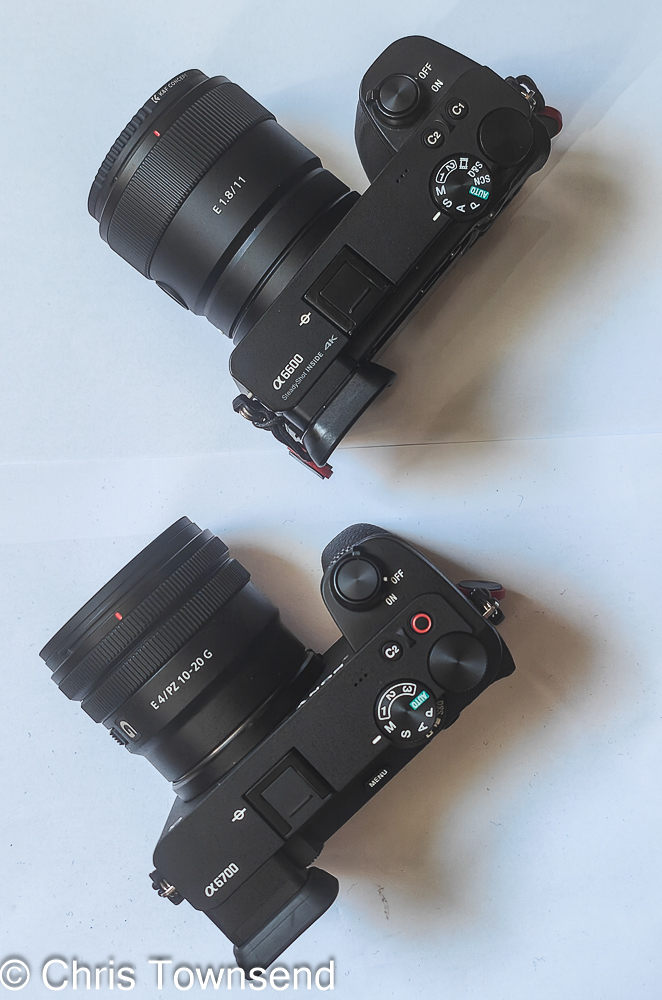
Top plates: a6600 top, a6700 bottom

With the controls it’s the addition of a scroll wheel in front of the on/off switch that I really like. I can alter aperture and shutter speed easily with this and the top dial without taking my eye from the viewfinder. A simple positive change is the movement of the video button from the side to the top of the camera, where it can’t be inadvertently switched on, as it can with the NEX and earlier a6000 cameras. Not a big deal but part of the overall improvement in design.

Great spotted woodpecker. Sony a 6700, Sony E 70-350 lens, f8 at 1/400, ISO 500. Cropped

I don’t know yet if the recognition auto-focus is better than on the a6600. It’s certainly easier to use and has many more options – seven instead of two, including insects, which I almost certainly will use, and cars, trains, and planes, which I probably won’t.

Screens: a6700 top, a6600 bottom

The screen is another big improvement. On the NEX 7 and the a6000 it just angles up and down. On the a6600 it can be flipped up so you can see yourself for selfies and videos. On the a6700 it can be opened to the side and angled up and down and front and back facing. It’s bigger and brighter too.

I am delighted with the a6700. It is so easy to use compared with the earlier cameras. But why has it taken Sony so long to do this? And why have I put up with the earlier designs?

The answer to the last is because I didn’t know any better and realising this started me thinking about the difference between being a reviewer and a user. I’ve been testing hiking and backpacking gear for over forty years. When I try a new item I can compare it to alternatives old and new. I know which features work well and I know which features I like (they’re not necessarily the same). I can see how well an item fits into the whole range of similar products. I can’t do that with cameras. I’m a user not a reviewer. I’ve never used a mirrorless camera not in the Sony APS-C line. I don’t know how much better other brands may be, if at all. I’m not in a position to try many different cameras to see which one works best for me (and I mean really try them not just play with them briefly in a store). Maybe if I was I’d have changed from Sony long ago. As it is I’m glad Sony has changed. I haven’t felt as excited about a camera since the NEX 7.

I rely on reviewers who know camera gear like I know backpacking gear. But I only read reviews of Sony APS-C cameras and compatible lenses in detail. The rest I just glance at. I have no idea how other brands compare. It doesn’t mean the camera reviews aren’t important though. They’re the reason I never considered the a6100, a6300, a6400 or a6500 cameras – none seemed to offer any significant advantage over the a6000 – and only considered the a6600 when the a6000 began to fail. Lenses were a different matter and good reports by reviewers I trust has convinced me to buy several of them, and they’ve all been worthwhile purchases.

The reasons I decided on the a6700 – the battery compatibility with the a6600, the weather-sealing, the stabilisation – are still important but they’re overshadowed by the changes to the menus and the controls.

Rainbow at dusk. Sony a6700, Sony E 18-135 at 37mm, F8 at 1/25, ISO 100

You may have noticed I haven’t mentioned image quality once. That’s because I doubt it will be much different to the a6600 or the a6000 or even the NEX 7. The a6700 does have a 26mp sensor rather than the 24mp one of the other three cameras but I don’t expect that to make a significant difference. So far I’ve only taken 30 photos and haven’t yet done a direct comparison using the same lens and settings. Maybe low light high ISO performance will be a little better, but I think the improvements in processing software, especially DxO PhotoLab, are far more significant. And of course lenses matter too when it comes to image quality.

Sunday, 27 August 2023

How does well-used old gear perform now? A test in winter conditions.

Early morning in Coire Ardair

This piece first appeared in a slightly different form in The Great Outdoors magazine and describes a trip in December 2022.  As this was a commissioned feature I was accompanied by photographer James Roddie, whose excellent photographs appeared in the magazine. For that reason I didn’t take as many photographs as usual so I’ve used some from other trips to show the gear.

Coire Ardair is a long winding valley that cuts deeply into the Creag Meagaidh massif, ending with great cliffs rising above the dark waters of Lochan a’ Choire. Creag Meagaidh became a National Nature Reserve in the 1980s and since then birch woodlands have spread out in the lower valley as overgrazing by deer has been reduced, making it a wonderful inspiring place.
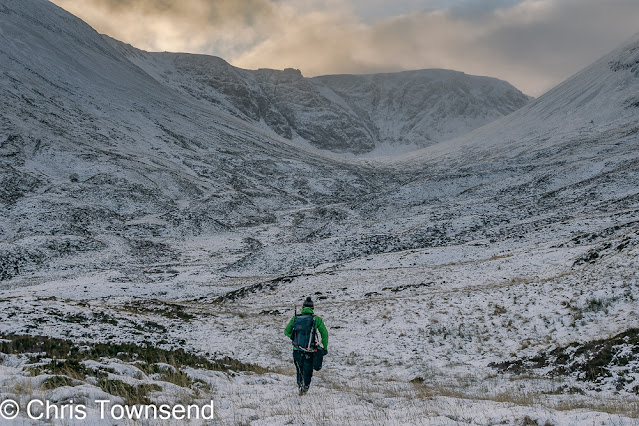
James Roddie in Coire Ardair

I set out up Coire Ardair with James Roddie on a freezing December day, with a pack full of old well-used and well-looked after gear as the idea of the trip was to see how it performed now.* There was a thin snow cover, enough to give a wintry look to the landscape but not enough to impede walking. The snowshoes I’d brought stayed in the car. Black grouse flew low through the trees as we made our way through the birches, this being ideal terrain for them.

The summits were sheathed in cloud, but we could see stark mountainsides rising into the clag ahead. Behind us, across hidden Loch Laggan, bands of mist drifted across the hills with occasional shafts of sunlight illuminating ridges and hills.

As the trees thinned out and the white ribbon of the path curved into the upper glen we could see the cliffs above Lochan a’Choire briefly free of cloud. Leaving the path we plunged through snow-covered deep heather and grass over a series of moraines and down to flatter ground by the Allt Coire Ardair. Ice fringed the rushing water, but it was mostly running freely. I’d thought I might have to melt snow and had brought enough stove fuel for this. I wouldn’t need to do so.

After stamping out an area of snow I pitched the Trailstar shelter. There was moss under some of the snow and I reckoned this might be too boggy for a camp in summer. In this freeze it was fine. Shelter pitched and my gear sorted out inside I settled down to light the stove and heat up water for instant soup. James wasn’t staying overnight and headed back down the glen. He’d return the next morning.
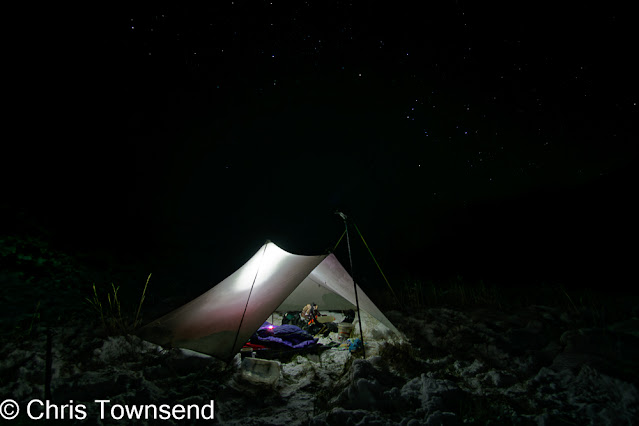
Under the stars, Coire Ardair

The temperature quickly dropped, settling at -7°C. I was warm though wearing my insulated jacket and half in my sleeping bag. The stove soon produced hot water and I felt quite content, here alone in the mountains. So content in fact that I dozed off, waking a few hours later to see stars shining. I ventured outside to tramp round in the snow watching the sky and the dark outlines of the hills. The stars came and went in drifting clouds, the great winter constellation of Orion standing out.

After starting the stove again for water for a meal I read for a while, wrote my journal, then fell asleep again, this time until dawn.

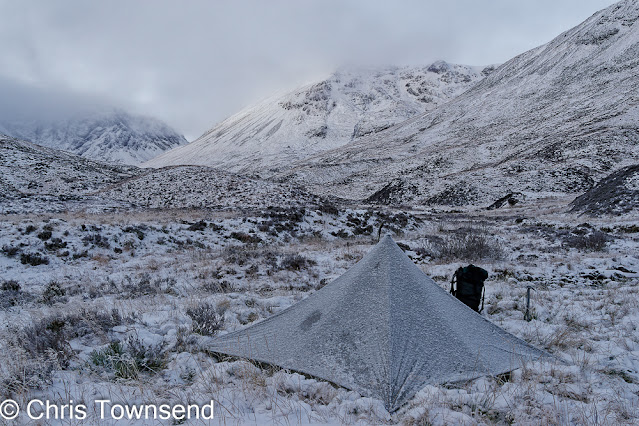
Sitting up when I woke I brushed my head against the tarp fabric and felt coldness. The whole of the inside was coated in frost. The pale fabric looked darker than usual. I poked my had outside. A thin layer of snow coated the Trailstar. The sky was heavy with cloud. More snow looked on the way.

After coffee and a breakfast of muesli porridge – frozen solid in the pan where I’d left it to soak overnight but soon thawed and heated up over the stove – I heard a voice and there was James, ready for more photography and more walking.
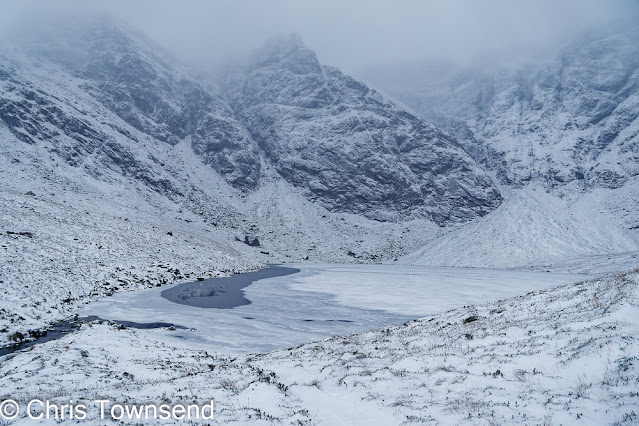
Coire Ardair

Once I’d packed up, we continued up the glen into the wilder country at its head. Again once moving I found the Aspira jacket over a Paramo Cambia Zip Neck base layer all I needed to keep warm. Occasionally a light breeze blew. My fleece hat came on and off. I was glad it had a neck cord so I could just push it back off my head when too warm. I’d got one pair of gloves soaked pitching the Trailstar and another pair similarly sodden taking it down so while walking I wore Buffalo Mitts, stuffing them in a jacket pocket whenever my hands felt too warm. I had an even thicker pair of mitts in the pack plus some waterproof shell mitts. You can’t have too many pairs of gloves and mitts in winter!

The river was still running as we approached Lochan a’ Choire, though the ice was encroaching on either side, leaving just a thin twisting snake of water. The lochan was mostly frozen. High above we could see ribbons of ice on the sombre cliffs. This is a popular winter climbing area, but we saw no-one else this day.

We were here to look not climb and after gazing at the crags we turned away and headed back down the path. Soon afterwards the clouds dropped and the cliffs and mountains vanished. By chance we’d timed it just right. Only a few minutes later and we’d have had no views.
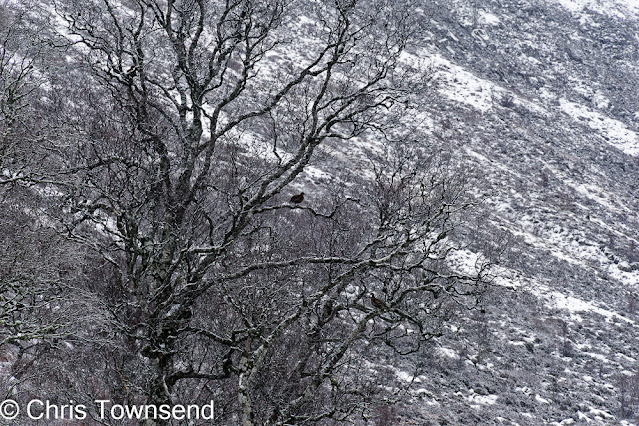
Black grouse

Light snow fell at times as we descended. As we reached the first trees we spotted half a dozen black grouse sitting in a big old birch, a magnificent sight. 

*It all performed well. 


Paramo Aspira Nikwax Analogy jacket                 

Paramo Aspira jacket, Paramo Cascada II trousers, & Outdoor Designs Windiush hat, February 2019

The Aspira has been my first-choice winter jacket for over twenty years. It’s not light at 885 grams but the double-layer fabric is tough and warm. It’s also very breathable, keeps out snow and rain, and has a great design with an excellent wired hood, underarm zips for ventilation, and four pockets accessible when wearing a pack hipbelt. On this trip it easily dealt with light snow and the odd gust of wind. I took it because I knew if the weather worsened I could rely on it for good protection.

Paramo Waterproof Cap

Paramo Cap, Cairngorms, December 2021

I’ve been using this 70g hat regularly since 1998. Made from the same Nikwax Analogy fabrics as the Aspira jacket it’s very breathable and easily sheds snow and rain. It’s warm enough for all but the coldest weather and has ear flaps, a neck cord to keep it on in the wind, and a stiff peak for protection against sunshine and snow. I can’t fault it. I took it on this trip because I take it on every trip outside of hot summer days. I wore it the first day and it was as comfortable and effective as ever.

Paramo Casacada II trousers     2019

These trousers are the third Nikwax Analogy garment I took on the trip and by far the newest, being only four years old. Like the Aspira and the Cap the trousers are very breathable, waterproof, and comfortable. They have two-way long leg zips that are superb for ventilation. On this trip I opened and closed them several times each day. They were just right for the weather, as expected. I had long base layer leggings with me that I’d have worn if it was much colder.

Paramo Torres insulated jacket   
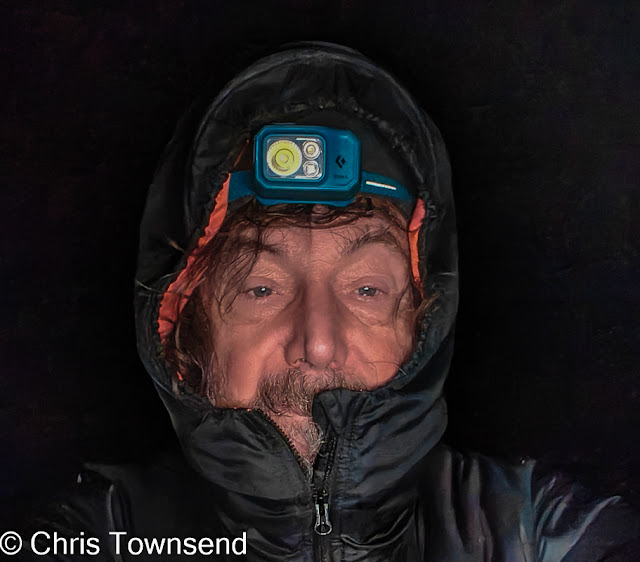
Paramo Torres at the Coire Ardair camp. The headlamp is not old!

This eleven-year-old thick 695g synthetic insulated jacket is very warm and comfortable. It’s particularly good in the wet, which didn’t apply on this trip. The design is excellent. It has a good wired hood and roomy pockets. It’s sized to go over all your other garments so you can just pull it on when chilly or when you stop. On this trip I only wore it in camp where it was especially useful when outside star watching during the night.

Paramo Mountain Pull-On          
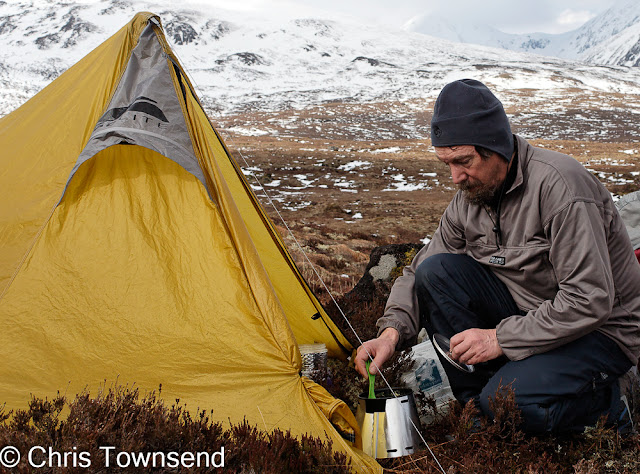
Paramo Mountain Pull-On & Outdoor Designs Windiush Hat, Glen Affric, April 2008

Twelve years old now, this 425g top was one of Paramo’s first fleece midlayers. It’s an over-the-head garment with a big pouch pocket and stud-fastened neck. I find it warm and comfortable but hadn’t worn it for a few years before this trip. I now wonder why not as I found it excellent. I did only wear it a short while when walking as I was soon feeling hot with it on under the Aspira jacket, but I put it back on in camp and in combination with the Torres jacket it kept me warm at -7°C.

Helly Hansen Double-Pile jacket

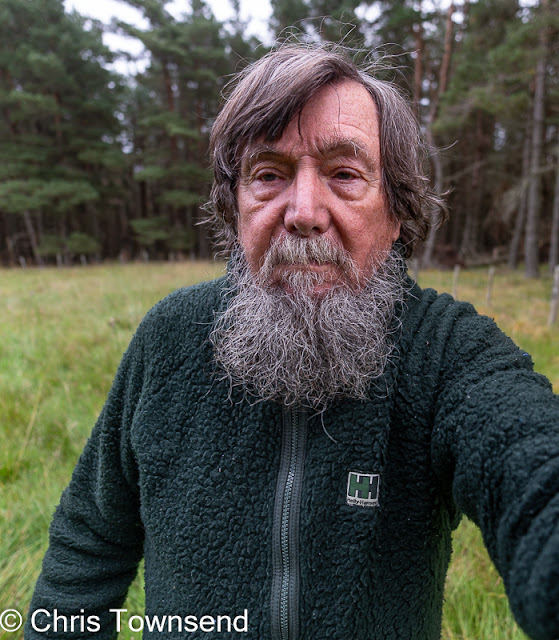
Helly-Hansen Double-Pile Jacket, August, 2023

This 580g fibre-pile jacket is forty-one years old and a veteran of my 1982 through-hike on the Pacific Crest Trail where it was my only warm wear much of the time. It’s fluffy on both sides and very warm. Warmer than I remembered in fact as I hadn’t worn it for several years. In the morning it kept me warm at -3°C without anything over it. It’s not windproof so I donned the Aspira jacket over it when outside packing away the Trailstar.

Buffalo Mitts                                   

I brought these ten-year old warm, lightweight (80g) Pertex/pile mitts as backup to my thinner gloves. As I managed to soak both pairs of those putting up and taking down the Trailstar I wore the mitts whenever my hands felt cold on the second day. They keep out the wind and dry quickly when wet, which didn’t happen on this trip. They pack down really small so I could easily stuff them in a jacket pocket when not needed. They came on this trip because they come on every trip in cold weather.

Outdoor Designs Windiush fleece hat

The 75g Windiush has been my favourite fleece hat for twenty years. It’s made from Polartec Wind Pro fleece with a wicking lining and is wind resistant, breathable, and warm. It has earflaps and a neck cord so it can be pushed back off the head when not needed, something I did several times on the second day. I wore it in camp that morning as I find a hat without a peak better inside a tent or tarp and just kept it on when set off. It was as comfortable as ever. I always take at least two hats in winter in case I lose or soak one. The Windiush and the Paramo Cap make a good combination.

Brasher Hillmaster boots              
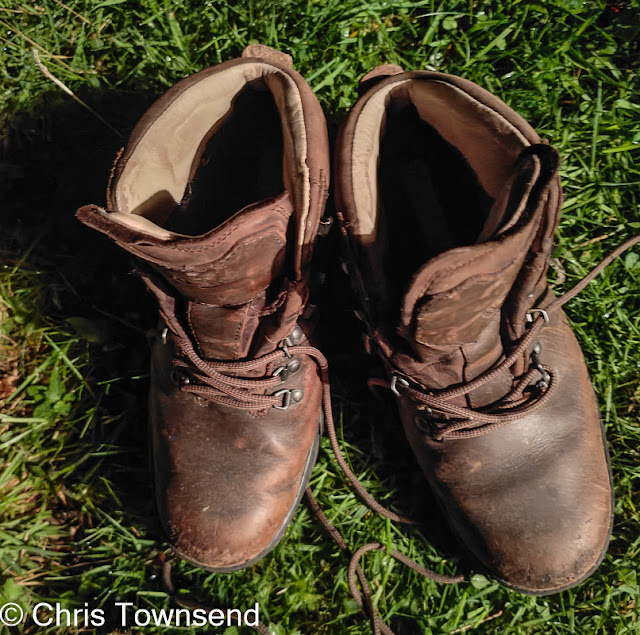
Brasher Hillmaster Boots, August 2023

I wear these mediumweight (1.4kg) boots regularly in winter if I’m not venturing on terrain verging on the technical. They can be used with walkers’ crampons, a pair of which I had with me but didn’t need on this trip. They’re ten years old now but still in good condition as I wax them regularly. On this trip any snow on them just slid off. The wide fit is just right for me, and I find them very comfortable. They have a Gore-Tex lining and I find them warm enough in snow.They're still available as the Berghaus Hillmaster.

Gregory Shasta pack                      1998
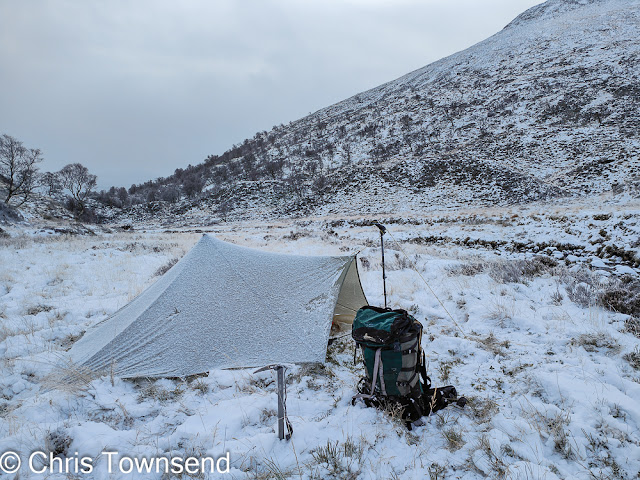
Gregory Shasta pack & Mountain Laurel Designs Trailstar, Coire Ardair

This pack is a monster. It weighs 3kg empty and has a capacity of 82 litres. It is however very tough and very comfortable with a big load. I had 18kg in it on this trip and it handled it easily. I carried much more than that when I used it on the Arizona Trail in 2000 and often had to carry a gallon of water and more. Now 25 years old the pack is in good condition and ideal for winter trips. It has big chunky buckles and zips that are easy to use when wearing gloves. I brought it on this trip to see how it compared with more modern packs. It’s just as comfortable as the best I’ve used and probably more durable.

Gregory Shasta on the Arizona Trail, March 2000

 Trangia 27 Stove                                  

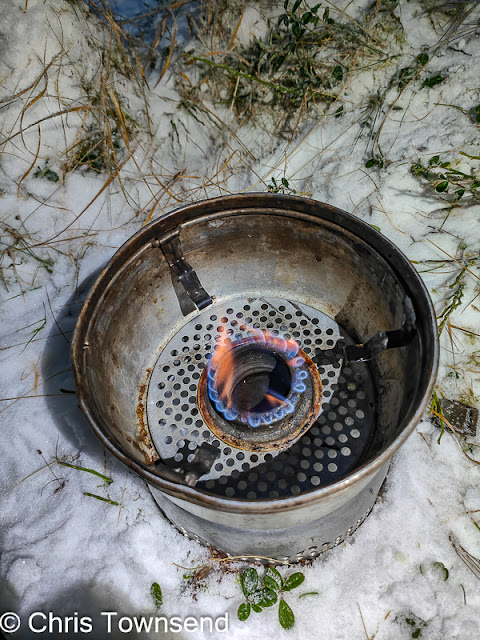
Trangia 27, Coire Ardair

Forty-five years old and a veteran of my first ever long-distance walk from Land’s End to John O’Groats in 1978 this stove will outlast me. The design is rugged, functional, and simple. Until this trip I’d recently only been using it for car camping due to the weight (880g) and bulk compared to more recent stoves but as this was an old gear reunion trip I brought it along. It worked fine.

Therm-A-Rest Prolite Plus & RidgeRest           

Prolite Plus, May 2004

On cold weather trips I don’t like relying on just an inflatable mat – I’ve had too many punctures – so I always take a foam pad as well. On this trip the latter was a twenty-year old 400g RidgeRest, on top of which I used a 490g Therm-A-Rest Prolite Plus, itself also twenty years old and so far unpunctured. The combination kept me warm camped on frozen snowy ground.

 Mountain Equipment Snowline     

Snowline sleeping bag at a camp in the Cairngorms, February 2010

Looked after properly – which basically means storing them loosely somewhere dry – down bags last well. The Mountain Equipment Snowline I brought on this trip dates from 1994 and was used extensively on the ski tours I led back them. I haven’t used it so much since as it’s too warm most of the time. On this trip it was just right at -7 without the hood being closed. It weighs 1485g.

 Mountain Laurel Designs Trailstar 2012
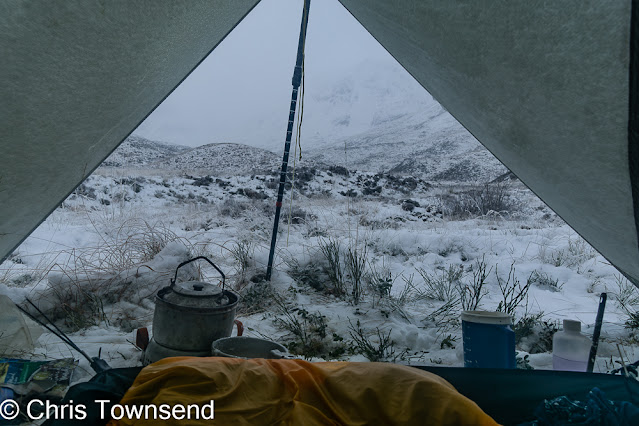
Morning view from the Trailstar

Ten years old now my Trailstar tarp has been used on hundreds of nights, including several multi-week walks, and is still in good condition. I took it on this trip for the space, always welcome in winter, and because I knew it would stand up to high winds if necessary. As it was the night was calm. The Trailstar is also lightweight (482g), which somewhat balanced the heavier older gear.


Saturday, 26 August 2023

A Walk Up Tom Mor To See The Site Of The Mast That's No Longer There (and heather, trees, clouds, some wildlife & lots of rain)

The summit of Tom Mor

My local hill, Tom Mor, has lost its mast, as I reported in this post earlier in the month. The hill now has a new profile that isn’t dominated by a tall metal structure.

To see what, if anything, was still there I went up Tom Mor on a day of showers, towering clouds, flashes of sunshine and, eventually, steady rain.

Tom Mor heather

Approaching the hill the purple of the heather stood out. It is at its peak now and under the dark clouds it really glowed.

The spreading wood

I also noted how much the pines are spreading out from Ballinlagg Wood on the south-west slopes of Tom Mor. Only decaying remnants of the fence that once surrounded it now remain. The slopes beside and below the wood are used for sheep grazing but in recent years there clearly haven’t been enough of them to stop the forest regenerating.

Rain sweeps across the Cromdale Hills

The estate track to Tom Mor (it doesn’t go quite to the summit) runs round the north side of the hill and here there are views down long Glen More. Squalls of rain swept across the Cromdale Hills on the far side of Strathspey.

Glen More

I left the track, which eventually descends into Glen More, for a short little-used side branch that leads up to the mast site. The hut that was beside the mast was still there. Next to it was the concrete base on which the mast stood. Inside the hut all the electrical paraphernalia and the many cupboards had been removed.

Where the mast was

There was no sign of disturbance on the ground around the hut and the platform. No vehicles had been here. No feet had trampled the ground. The mast had been removed without it toppling over. It must have been by helicopter. I was impressed that there was no trace of those who had done this. I wonder if they will return and remove the hut and platform.

Young pines on the summit of Tom Mor

Leaving the mast site I walked through the heather to the slight rise that marks Tom Mor’s summit. There’s a small cairn here and not far away a much bigger one from where there’s an excellent view of Strathspey and the Cairngorms. Today clouds hid the mountains. Far below I could see the pale line of the River Spey. Small pines sprouted from the heather. One day this will be a wooded hill and its profile will change again.

So far the rain had been light and intermittent but on the summit it became heavier, swept along by a north-west wind. I sheltered behind the big cairn to don my waterproofs and have a bite to eat then set off down through the heather to the wood. The rain stayed with me all the way home.

The conditions were not good for observing wildlife but I did see a red kite soaring over Tom Mor, a kestrel hovering over the fields, three roe deer that raced away into trees long before I was close enough to even think of a photograph, and finally a brown hare on the edge of the wood, where I didn’t get my camera out as the rain was torrential.

Monday, 21 August 2023

A Look At The September Issue Of The Great Outdoors

The September issue of The Great Outdoors is in the shops now. My contribution this month is an opinion piece on the funding shortfall for mountain paths in Scotland.

In the gear pages Lucy Wallace and David Lintern each review four pairs of three-season boots and Alex Roddie looks at five hiking apps and three outdoor smartphones. 

In the main features Francesca Donovan goes up Sharp Edge on Blencathra with the Keswick Mountain Rescue Team, Richard Hartfield and John Fleetwood undertake an astonishing 74km continuous scrambling route across the mountains of Torridon, and Huw Oliver and Annie Lloyd Evans go bikepacking on Skye.

In the skills section mountain leader Lucy Wallace gives navigation advice for beginners. 

The issue opens with a dramatic double-page photography by David Lintern of a walker in the Knoydart hills.

Creator of the Month is Kwesia, a podcaster and Youtuber who connects young inner-city people with the healing power of the outdoors.Trail of the Month is the Snowdonia Slate Trail, described by Alex Roddie with an illustration by Jeremy Ashcroft. Sarah Stirling and Francesca Donovan talk to Mountain Rescue Teams in Scotland, Wales, and the Lake District about accident 'black spots'. Francesca Donovan also provides a guide to Castleton in the Peak District. Jim Perrin's Mountain Portrait is The Cobbler in the Southern Highlands. On her coastal walk Emma Schroeder visits entertainment arcades in seaside resorts.

In Wild Walks Stefan Durkacz visits Caenlochan and Upper Glen Isla in the Cairngorms, and Alex Roddie goes up the Central Fannichs in the NW Highlands. In the Lake District Vivienne Crow climbs Fairfield via Greenhow End and also Middle Fell and Seatallan, and James Forrest follows the Gable Girdle around Great Gable. Nearby in the Howgill Fells Ian Battersby visits Black Force and Langdale Fell. In the Northern Pennines Roger Butler walks over Fiend's Fell, Black Fell and Thack Moor. Further south in the Peak District Andrew Galloway searches for airplane wreckage on Higher Shelf Moor and Bleaklow Head. Wales has just one Wild Walk this month in which Steve Eddy visits Llyn y Fan Fawr and Llyn y Fan Fach in the Brecon Beacons. Finally on Dartmoor Emily Woodhouse has a mystery walk.