Showing posts with label backpacking photography. Show all posts

Monday, 15 May 2023

Photography Post: New camera, lens & accessories


New camera and lens

Since 2016 the Sony a6000 has been my main camera and it has been excellent. It’s been on every walk since I bought it and has taken many thousands of photos - 42,244 according to Lightroom and that of course doesn’t include deletions. However it is beginning to show its age and has developed a few quirks, most annoyingly it changes settings and opens menus at random. My half dozen batteries are fading too, only taking half the pictures they used to before needing recharging. They never lasted long anyway and on anything longer than a day walk I always carried four of them. Pondering this I decided I needed a new camera and new batteries. That was some time ago and the camera quirks have got more pronounced and the battery lives shorter. Rather than ponder I decided to actually do something and started looking for a replacement for the a6000.

Now since the a6000 was launched in 2014 there have been five successors in the a6xxx series, though none since 2019. Looking through the specs of these five cameras one stood out, the a6600. It is heavier than the a6000 – 503 grams rather than 344 grams but it has a much bigger battery meant to last over twice as long so I shouldn’t need to carry so many spares. The a6600 also has two other advantages – a flip-up mirror for selfies and vlogging (this might encourage me to do more videos!) and built-in stabilisation, useful for non-stabilised lenses. There are plenty of second-had ones available and I’ve bought one in excellent condition from MPB, a company I’ve used before for both buying and selling and who I’ve found reliable with great service.

Sony a6600 & Sony E 11mm lens

Along with the camera I bought, new but on sale, a Sony E 11mm F1.8 lens. This replaces the Samyang 12mm F2 lens I’ve had since 2015 which I’m selling. Now the Samyang is a good lens and I’ve taken some great night shots with it, which is the reason I bought it. However it’s a fully manual lens with no electronic connections to the camera. This means no autofocus, which the Sony 11mm has, though this isn’t a huge deal in an ultra-wide-angle lens, but also no record of settings. I’ve recently been using DxO Photolab 6 and DxO Deep Prime for processing raw files (more on this in future posts) and have found the results superb. Having lens information is crucial for this. DxO has a huge database of cameras and lens but this can’t cover non-electronic lenses like the Samyang that provide no information. The Sony 11mm is recognised by DxO.

The next two weeks I’ll be out camping in the hills with the Sony a6600 and the Sony 11mm lens. I’ll find out just how long the camera battery lasts and when I’m home just what results I can get from images taken with the 11mm lens in DxO software. I hope I’m not disappointed on either count!

Peak Designs

I’ve also been trying out some products from innovative camera accessories company Peak Design, namely the Capture Camera Clip, the Leash, and the Travel Tripod.

Capture Clip plate attached to camera base

The Capture Clip is a two-part device that lets you carry your camera securely on a rucksack strap or a belt and access it almost instantly. Now I’ve always carried my camera in a padded bag slung across my body which gives reasonably quick access whilst providing protection against rain or knocks. I really wasn’t sure how I would like having the camera hanging free.

Capture Clip in place

The Capture Clip consists of a plate that screws onto the base of the camera and a two-part Clip that fastens round the strap with two screws, total weight 84 grams. The plate slides into the clip and immediately locks into place. I tried it with my biggest and heaviest camera and lens combination – the Sony a6600 with Sony E 70-350mm lens – which weighs 1.2kg and it felt very secure on a walk over rough boggy ground where I was lurching around a great deal. It also felt comfortable and once I was used to finding and pressing the release button I could have the camera to my eye far faster than when removing it from a bag.I also tried it with the a6600 and lighter Sony E 18-135 lens (863 grams total) and this was also fine.
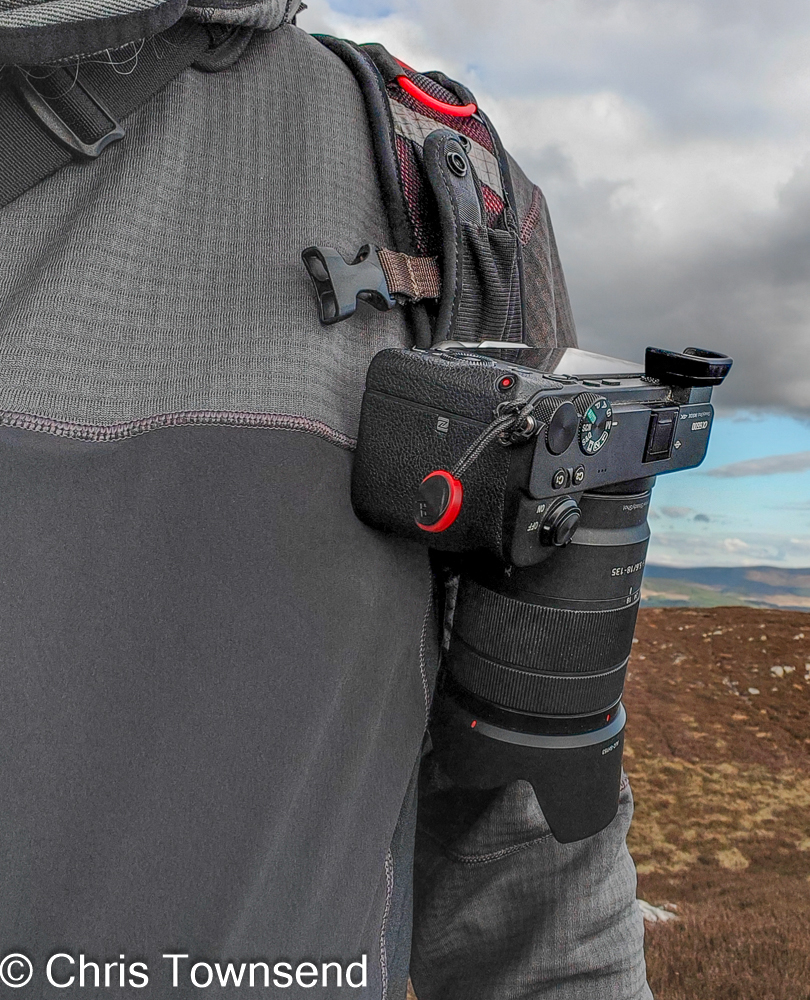
Sony a6600 & Sony E 18-135 lens attached to the Capture Clip

Of course the Capture Clip gives no protection against rain or knocks so I would still carry a waterproof camera bag for use in rain or when scrambling. How useful the Capture Clip will be for multi-day backpacking I’ll find out on my forthcoming trip.

Peak Designs Leash

On first attaching my camera to the Capture Clip I immediately discovered that the dangling camera strap was a nuisance. As I rarely actually use a camera strap I’ve always stuck with those that come with the camera. These however are hard to remove and hard to adjust. The one with the Sony a6600 does have quick release buckles so most of the strap can be easily removed but this still leaves fairly long pieces of webbing with chunky buckles hanging down in the way. To solve this I bought a Peak Design Leash. This is a brilliant strap. It attaches to the camera with tiny anchors that can be released very quickly and which are then barely noticeable, and it is very easy to adjust. I might finally start using a camera strap quite often.

Peak Designs Travel Tripod alongside the Sony a6600 with 70-350mm lens

Along with the Capture Clip Peak Design also loaned me an aluminium Travel Tripod. This is also brilliant, the best tripod I have ever used. But it’s also the heaviest at 1.56kg – there is a carbon-fibre version but that still weighs 1.29kg. The tripod I’ve used for many years, a now battered Velbon V-Pod weighs 281 grams. When I wrote about tripods for backpacking back in 2017 I gave one at 396 grams as the heaviest I’d consider as a replacement for the V-Pod.

Sony a6600 with 70-350mm lens on the Peak Design Travel Tripod

The Peak Design Travel Tripod is superbly designed. It’s very compact for the size, fast to set up, and easy to use. A camera fitted with the Capture Clip plate can be slid onto the ball head very quickly. I took the tripod on the same walk as the Capture Clip and set it up on a breezy summit. It easily supported my camera with 70-350 zoom lens – a combination that’s too heavy for the V-pod but then I’d never take that lens backpacking. If the weight doesn’t matter this is a brilliant tripod. I’d love Peak Design to make an ultralight version.

Just Mobile Shutter Grip 2

Using a smartphone for more serious photography and especially for videos over the last year I quickly came up against the limitations of trying to hold it securely and without my fingers getting in the image so I looked for a clamp with a shutter button to make this easy. The first one I bought was inexpensive and did make using the phone easier. It only had one position though. Then I discovered the Shutter Grip 2. This is another brilliant accessory. It not only provides a solid handle with a wireless shutter button but has a built-in selfie stick and a tripod thread. It can also be used as a phone stand. It weighs just 68 grams and is now something I wouldn’t be without. It really makes a huge difference to smartphone photography.I'll take some pictures of it in use on my next trip.


Wednesday, 17 April 2019

A New Lens for Backpacking: Sony E 18-135 f3.5-f5.6

Sony E 18-135 with lens hood

For several years my photography setup for backpacking and hillwalking has been Sony a6000 and NEX 7 bodies with Sony E 10-18mm and 16-50mm zoom lenses. This system went on the GR5 through the Alps walk last autumn and the Yosemite Valley to Death Valley walk two years before that. I've found it versatile and easy to use. Two cameras, two lenses, slung across my body in padded cases. Never any need to change lenses, always accessible.

Sometimes though I've wanted a longer lens - for wildlife, to zoom in on distant features, to pick out details. I've had the Sony E 55-210mm zoom lens for many years and this often comes with me on day walks, rarely on longer ones, as I like the two cameras and lenses system and I don't want to give up either of the shorter zooms. That leaves the 55-210 in the pack, where it too often stays, forgotten.

Sony E 18-135 fully extended

I accepted this two, sometimes three, lens system as there were no compact lightweight alternative lenses to the 16-50 that had a longer reach other than an expensive Zeiss 16-70, and the extra cost and weight didn't seem worth it for a measly 20mm increase.

Then, a year ago, Sony brought out the first new lens in many years for the a6000 series cameras, the 18-135 f3.5-f5.6. Light, compact and with a 7.5x zoom as opposed to the 3x zoom of the 16-50 this interested me straight away. I then spent a year deliberating!

Of course compared with the 16-50 the 18-135 is enormous and considerably heavier - 360 grams as opposed to 127 grams. The 55-210 is 380 grams so the saving over that lens plus the 16-50 is only 147 grams. I think though that the longer reach is well worth the extra 233 grams over the 16-50.


The big benefit of the 18-135 for me is that it extends my two cameras, two lenses system considerably. 10-135mm is a big range, equivalent to 15 to 202.5mm in 35mm/full frame. This is the biggest range in two lenses I've ever had.

I've had the 18-135 for nearly two months now and I've taken 310 images with it, half of them at focal lengths over 50mm. I'm pleased with the results. Reviews - and I read quite a few - suggested the image quality was good, better than the 16-50 in fact. I'm happy with that lens so I expected to like the 18-135. It's certainly sharper than the 55-210.

I did sometimes crop images taken with the 16-50 but this does mean lower quality and, more significantly to me, I found it harder to 'see' the image. With the 18-135 I can compose much more precisely. Looking at the data (ah, the wonders of Lightroom!) I can see that I've used just about every focal length at least once.

Carrying the 18-135 hasn't felt noticeably different to the 16-50 despite the difference in size and weight. I do have a bigger case of course but I carry it the same way.

I think for now I have found an ideal combination.

Here are some 18-135 images at different focal lengths, all taken in the Cairngorms on April 5.

18mm

24mm

31mm

71mm

95mm

135mm

Friday, 23 February 2018

Just One Lens: A Photography Gear Post. Updated July 28.


Since I wrote this piece in February I've found that I'm using the 55-210 zoom lens more than before as the limited reach of the 16-50mm often feels frustrating. I don't like changing lenses and I don't want to carry the 55-210 on long trips so I've almost decided to get the Sony E 18-135 mentioned in the last paragraph before the postscript. Almost.

Whilst I haven't bought the 18-135 yet I have bought another fixed focal length lens, the Sony E  35mm f1.8 (52.5mm 35mm equivalent). This weighs just 201 grams. I bought it for low light use. It's faster than the Sigma 60mm and is stabilised, which the Sigma isn't. How much will I use it? I'm not sure yet. It's been on one backpacking trip where I took the image below with it.


Ironically  in June Alex Roddie, who started this train of thought about fixed focal length lenses, posted  that he's ditched his Fuji gear for a much lighter Canon PowerShot G9x Mk II with a 10.2-30.6mm zoom lens (28-84 35mm equivalent). It's near the bottom of this interesting piece on the electronics he carries.

Anyway, here's the original post with minor edits.

As I've written before my favourite lenses are zoom lenses. It's over thirty-five years since I last took fixed focal length lenses on a long walk. That was on the Pacific Crest Trail where my most used lenses were Pentax 28mm and 50mm ones (I did have a 75-150mm zoom but that took a dunking in a creek and never recovered before I was half way). Back then wide angle and mid range zooms were generally regarded as poor quality. I wanted one though and just three years later I had one, a Tamron 35-70mm zoom that was judged pretty good. I took it on the Continental Divide Trail along with another Pentax 75-150 zoom and was pleased with the results. I missed a wider option though and over the years changed to 28-70mm and then 24-70mm lenses. These were always by far my most used lenses, as is my current Sony 16-50mm, which is equivalent to 24-75mm in 35mm/full frame terms.


However for quite some time I've been thinking about fixed lenses after reading a piece by Alex Roddie in which he said he saw the world at the 35mm (53mm full-frame equivalent) focal length and his favourite lens was a 35mm one*. I tried to imagine going out with just one fixed length lens and couldn't. When I analysed the 3500+ images I took last year I found that only a few hundred were taken around 30-40mm (see this post) so I clearly don't see the world in that range. My most used focal length by far was 50mm (75mm full-frame equivalent), a short telephoto length, so maybe that was how I saw the world.

*Update: after reading this Alex Roddie commented on Twitter 'I've gravitated towards 23mm (35mm FF equivalent) in the hills, as 50mm equivalent can sometimes be too tight, but still prefer 50mm for most other subjects. I rarely carry more than one prime lens now.'


To find out I've taken just one lens on several local walks in the last week. This is the Sigma E 60mm f2.8, which is equivalent to 90mm on full-frame. It's a sharp lens but one that I hardly use. I took just 36 images with it last year. At a weight of 215 grams it's very light but I've only ever used it on walks from home. All the pictures accompanying this piece bar one were taken with this lens on the Sony a6000 camera.


Just using one fixed lens surprised me. I didn't find it as restrictive as I thought and after the first day I started to 'see' at its focal length, that is I saw compositions that suited it and there were fewer times when I couldn't take the picture I'd seen because I didn't have the right focal length. I could, I thought, manage with this lens alone if I had to.


So will I start carrying and using the Sigma 60mm regularly now? Maybe. For a while. What this exercise has really taught me though is that the 50mm end of my 16-50mm zoom isn't long enough. In the hills and on long walks I usually just take that lens and the Sony 10-18mm wide angle zoom. I do have a Sony E 55-210mm f4.5-6.3 zoom that I sometimes carry and which gives me a huge reach as it's equivalent to full-frame 82.5-315mm. Maybe I should carry it more often. I prefer to have just two lenses and two bodies though, especially on long walks. Both are in cases and accessible while I'm walking and never changing lenses protects the camera sensors from dust and dirt. So ideally I'd like a lens that goes from wide angle to longer than the 16-50mm. Sony has offered a couple of these for a few years but they are quite heavy and bulky. There is the Sony Zeiss 16-70mm f4 lens that is lightweight and compact. It's very expensive though and reviews are mixed with most saying it's not worth the money.

 
This year though there's a new Sony E 18-135mm (27-202.5mm full-frame equivalent) that sounds like it might be ideal. It's quite compact and weighs just 325 grams. Reviews have been mostly positive. Maybe this is the lens to pair with the 10-18mm. It would certainly give me a much greater range than the 16-50mm at a penalty of 200 grams extra to carry and more bulk. In the meantime the Sigma 60 and the Sony 55-210 are likely to see more use. Otherwise I'll miss that extra reach.


Postscript. Sometimes blog posts bring up entertaining and valuable responses. This one led to interesting threads on social media. Amongst these was this fascinating and useful comment from photographer and writer David Kilpatrick on Facebook  "The 60mm Sigma is a superb lens. It's the one I picked for my article on macro - add extension tubes to it and it beats most macro lenses. I think it is a natural fit. After all, the 'Mountain Elmar' from Leica was 105mm, and the 'Lightweight Elmar' which inherited that title was a 90mm f/4 in a special skinny lightweight mount for alpinists - 90mm being considered the ideal field of view for peak-to-peak photography (the view from the ground always diminishing the apparent height of the mountain or hill - best to get half way up the height of the target). The 60mm is lightweight, and exactly that angle on the A6000." 

I never knew that about 90mm and mountain photography. I'll definitely be taking the Sigma 60mm on my next hill walk. I'd never thought about using extension tubes with it either. I've now ordered some. David's article on macro is on the PhotoclubAlpha site here. David has just started a blog too - so far the only post is a link to this article!

Sunday, 1 October 2017

My Camera Set-Up

Sony a6000 & Sony E 16-50 f3.5-5.6 zoom lens

Back in August I collected together the various pieces on backpacking and photography that I've posted over the years and said that I'd add a post on my current set-up. Here it is.

Firstly I'd like to point out that I'm not suggesting that this is an ideal or best set-up, just that it's one that works for me. I use mirrorless cameras with APS-C sensors because they are small and light, not because I think they produce better pictures than DSLRs with the same size sensors. I use Sony mirrorless cameras because of the only four makes available when I changed from DSLRs I liked the rangefinder style Sony NEX 5 best as I explained in detail here. Back then in 2010 Fujifilm hadn't launched their mirrorless X series, which I would certainly consider if making the change now. As it is I'm happy with my Sony cameras and don't see myself changing systems anytime soon.

Of course whether your photographs are ones you're happy with depends on many factors. A good quality camera and lens should mean your pictures are technically okay once you know how to get the best out of them but that's all. Composition and light are key to a good photo. 

CAMERAS

Sony a6000 & Sony NEX 7   384 & 374 grams (with battery, memory card & strap)

These two cameras go on almost every trip. Both have 24 mp sensors. In theory the a6000 produces slightly better images than the NEX 7. In practice I can't see any significant difference when used with the same lens. I normally use manual exposure settings - guided by the histogram rather than the light meter - and can change aperture, speed and ISO without having to delve into menus.

Sony NEX 7 & Sony E 10-18mm f4 zoom lens


LENSES 

Over the years I've acquired seven lenses and a tele conversion lens. I haven't ever carried all these lenses, even on a day hike. Indeed, mostly I carry just the first two, sometimes the third as well, and less often again, the fourth.


Sony E 16-50mm F3.5-5.6 zoom       117 grams

Sony E 10-18mm f4 zoom                 266 grams

These are the two lenses I almost always carry. On long trips like the one from Yosemite Valley to Death Valley that I undertook this time last year they are the only lenses I carry. Two bodies and two lenses means I never have to change lenses and risk getting dust on the sensors. The 16-50 is tiny and I can carry it on the a6000 in a pocket. If I only take one camera and lens - which is rare - it's that combination. The 10-18 is a fair bit bigger but I love the wide angle picture opportunities it gives.

Both are zoom lenses, which I prefer for fine-tuning composition. When I did an analysis earlier in the year I found that I did use the zooms to the full. And when I've been out with just a fixed focal length prime lens I've found it frustrating as there are always pictures I can't take.

Sony E 55-210mm f4.5-6.3 zoom     390 grams

My third zoom lens comes along when weight isn't too important - day walks and one or two night backpacking trips when I'm not planning on high mileage. This is always the lens whose usefulness I weigh up before a trip, often feeling reluctant to leave it behind. For a telephoto zoom it's very light but even so it's more to carry. Sometimes photography wins and I take it, sometimes the weight of my load is uppermost in my mind and I leave it behind. Recently I bought a Sony 1.7X Tele Conversion lens (254 grams) to extend the reach of the 55-210. It works well but won't be coming on any backpacking trips.

Sony NEX 7 & Samyang 12mm f2 NCS CS E

Samyang 12mm f2 NCS CS E        291 grams

This is the most-used of the four prime lenses I've managed to acquire. I bought it for its reputation for night photography and I haven't been disappointed. It's sharp and has a fast aperture. It's fully manual with no autofocus and I use it with focus peaking on the a6000, which makes focusing easy. It's a lens I always think I should use more. It usually comes on overnight trips if  starry skies are likely but rarely on day trips.

Sigma 30mm f2.8 EX DN E            162 grams

This lovely little lens hardly ever gets used. If there's one lens I should dispense with it's this. The 16-50mm zoom covers the same focal length and is far more versatile. As it was inexpensive I'll probably keep it though.

Sigma 60mm f2.8 DN E                  236 grams

Regularly praised for its performance I bought this inexpensive prime lens on the basis of reviews. And it really does produce superb results, especially portraits. Even so, as with the 30mm, I haven't used it much.

Sony E 30mm f3.5 Macro              162 grams

The only lens not intended for outdoor use I bought this for photographing my old transparencies on a lightbox. It does this pretty well though a longer focal length would make it easier. I have taken it on walks occasionally for photographing details of trees and flowers and more but generally it stays indoors.

From left: Sony 1.7x Tele Conversion lens, Sony E 55-210mm zoom, Sony 30mm Macro, Sigma 60mm, Sigma 30mm

CASES

For the last few years I've carried the a6000 & 16-50mm lens and the NEX 7 & 10-18mm lens in ThinkTank Mirrorless Mover 5 and 10 padded bags (192 and 302 grams).  These little bags have rain covers and pockets for memory cards and batteries. What I find most useful though are the magnetic flap closures, which make accessing the cameras quick and easy, and mean the zips under the flap only need to be used when it's rainy or dusty. So far the cases have proved tough.

ThinkTank Mirrorless Mover bags


Spare lenses are carried in Zing! neoprene bags that weigh 80 grams each.

TRIPODS

I always carry a very light tripod for low light, night, camping shots and self-portraits. As I'm usually alone in the hills taking pictures of camp activities means a tripod is essential. Currently this is a now rather battered Velbon V-Pod (281 grams). I wrote about tripods earlier in the year.

FINALLY ... SAMSUNG S7 SMARTPHONE     155 grams

I do always have a third camera with me, my smartphone. I use it often too, for the photos that I post on Instagram and occasionally elsewhere. In good light it takes pretty good pictures. I've never explored its potential fully but overall I'm pleased with it for snapshots and selfies.

AND NEXT .....

I'm happy with this set-up and feel I should try and get more out of the lenses I have before considering any others. However I am thinking about another body, a Sony a6500, for two reasons. Firstly the NEX 7 is quite battered now and may not last too much longer. Secondly the Samyang and Sigma lenses aren't stabilised, something I have to remember when using them as my other lenses have this very useful feature. The a6000 and NEX 7 aren't stabilised either but the a6500 is and so would extend the usefulness of those three lenses. I'm in no hurry though.


Saturday, 16 September 2017

Wildlife Photography & Backpacking


Red deer stag. Sony NEX 7 with 16-50mm E lens, 1/125 @ f8, ISO 400. Cropped.

Encountering wildlife is one of the joys of backpacking and hiking. Often all we catch are glimpses – an eagle high in the sky, an otter slipping into the water, an owl skimming past the tent – but sometimes there are longer, clearer views – a herd of deer grazing on a hillside, a heron fishing, a snow bunting hopping round a summit in hope of crumbs from your lunch. Over the years I’ve seen all these, some many times, and many more creatures including bears, wolves, moose and bison on walks outside the UK. 

Bison in Yellowstone National Park. Canon EOS 350D with 80-200mm lens. 1/500 @ f8. ISO 200.
 
Whilst seeing wildlife is an integral part of backpacking it’s not easy to take successful photographs of animals and birds. Wildlife photography requires patience and staying in one place for long periods watching and waiting. Big heavy telephoto lenses and specialist equipment like hides and remote camera triggers are standard equipment. Backpackers only stay in one place for long overnight and don’t carry the big lenses or other equipment unless wildlife photography is the main aim of the trip.
 
The full picture from which the one at the head of this piece was cropped.

Now I’m not a wildlife photographer. But I do take wildlife photos when the opportunity arises and over the years I’ve learnt various ways to improve the quality of these that may be of use or at least of interest to others. These photos are all opportunistic in that I didn’t set out to find the animals and birds nor did I spend time stalking them. Indeed, I think it best not to approach or scare creatures. Many have a harsh enough life anyway. If I can’t take a decent photo from a distance then I don’t bother. That said, as I’ll show below, a photo that doesn’t appear that good as the subject is rather small can often be cropped with surprisingly good results. Also, showing an animal in its habitat rather than as a close-up is often interesting.


Heron in the River Annan. Canon EOS 450D with EF-S 55-250mm lens. 1/1000 @ f5.6. ISO 800
 
I think the best cameras for backpackers are lightweight ones with sensors smaller than full frame, which is a sensor the same size as a frame of 35mm film. The cameras I use have the next size below full frame, known as APS-C. These cameras also have a great advantage for wildlife photography because telephoto lenses can be much lighter for the same equivalent focal length than full frame ones due to what’s known as the crop factor, which means that less of the image is recorded on the sensor so it appears larger. (A good explanation of this can be found here). Now the focal length of a lens doesn’t change when it’s used on different cameras. However as full frame is often regarded as the norm (because 35mm film really was) the focal length is often given as the 35mm equivalent. Thus my Sony E 55-210mm lens when used on my APS-C sensor cameras is equivalent to an 82.5-315mm lens on a full frame camera. There are similar lightweight telephoto zoom lenses for other APS-C cameras. 

Pheasant in the snow. Sony NEX 6 with 55-210mm lens. 1/320 @ f8. ISO 800.
 
 An alternative I haven’t used could be a ‘bridge’ camera, which is a camera with a smaller sensor than APS-C and a fixed zoom lens with a huge range, up to 2000mm equivalent. The ones with the biggest range are quite heavy but you don’t need to carry different lenses.

The 55-210 weighs 379 grams, which is light enough to carry on most trips. On walks where I’ll be carrying many days food or water I don’t take it though and just use my 16-50mm (24-75 35mm equivalent), knowing I won’t get some shots and may have to crop some drastically.

Sony NEX 7 with 55-210mm E lens & 1.7x tele conversion lens.
 
Recently I’ve bought a Sony 1.7x tele conversion lens (second-hand as it’s a discontinued model) which turns the long end of my 55-210mm lens into a 535.5mm 35mm equivalent telephoto lens. Although not designed for the 55-210 the tele conversion lens fits fine with a step-ring. Once in place I then use the lens as normal. It weighs 243 grams with the required step-up ring though so I probably won’t take it on more than overnight trips. From the shots I’ve taken so far the image quality looks about the same as crops from 210mm images but it has advantages for composition and focusing. 

Sparrowhawk. Sony NEX 7 with 55-210mm lens & 1.7x tele conversion lens. 1/640 @ f6.3. ISO 400.
 
Wildlife photographers generally use heavy tripods to support their big lenses. The few backpackers who carry tripods, like me, use small lightweight ones. These will just support lightweight tele lenses like my 55-210mm. Most wildlife encounters take place whilst walking anyway and don’t allow time for setting up a tripod. There’s usually no time for getting camera gear out of the pack either. Having it to hand can make a difference between getting or missing a picture. Except in heavy rain I have my camera gear in accessible pouches slung across my body or in stretchy pack side pockets. If you use trekking poles there are various camera attachments that clip onto the handles that can make a difference, as shown in my picture of the bison. In camp shelters make good hides and I often have my camera on a tripod in the doorway.

Practising wildlife (and other photography) is always wise. I try out new lenses photographing wildlife in my garden, usually on the feeders. Red squirrels make subjects. They're rarely still for long and they're very entertaining! I can watch them for hours with the pretense that I'm practising photography.

Red squirrel. Sony NEX 7. 1/400 @ f6.3. ISO 400

Here are some more full size photos and crops with technical information. All were shot as raw files and processed in Adobe Photoshop Lightroom. They were taken over quite a few years, hence the change from Canon to Sony cameras. All the cameras are APS-C. To find the 35mm equivalent focal length the Canon lens focal lengths should be multiplied by 1.6, the Sony by 1.5.


Mallard, River Spey. Sony NEX 7 with 55-210mm lens. 1/250 @ f8.ISO 100
Crop from above


Great spotted woodpecker feeding young. Sony NEX 7 with 55-210mm lens. 1/320 @ f7.1. ISO 400

Crop from above

Red deer stag. Canon EOS 450D with 55-250mm lens. 1/320 @ f5.6. ISO 400.

Crop from above

Ptarmigan in winter plumage. Canon EOS 350D with 18-55mm lens. 1/250 @ f8. ISO 100.


Cairngorm reindeer. Semi-domesticated these reindeer are relatively tame and quite easy to photograph. Canon EOS 450D with 18-55mm lens. 1/30 @ f5.6. ISO 400.


Cairngorm reindeer. Sony NEX 7 with Sony E 30mm lens. 1/160 @ f8. ISO 100.

Fire salamander. Sony a6000 with 16-50mm lens. 1/50 @ f5.6. ISO 800