Showing posts with label long-distance hiking gear. Show all posts

Tuesday, 7 July 2026

The Gear I Used On The Moray Way

Last camp of the walk by the river Spey

The weather on my week-long Moray Way walk in late May was pleasant. There was a strong wind the first four days but it wasn’t cold and although often cloudy there were only a few very short showers – my waterproofs never came out of the pack. The last two days were hot and sunny, making water and sunscreen the two most important items in my pack. I required copious amounts of both.

The weather was not challenging for gear. The Moray Way is a low-level walk. On the windiest days I had no problem finding sheltered places to camp. Nights were mild with the temperature only once falling below 10°C. Underfoot the ground was dry and often hard. Much of the route follows disused railway lines and too much is on tarmac or hard packed forest roads. I found it harder on the feet than mountain walking where there is more variety underfoot and much less regular pounding on a flat surface. Rougher terrain was actually welcome.

Here’s a breakdown of my gear.

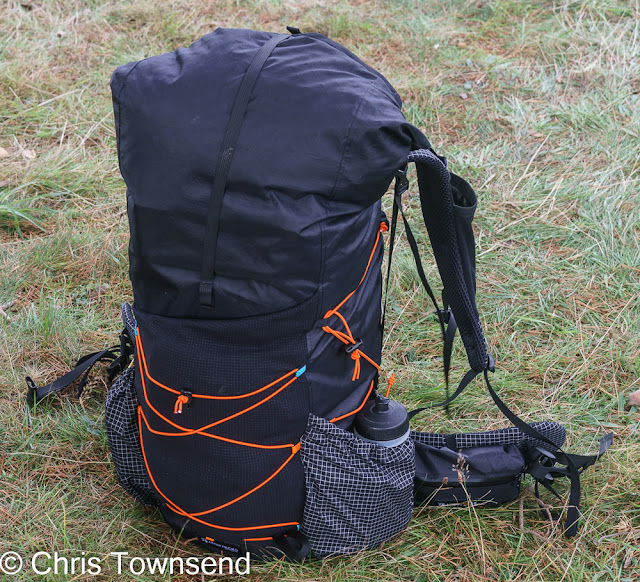
Pack: Hyperlite Mountain Gear Junction 55


This was my first use of this pack and it was fine. At 910 grams it’s ultralight but still has an internal frame. It carried 12kg comfortably. At 16kg (when I had four litres of water) it did pull down on the shoulders and hips a bit but I didn’t have any soreness or aching. The design is fairly standard for lightweight packs – roll top, mesh front pocket, open-topped side pockets, hipbelt pockets, and compression/adjustment straps. The fabric is a Dyneema Composite one and it has taped seams. It’s probably waterproof – the few brief showers on the trip were not enough to test this.

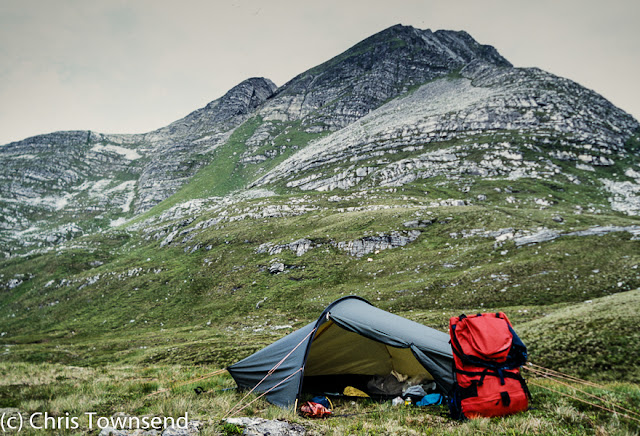
Tent: Mountain Laurel Designs SoloMid Xl with InnerNet


The SoloMid pyramid tent has become a favourite shelter in recent years. I like the headroom, the space, and being able to pitch it with a trekking pole. I took the InnerNet, which effectively makes it a double-wall tent, in case the first midges were out. They weren’t and I never did up the inner doors. The total weight with pegs was 1020 grams, so still very light for such a roomy shelter. I only had one light shower in camp and the wind was never strong enough to be a problem so I never closed the outer door either.

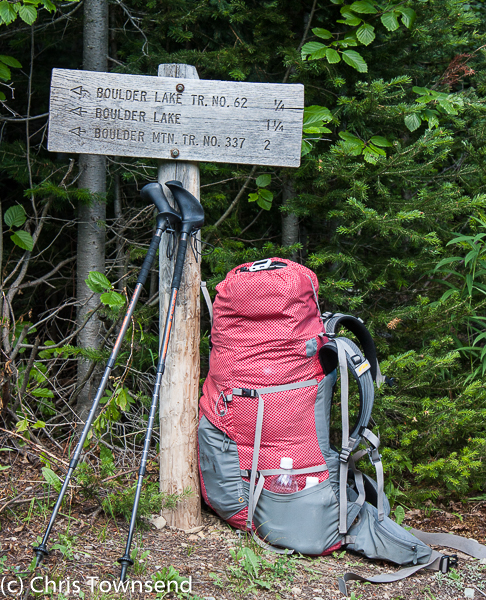
I pitched the SoloMid with a Pacerpole and used a pair of these throughout the walk, as I have on every trip for many years.


Sleeping Bag: Rab Mythic Ultra 120

Launched just two years ago this down bag has already gone from Rab’s range, which is a shame as I find it excellent for summer use. (It is still available for now though). It’s ultralight at 330 grams and packs into a tiny bundle. There’s no fill on the bottom of the upper half, just thin nylon and straps to hold it in place on a sleeping mat. I don’t use these so I can sit up in the bag without the mat coming with me. The upper is wide enough that I can wrap it around me to stay warm and keep out drafts. The lower section is insulated top and bottom.

Sleeping Mats: Therm-A-Rest NeoAir XLite & MultiMatSuperlite 8

As has been my approach for several years now I took two mats – one for comfort, one for security. I’ve had too many failures to trust inflatable mats anymore. The inflatable XLite is comfortable enough and lightweight at 370 grams. The closed cell foam Superlite 8 is not very comfortable but can’t be punctured and weighs only 190 grams. The Superlite is bulky too. I couldn’t decide whether strapping it to one of the sides, which impedes the pocket, or on top, which impedes access to the main pack, so I alternated between the two. 


Stove & Pot: Fire Maple Petrel Titanium UltralightStove & Fire Maple Ramen 800ml Pot

These two items work together, the heat exchanger pot slotting onto the stove to give a stable unit. I took them because I’d be resupplying with food that needed simmering and I wanted to eat out of the pot. The Petrel stove simmers well and the Ramen pot is wide rather than tall and narrow and so much easier for stirring food and for eating from. Both are lightweight - the stove 96 grams, the pot 194 grams. They worked fine.


Mugs, Cups, Spoons, Bottles 
& More

I took two drinking vessels – the Snow Peak TitaniumBackpackers Cup (37 grams), which is the classic Sierra Cup design, and is useful for dipping water out of burns and could double as cooking pot if needed, and the Sea To Summit X-Mug (68g), which folds flat, holds more and keeps drinks warmer than the Cup. I didn’t really need both of them but I did use both.

I also took two titanium spoons – a standard one and a long-handled one. Again, one would have done but I like two in case of loss (it has happened). I also prefer the shorter one except when eating out of food packets.

The total weight of the pot, stove, mug, cup, spoons, lighter and fire steel, all carried in a mesh bag, was 520 grams.

One concern was water. Both how often there’d be sources and how clean these would be. With the first I ended up carrying four litres of water for the last few hours on several days, both for camp and to get me to the next source the following morning. For water that needed treating I took the LifeSystems Peak Series 650ml Collapsible Squeeze Bottle Water Filter System which I used enough to justify its 120-gram weight, especially on the coastal section where any running water had come through farmland, villages or both.

Otherwise, for day use I had my now twenty+ year-old GoLite 700ml hard plastic bottle. I like it because it’s light at 78 grams and has a wide mouth and so is easy to fill. For camp and when much water had to be carried, I had two collapsible water bags, a 2-litre Platypus (45 grams) and a 2-litre Hydropak (80 grams). These three are all I usually take on backpacking trips.

Clothing

Clothing was about comfort and staying cool rather than dealing with storms or cold. The first four days I walked in nylon trail pants (EddieBauer Guide Pro, 400 grams) and a polyester Rohan shirt (so old I’ve forgotten the name – the current Frontier shirt looks similar) that I like because it closes with studs not buttons and has big pockets. These kept off the wind and didn’t get sweaty. I did take a windshirt – I always do – a now well-worn PatagoniaHoudini (110g) but I only wore it a few times as the wind wasn’t cold.

Once the weather was warmer I changed to an old pair of shorts and a favourite BAM bamboo T-shirt, which is very soft, very comfortable, and after much wear somewhat disreputable.


I had one warm garment, which I wore in camp early and late when the temperature dropped to around 10°C. This was another favourite, the very light (220 grams) insulated Berghaus Hydroshell hooded jacket (now replaced by the very similar MTN Arete Synthetic Hoody). It was all I needed.

Waterproofs, unworn but I’d never leave them behind, were the 335-gram Montane Cetus Lite jacket and an old pair of Berghaus Paclite overtrousers (225 grams).

Shoes


Altra Lone Peak shoes have been my favourite hiking footwear for many years and they were fine for this trip as I expected. I wore them with thin Darn Tough socks the first four days and then without socks for the warmer last three days.

Other Stuff

I had a tiny headlamp (Petzl Bindi), Kindle, compass, first aid kit, repair kit, and various other items. Camera gear of course and smartphone and power banks and accessories. Lots of little things in fact that lived in some zipped bags.

Note: I am an Amazon Associate. If you buy from the Amazon links I receive a commission at no cost to you. Every click helps! Thank you if you do purchase something or click on one of my links. StoreID: christownse0c-21

Note 2: All photos were taken on the walk.

Note 3: After the walk I made a video about the gear I used.


Tuesday, 18 January 2022

Packs I've Used On Long-Distance Walks

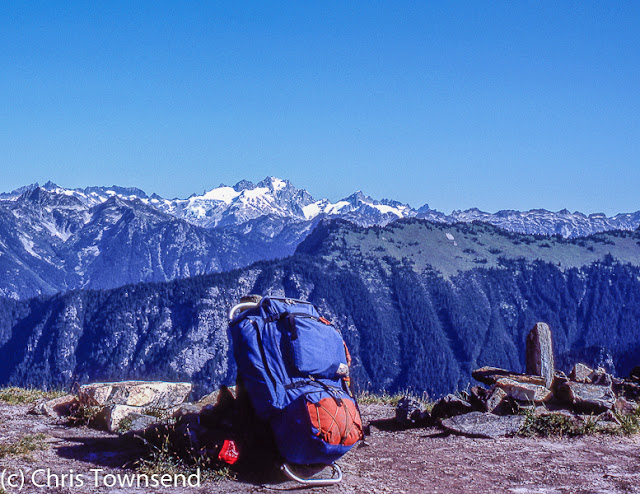
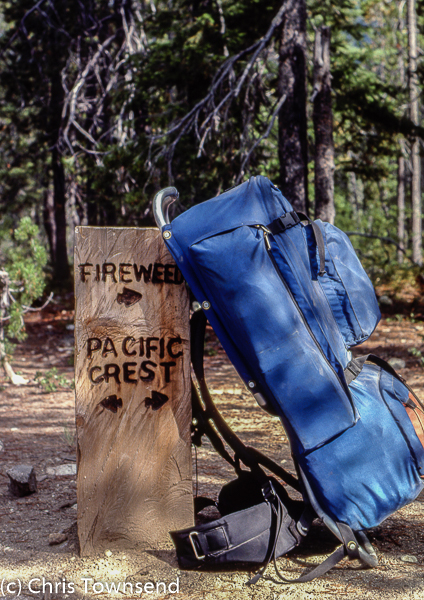
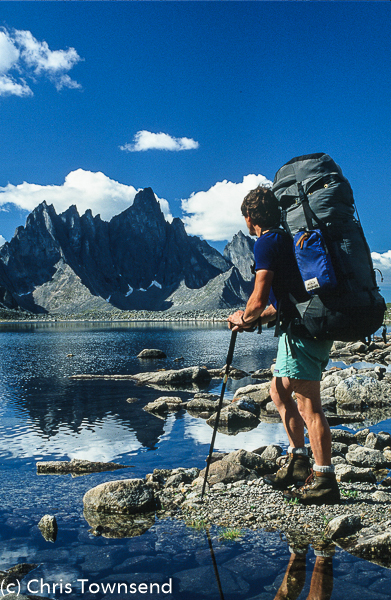
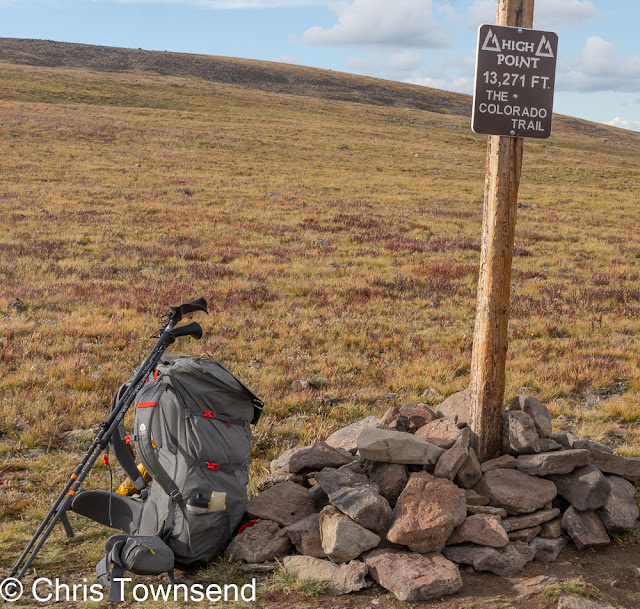
The North Face Back Magic II, Pacific Crest Trail, 1982

This is an updated feature that first appeared in 2018. I've made some edits, added some new words, a new pack, and a few different pictures.

Thinking about the packs I’ve used over the years, especially on long-distance walks, I realised that the big change has been in capacity and weight – as gear in general has got more compact and lighter so have the packs I use. However, despite all the developments in materials and designs the packs I used over forty years ago would be fine today. Over the years I’ve gone from external frame to internal frame to, briefly, frameless and back to internal frame. Here’s a run-down of the key packs.

After a couple of poor choices when I started backpacking – a cheap external frame that broke and a better quality one with no hipbelt and a difficult to use packbag – my first good pack was the Camp Trails Ponderosa, which came with an external frame called the Astral Cruiser. I bought this because it was recommended in the first backpacking books I read, Teach Yourself Backpacking by Peter Lumley and The Backpacker’s Handbook by Derrick Booth (much later I pinched the last title for one of my books). The Ponderosa was a classic external frame pack of the time. In 1976 I used it on my first walk longer than a weekend, the Pennine Way, and found it a little unstable on rough terrain though very comfortable on good paths. However, the hipbelt ripped off towards the end of the trip and I had to sew it back on. 

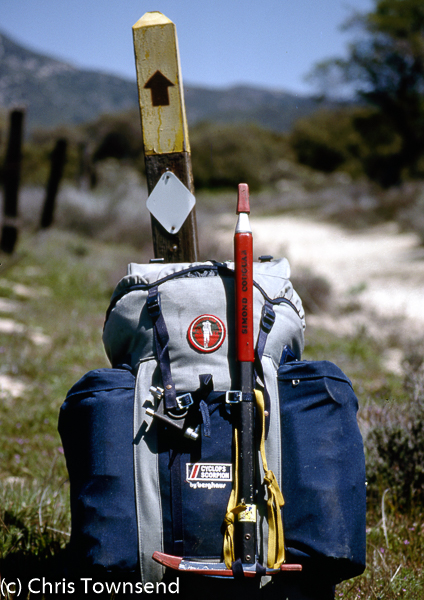
Berghaus Cyclops Scorpion, Pacific Crest Trail, 1982

That failure meant I wanted a new pack for my first really long walk two years later, Land’s End to John O’Groats. Berghaus, then still a fairly new company, had recently launched their internal frame Cyclops pack and they looked tough, so I picked one of these, the 80 litre Serac. This proved comfortable and survived the walk so for my next long trip, the Pacific Crest Trail in 1982, I went for a bigger Cyclops model, the 100 litre Scorpion, reckoning I’d need the extra capacity. I did and could have done with more. At one point I carried my heaviest every load – 23 days supplies plus ice axe, crampons, snowshoes, and extra clothing. The pack almost disappeared under all the gear on the outside. 

The ridiculously heavy load, Pacific Crest Trail, 1982

The Scorpion performed well but after around 1500 miles the frame snapped – probably weakened when I let it bounce down a steep snowy pass in the High Sierra. As the frame was sewn-in to the padded back and was an unusual asymmetric X shape I couldn’t replace it. Unable to find an internal frame pack big enough I replaced it with an external frame one, The North Face Back Magic II. This had an equally unusual frame, an asymmetric hour-glass shape. It handled the last 1000 miles of the PCT fine but developed a slight bend in the frame on the airplane on the way home. I still have it. Maybe I’ll try it again soon.

The North Face Back Magic II, Pacific Crest Trail, 1982

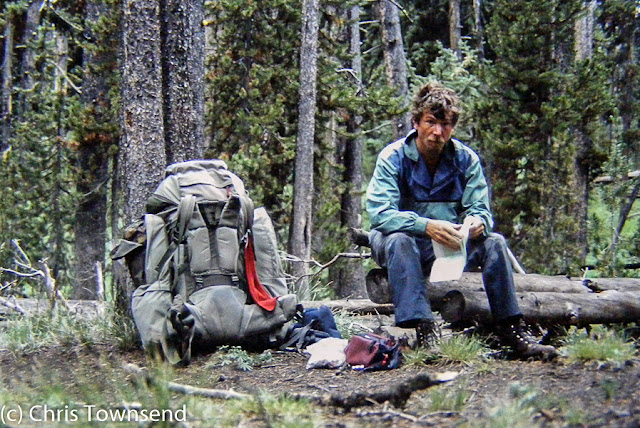
Next came my 1985 Continental Divide Trail walk. After the broken Cyclops frame I looked for a different internal frame one and ended up with the Karrimor Condor 60-100, another huge pack with the biggest side pockets I’ve ever seen. This lasted around 2000 miles and then one of the shoulder straps snapped. It had rubbed against the hard plastic reinforcement in the hipbelt and slowly weakened – if I’d spotted this I could have padded it. After that I checked packs more often. I replaced it with an even bigger 125 litre Gregory Cassin, bought because it was recommended by Colin Fletcher in the latest edition of The Complete Walker. It was very heavy but also the most comfortable pack I’d yet used.

Karrimor Condor 60-100, Continental Divide Trail, 1985

I went back to the Karrimor Condor 60-100 for my 1988 walk the length of the Canadian Rockies but the hipbelt design had changed and I couldn’t get it comfortable – I obviously hadn’t tested it at home adequately. By this time I was reviewing packs for magazines and so had quite a choice of models. Lowe Alpine, who’d invented the internal frame pack, had sent me a prototype for their first external frame model called the Holloflex. This had the most massive padded hipbelt I’d ever seen plus a plastic frame that was said to be extremely tough. With sore hips from the Condor I fancied that hipbelt and had the pack sent out to me. It did prove superbly comfortable but the hipbelt began to part from the frame towards the end of the walk and ended up being held on with duct tape. The Holloflex never went into production due to the costs. It was the last time I used an external frame on a long walk.

Gregory Cassin, Yukon Territory, 1990

Two years later I went back to the Gregory Cassin for a walk the length of the Yukon Territory and again it was fine though by the end of that trek it was looking rather worn so I decided it wasn’t up to another long walk. By this time New Zealand company Macpac had arrived in the UK and their packs, made from a canvas like polyester/cotton fabric, looked really tough so I took the 90 litre Cascade on a 1992 walk the length of the Scandinavian mountains. Most of the way it was fine but towards the end of the walk the buckles on the hipbelt and shoulder straps started slipping annoyingly often.

   
Dana Designs Astralplane, Cairngorms, 2021

During the 1990s I led many ski tours, including camping expeditions to places like Greenland, Spitsbergen, the Yukon Territory, and the High Sierra. For this I needed a monster pack that was very stable as well as comfortable. A bit of research and I discovered the 115 litre Dana Designs Astralplane. I bought one and it was superb, the most stable huge pack I’ve ever tried. It proved very tough too. Indeed, I still have it and it’s in fine condition. I’ve never used it on a long-distance walk, however. I did take it on a two-week walk in Yosemite National Park in 1995 and have used it a few times for one and two night trips with bulky gear I’m testing, most recently in December 2021. It's indestructible.

Aarn Natural Balance, Munros & Tops, 1996

The packs above all weighed in the 2.5 -3.5kg range. That’s heavy. The ultralight gear revolution had begun in the early 90s and there were now frameless packs that weighed less a kilo. I didn’t find them comfortable with more than a very light load. For my next walk I did want a lighter pack though. Climbing all the Munros and Tops in one walk meant far more ascent than on any previous long-distance walk so I wanted to keep my load as light as possible whilst still being comfortable and functional. I tried a few of the new lighter packs but wasn't convinced by any of them. Then Aarn Tate asked me to try some prototype Natural Balance lightweight packs. As I’d be able to change packs quite easily this being a walk at home rather than abroad, I agreed and ended up using several models in the 65-75 litre range. When these packs were being shuttled around I used a 70 litre Lowe Alpine Alpamayo, which was fine, or an Arc’teryx Bora 60, which was very comfortable but unstable when scrambling as I discovered on the Aonach Eagach. This was the only walk I intentionally planned on using several packs though as I’ve shown above having one pack last a whole walk was rare.

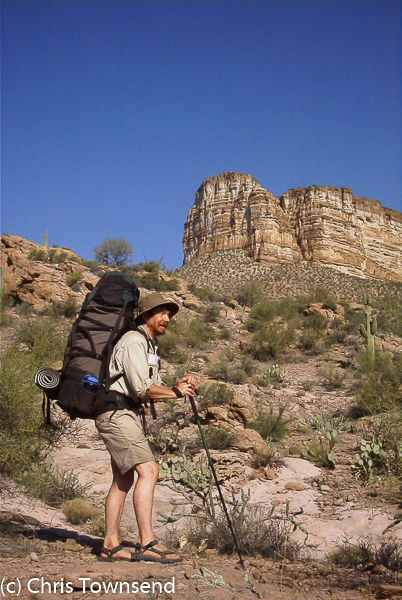
Gregory Shasta, Arizona Trail, 2000

Whilst the Aarn packs were good with medium loads I needed one that would handle much more for the Arizona Trail, which I walked in 2000, as I knew I’d be carrying large quantities of water at times. Still not convinced by lightweight packs I returned to Gregory and the 82 litre Shasta, which survived the walk and carried the weight well.

GoLite Pinnacle, Pacific Northwest Trail, 2010

During the first decade of this century the development of lightweight packs moved fast and soon there was quite a choice of models that would handle quite heavy loads. Having used one of the lightest ones, the GoLite Pinnacle, on several two-week TGO Challenge crossings of the Scottish Highlands I decided on one of these for the Pacific Northwest Trail, which I walked in 2010. The 72 litre Pinnacle had no frame, just a lightly padded back, and a fairly minimalist hipbelt. However, the curved shape meant it was surprisingly comfortable. The PNT was too much for it though. After three weeks the shoulder straps began to deform and feel uncomfortable. Holes started to appear in the fabric too. GoLite replaced it with the heavier though still lightweight Quest which had a frame, and which was excellent for the rest of the walk. I reckon the Pinnacle was probably a rogue model that had slipped through quality control.


GoLite Quest, Pacific Northwest Trail, 2010

Whatever the reason for the failure I decided that my experiment with frameless packs for long walks was over. The comfort of the Quest, which was still far lighter than the packs I’d been using not many years before, was a key factor in this. 

Lightwave Ultrahike, Scottish Watershed, 2013

In 2013 I chose the internal frame 1.23kg 60 litre Lightwave Ultrahike for the Scottish Watershed, partly because it was far more water-resistant than most packs and I thought the walk could be quite wet, as indeed it was. The Ultrahike was excellent, but the shape wasn’t right for my next walk. In 2016 I walked 500 miles from Yosemite Valley to Death Valley with an internal frame ULA Catalyst pack because I could fit a bear-resistant canister in the top, which I couldn’t do in the Ultrahike. I carried heavier loads than recommended in this pack – I had eleven litres of water at one point in the desert – and it was fine. 

ULA Catalyst, Yosemite Valley to Death Valley, 2016

I’d planned on using the 1.4kg Catalyst on my next long walk – it is one of my favourite packs – until I was offered a much lighter pack to test, the 60 litre internal frame Gossamer Gear Mariposa, which weighs 945 grams and handles 15kg loads well. After some initial testing I really liked the design and the comfort, so I took the Mariposa on the GR5 Through the Alps walk from Lake Geneva to the Mediterranean Sea and was really pleased with it. I loved the massive pockets in particular. I then took the Mariposa on the fortieth TGO Challenge in 2019. Unfortunately, one of the load lifter straps ripped out and whilst I managed without it, the pack wasn't as comfortable.

Gossamer Gear Mariposa, GR5 Through the Alps, 2018

My next long walk was on the southern part of the Continental Divide Trail in Colorado, a section where I'd been forced by snow and storms to take a lower route in 1985. On this I took another new test pack, the 1.2kg internal frame Sierra Designs Flex Capacitor 40-60, which proved comfortable and stable. I did miss having a front pocket but discovered that the flat zipped lid meant I could lay out gear in the top of the pack and have quick access to it. I did overload the pack with ten days food at one point and the hipbelt did slip a little under the extra weight but with five to six days food it was fine.

Sierra Designs Flex Capacitor, Colorado Rockies, 2019

My final words on this piece were “for my next walk? Probably the Catalyst, Mariposa (which is away being repaired), or the Flex Capacitor. Unless, of course, a new pack arrives to test that I like.” Well, one did arrive last autumn, the 925 gram Atom Packs The Mo EP 50 (review here) and I may well use this, though more likely the 60 litre version. 

Atom Packs The Mo EP50, Cairngorms, 2021
 

Wednesday, 8 July 2020

Gear I Used On My Long Walk In The Colorado Rockies


Last year I spent 29 days walking around 400 miles (644km) through the Rocky Mountains in Colorado on the Continental Divide and Colorado Trails. Most of the time I was above 10,000 feet (3048 metres). I camped on 25 nights, of which 18 were above 11,000 feet (3353 metres), the highest 12,460 feet (37987 metres). I was usually at or above timberline so many camps were exposed. For the first two weeks the weather was dry and mostly warm and sunny though there was sometimes a cool wind. Nights were chilly though, with overnight lows mostly between 0 and 5°C.  The second half of the walk was stormier and cooler with thunderstorms, heavy rain and hail. Nights were a little colder too, with sub-zero temperatures on three.

As on any long walk my gear needed to be durable and light while being able to cope with hot days, stormy weather, and chilly nights. My selection was a mix of tried and trusted items and new ones I felt would prove reliable. Here’s how they performed.

BIG THREE

Pack

Sierra Designs Flex Capacitor 40-60L /£165/1200g/ www.sierradesigns.com  /****1/2

 
I’d used this pack on several one- and two-night trips and reckoned it would be fine for the Rockies. At 1.2kg it’s lightweight rather than ultralight and designed to handle 20kg loads. It has a rigid curved internal frame that creates an air gap between your back and the pack. In hot weather this really did reduce perspiration. There are six small external pockets and a flat lid that zips open, with no drawcords or internal sleeves. Organising gear so I had access to often needed items was easy. Straps can reduce the volume from the maximum 60 litres to 40 litres. I never needed to do this; I just didn’t compress items so much when it wasn’t full. With 6 days food inside the pack carried well. Nine days food , which meant a total weight of around 25kg, was pushing it a bit as the hipbelt tended to slip. With that much food I had to strap my shelter on the outside – one disadvantage of the zipped lid is that it can’t be raised. Overall though the pack performed well and proved durable with little sign of wear at the end of the walk.

Shelter

Mountain Laurel Designs Trailstar/US$230/482g/ www.mountainlaureldesigns.com /*****
Oookworks Trailstar Nest/380g/no longer available/**** 16 pegs 143g


The Trailstar has been a favourite shelter for many years and the veteran of three previous long-distance walks plus several TGO Challenges. Easy to pitch with trekking poles and with a vast amount of room it always feels like home. After hundreds of nights use it’s as wind and waterproof as ever, withstanding some torrential rain and gusty thunderstorms. 

I took the Nest rather than just a groundsheet because there were likely to be mosquitoes for the first week or so. It too was a veteran of several long works and is still in good condition. After ten days there were no more mosquitoes and I sometimes used it just as a groundsheet, mostly I still pitched it though but left the doors open. 

Sleeping Bags & Mats

PHD M.Degree° 100 K Sleeping Bag/£371/245g/ www.phdesigns.co.uk /*****
PHD Filler Bag/£317/240g/ www.phdesigns.co.uk /*****
 

Therm-A-Rest NeoAir Uberlite Regular/£185/245g/ www.thermarest.com /***


 Therm-A-Rest Ultralite ¾ /482g/ no longer available *****

 
OMM DuoMat/£22/135g/ www.theomm.com /****

Expecting a wide variation in overnight temperatures I decided to use PHD’s Sleep System, as I had on my two previous long-distance walks, except that this time I took an even lighter outer bag, the M.Degree° 100, rated to 10°C.  Combined with the Filler K inner bag, rated to 15°C, I though this would keep me warm to -5°C and on colder nights I’d wear the PHD down smock, trousers and socks I was carrying as well. In fact, overnight temperatures only varied from -1.2°C to 9°C. I alternated between the Filler bag and the clothing, mostly based on what I was wearing in the evening. If I had the down clothing on I kept it on. The M.Degree bag is a simple mummy bag. I found it comfortable and the very low weight and packed size were welcome. 

My sleep mat when I set out was the ultralight NeoAir Uberlite. I found this airbed very comfortable as long as I didn’t inflate it hard, as then I tended to roll off. However, after thirteen days it deflated in the middle of the night due to a split in the top surface of one of the tubes. Given that only my sleeping bag was on the mat I can’t work out how this happened. Maybe there was already a weakness or the start of a tear (it has gone back to Cascade Designs for examination). Trying to sleep on the flat mat (just two thin bits of nylon), the thin foam DuoMat and clothes wasn’t successful.

Luckily that was the one-night Andrew Terrill joined me, bringing up my supplies for the next week, and I was able to borrow his old Therm-A-Rest UltraLite self-inflating mat. This was a model I’d used on long walks back in the 1980s and dated from a time before cored foam and curved mats. It was nearly twice the weight and bulk of the Uberlite but just as comfortable. It was only three-quarters  length, but I’d also brought an OMM DuoMat for use as a sit mat and its thin closed cell foam was fine under my feet and lower legs. 

TREKKING POLES

Pacerpoles Dual Lock/£107/570g/ www.pacerpole.com   *****

 
Constant companions on long walks for many years I regard Pacerpoles as indispensable. I used them every day when walking and every night for holding up the Trailstar. Tough, reliable, comfortable.

KITCHEN

Stove

MSR Pocket Rocket 2/£35/75g/ www.msrgear.com   *****

  
For many years I’ve used the Trail Designs Ti-Tri alcohol/wood stove on long walks. I didn’t take it this time because if there were forest fires stoves without on/off switches could be banned, as they were the previous year. Instead I took the tiny Pocket Rocket 2 canister stove. It worked really well and proved really fuel efficient, a 250g canister lasting eight or nine days. As it happened there were no forest fires.

Utensils

My pots did remain the same, the Evernew 0.9 litre and MSR 0.7 litre titanium ones I’ve used on every long walk for well over twenty years. Together they weigh 220 grams.

CLOTHING AND FOOTWEAR

Shoes

 
Altra Olympus 3.5 shoes/£130/680g/ www.altrafootwear.co.uk    *****

Altra’s wide forefoot design fits me well and I’ve used its Lone Peak shoes on quite a few walks. For Colorado I thought I’d try a different model, the Olympus 3.5. These have extra thick cushioning plus a Vibram sole. I found them extremely comfortable. The cushioning feels bouncy on hard smooth surfaces like pavements. I didn’t notice this on trails. The grip was good, and the sole had a little tread left at the end of the walk. The uppers are in fine condition. The latter are mesh and the shoes were cool in the heat.

Socks

Point 6 Hiking Essential Light Mini Crew/£15.95/70g/ www.point6merinosocks.co.uk   *****

These light ankle socks were a revelation and some of the best socks I’ve ever worn on a long walk. I wore them every day and only washed them twice and they were comfortable throughout. There are a few thin areas on the outsides, but they’ll still do for more walks. They’re made from 58% merino wool, 37% nylon and 5% spandex. 

Shirt

Paramo Katmai/£65/210g/ www.paramo-clothing.com    *****


I wore my  first Katmai shirt on so many long walks it fell apart. I love this design! The fabric is soft and comfortable, shifts sweat, and dries fast. The pockets are roomy. The cuffs are wide so the sleeves can easily be rolled up. An ideal hiking shirt. I wore it every day. 

Trousers/Shorts

Mammut Runbold Pants/£90/310g/ www.mammut.com   ****
Slazenger Woven Shorts/£7/165g/ www.slazenger.com     ****

I wore shorts most days when walking. These Slazenger ones I picked up in Fort William on the TGO Challenge the previous May when I found the weather too hot for long trousers. I didn’t expect them to last but as they were okay afterwards I took them to Colorado. They’re still fine. They’re made from soft polyester and have a mesh inner, elasticated waist with drawstring, and two hand pockets. They were very comfortable.

The Runbold Pants were mostly worn in camp for warmth. On stormy days I wore them under my waterproof trousers. They performed well.

Hat

Tilley Hiker’s Hat/£85/105g/ www.tilley.com   *****

I’ve worn a cotton Tilley Hat on every long walk for thirty years. I wouldn’t be without one. They are comfortable and tough. This latest one is made from organic cotton and has an evaporative insert in the crown. Soak it in water in hot weather and it takes even longer to dry, helping to keep you cool.

Windshirt

Patagonia Houdini/£90/105g/ www.eu.patagonia.com       ****

 
Windier weather than I expected meant that I wore this windshell quite often. Most days I found it all I needed over the Katmai shirt. The fabric is comfortable and quite breathable, and it is very light. A larger pocket would have been good, along with cuffs that aren’t elasticised so the sleeves could easily be rolled up, but overall it served its function.

Waterproofs

Alpkit  Gravitas jacket/£160/165g   www.alpkit.com    *****
 

Montane Minimus Pants/£100/153g www.montane.co.uk    ****

I took ultralight waterproofs as I knew I probably wouldn’t need them often, if at all. The big storms of the second half of the walk meant I used them more often than I’d hoped. When called on they did perform well, even though some of the storms were severe, and I never got more than slightly damp in them (from condensation). The wired hood of the Gravitas was especially good in driving hail. Both garments were comfortable. I could just get the Minimus Pants on over my shoes – slightly longer zips would be useful.

Insulation

Berghaus Vapourlight Hypertherm Hoody / 224g/ no longer available  *****

 
I’ve taken this synthetic insulated wind-resistant ultralight jacket on my last three long-distance walks and it’s become a firm favourite. It provided just the right warmth and weather resistance on cool days and at rest stops. It’s a real shame Berghaus don’t make it any more.

PHD Wafer Ultima K Down Pullover/£337/ 200g/ www.phdesigns.co.uk /*****


PHD Wafer Down Trousers K Series/£285/151g/ www.phdesigns.co.uk /*****

This down clothing did double duty as warmwear in camp and sleepwear on cold nights. Both garments are astoundingly warm for the weight and very comfortable. I ended up sleeping in them more often than intended as I was often reluctant to take them off before going to sleep.

Navigation and Electronics

For paper navigation I had National Geographic Trails Illustrated topographic maps to the Colorado Trail and the Weminuche Wilderness (324g – though I didn’t carry all of them at once), and The Colorado Trail Databook (210g).  I took my Silva Ranger compass (34g) of course. I don’t remember ever using it.

Just as important for navigation was my Samsung Galaxy S7 smartphone. On this I had mapsets and guides from the Continental Divide Trail Coalition and Guthook Guides. 


To charge my phone I had a GoalZero Nomad7Plus solar panel (380g) and GoalZero Venture30 powerpack (255g). The solar panel was clipped to the pack during the day and put out in the sun in camp. On hot clear days it charged the powerpack around 80%, enough to almost twice charge the phone. On cloudy days or ones when I was in the forest for hours it only charged the powerpack a few percent. Overall, it was just adequate. 

For sending OK messages home and in case of emergency I had an original SPOT GPS Messenger (132g). I sent a simple OK and my location home every evening so my partner knew I was fine and could see where I was.

Accessories 

As always, the list of accessories is long, but everything was needed. It included 2 2-litre Platypus water containers (79g), a GoLite 700ml water bottle (87g), Sawyer Mini Water Filter (47g), Smartwool Beanie (56g), Lifeventure Drybags (100g), Petzl Actik and e+Lite headlamps (119g), Leatherman Micro multi-tool (50g), notebook and Space pens in Alosak bag (175g), reading glasses and cases x 2 (195g), Lifesystems Light & Dry Pro First Aid Kit (172g), repair kit (50g), Kestrel 4500 Weather Station (102g), wash kit/medication/toilet paper (174g), Samsung Fury dark glasses and case (125g), Kindle Paperwhite e-reader (263g).

 All the photos were taken on the walk. You can read more about it and see more pictures here

This article first appeared in The Great Outdoors.