This trip report/gear review first appeared in The Great Outdoors in spring last year and
describes an overnight trip in the 2021-2022 winter. I’ve edited it slightly
and updated the gear prices.
When a weather forecast suggested a short window of calm weather after a
long stormy period I decided to head up to the vast boggy plateau of the Moine
Mhor in the western Cairngorms, a favourite place for a high-level camp.
Unusually, the forecast suggested the temperature would be warmer on the tops
than in the glens.
The air was frosty as I set off in the
afternoon, the sun having gone from the floor of Glen Feshie though it still
shone on the hills high above. As I climbed through the woods onto the open
hillside I passed through bands of cold and warm air, some very narrow. A
strange experience I haven’t had before. Overall, the temperature rose though,
and by the time I was on the tops, some 700 metres above the glen, I’d shed hat, gloves, and
fleece jacket.
In the west a brilliant
red sunset lit up the sky with far peaks sharply silhouetted. I crossed crunchy
patches of snow and slippery icy moss. The light faded, the headtorch came out.
I didn’t need it on the snow, but the moss and bog turned into impenetrable
solid blackness. Soon the almost full moon rose and bathed the snow dappled
hills in its eerie light. There was no wind, no sound at all. The silence was
enormous.
There are a huge number of good camp sites on the Moine Mhor. Usually.
Finding a site wasn’t easy this time though. Every hollow was filled with snow,
either hard and rippled or soft and wet. Snow free areas oozed water.
Eventually I found a dry, stony, flattish area. It would do.
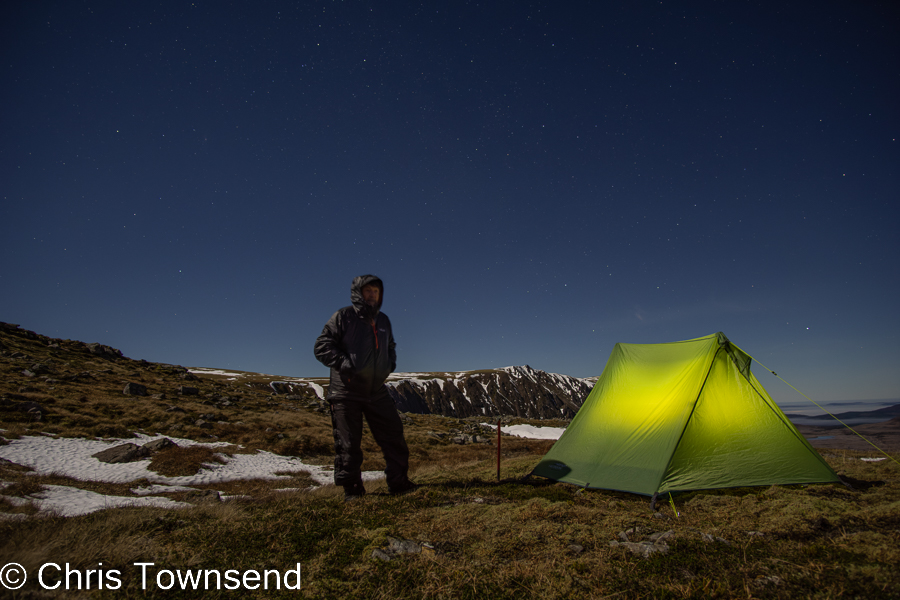
As always when the weather allows I left the tent doors open. At 1
a.m. I woke and looked out to the now high moon shining on the little pointed
peak of Sgor Gaoith. I can take a photograph from the porch, I thought. But
what’s happening the other side of the tent? I had no choice but to get up and
go and see. This was a magical night. All around the moon shone. Stars
sparkled. Away to the north a bank of fog hung over Aviemore. I was up for well
over an hour before retreating to make a mug of hot chocolate then fall back
asleep.
Awake again as the sun rose I was soon back outside. The
temperature was a touch below freezing. Chilly but under a clear sky in winter
I’d expect it to be much colder.
I watched the sun light up the tops of the hills then slowly creep
down the mountainsides until it reached the tent. Brightness and warmth enveloped
me.
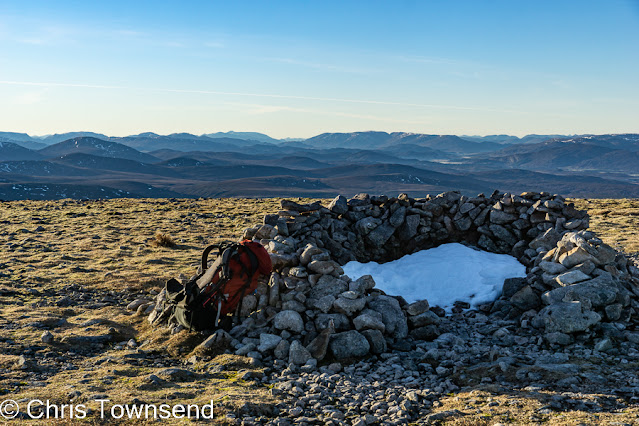
From camp I took a meandering line over to the edge of the steep
rocky slopes tumbling down to Loch Einich then followed this round to the
spring called Fuaran Diotach before heading up Carn Ban Mor. I could see many
people on Sgor Gaoith and decided I preferred the quieter slightly lower top.
The still air was warm, and I sat in the sunshine, my jacket undone.
Then it was time to descend, back down the long path to Glen
Feshie. On one short section across a steep hard snow slope falling away into a
stream gully I put on my microspikes and took out my ice axe as a slip could
have sent me a long way. Then it was down to the frosty glen and home,
satisfied.
Planning & Preparation
A high camp in the Cairngorms in winter is always a serious proposition,
even when the forecast is good. The weather can change suddenly, as I knew from
previous trips. In case of a big storm coming in I like to have escape routes
planned. Having ones in different directions means I don’t have to battle
straight into the storm. On this trip I camped on the northern edge of the
Moine Mhor not far from the steep drop into Gleann Einich - no safe route in that direction. The quickest escape
route was east, back the way I’d come. West would take me deeper into the
mountains so that was out. The easiest route was south, down the long River
Eidart glen. This would leave me with a long walk down Glen Feshie to my start
point but would get me off exposed high ground quickly. As it was, I didn’t
need either of these but knowing what I would do in case of a storm was
reassuring.
As the forecast was for the weather to be calm and mild I took a
lightweight tent and a sleeping bag just adequate for temperatures around zero.
If the night was colder I had plenty of warm clothes to boost the sleeping bag.
If there’s snow on the hills I always take an ice axe and crampons or micro
spikes. As I knew there were only patches of snow left from the last big fall
and there were no really long steep slopes on my route I took the latter.
EQUIPMENT
PACK
Dana Designs Astralplane
3.5kg *****
Likes comfort, durability, pockets
Dislikes weight
Capacity 106 litres (Terraplane 82 litres)
Materials nylon
Closure detachable lid with four
pockets
Back system internal frame, framesheet
Sizes four
Compartments two
Pockets lid, two front
Features side zip access
This huge heavy
pack is well over 20 years old. I bought it in the 1990s for leading ski tours
when I was sometimes carrying a week or more’s food as well as camping gear in
places much colder than Scotland like Spitsbergen and the Yukon Territory. I
don’t use it often now, but I took it out for this trip as I had some bulky
gear, and I couldn’t fit everything easily in my usual 68-litre winter pack. I
had forgotten how comfortable the Astralplane is. The most comfortable pack
I’ve ever used in fact. It has a massive thickly padded hipbelt and a frame
system that’s rigid longitudinally but flexes side to side, which makes the
pack stable, important when skiing and useful on rough ground. The pockets are
huge with long zips and there’s zipped access to the main compartment. I can’t
fault the design. Dana Designs is long gone however and the Astralplane with
it. However, the company did resurface as Mystery Ranch, which offers a similar
pack with the same design and back system. The Terraplane is a bit smaller,
with a capacity of 82 litres, and a bit lighter at 3.08kg.
TENT
Vango Haddon
100 1.6kg £210
**** Recommended
Likes roomy, pitches
with trekking poles, cost
Dislikes not that light
Outer Protex Eco 70D
polyester, 3000mm hydrostatic head
Inner breathable
polyester/mesh
Groundsheet nylon, 6000mm hydrostatic head
Poles none, uses trekking
poles
Porches 2
Inner
Dimensions 220 x 85 tapering to 75
cm, 90cm high at high point
The
Heddon 100 is the first tent from Vango that pitches with trekking poles. It’s
an offset transverse ridge design with the high point between the poles towards
one end. It’s not designed as a winter mountain tent, but I reckoned it would
be fine given the forecast. I’d already had it up in strong winds and it
performed ok. As it was, due to the test poles I took with me (see below), I
was careful to select a site with a bit of shelter from the breeze that was
blowing.
Many
solo tents are quite small, which keeps the weight down. The Heddon 100 is
roomier than many with more headroom, which was welcome on a long winter night.
I didn’t feel at all restricted inside. There’s a big porch that’s great for
views, access, and cooking under cover. The weight is a little high for a solo
tent that pitches with trekking poles but that’s because of the extra space and
the use of heavier, less high-tech materials, which keeps the cost down. I
think it’s an excellent tent and good value for money.
SLEEPING
BAG
Robens Icefall Pro
600 1.21kg £166
**** Recommended
Likes
roomy shape, central zip, cost
Dislikes
not that light, quite bulky
Fill 600g MicroThermo Ball
polyester
Shell 20D Nylon
Ripstop shell, 20D Nylon Taffeta lining
Construction box wall
Zip two-way ¾,
central
Sizes men: Regular, Long women: Regular, Long
Rating men limit -1°,
women comfort +6°C
As the forecast didn’t suggest temperatures much below zero I took this
synthetic-filled bag with a rating of -1°C and it was just right. I slept warm
and reckoned I would probably be okay in temperatures a few degrees lower
without needing warm clothing. The fill
consists of polyester clusters that are contained in channels just like down.
It feels a bit softer and more flexible than many synthetic insulations. The
bag has a central zip, which I love as it makes sitting up in the bag with it
partially open easy, and a good hood that snugs round the head. The bag is
quite roomy and I was able to move easily inside it. There’s a neck baffle and
a thick baffle behind the zip. As a three-season synthetic bag I think it’s
excellent. I wouldn’t usually choose one with this rating for winter. I was
glad the forecast was correct! The price is low but the weight a little high
for the warmth compared to a down bag and it is quite bulky.
SLEEPING MAT
Robens Iceshield
55 795g £87 **** recommended
Likes comfort, warmth
Dislikes bulky, heavy
Type self-inflating
Shell 20D PU ripstop nylon
Insulation foam
Dimensions 183 x 53cm
Thickness 5.5cm
Rating R-Value 4.2, -12°C
Roben’s Iceshield
self-inflating mats have a new construction with offset horizontal channels cut
across the top and bottom surfaces of the foam fill to ensure an even thickness
and to eliminate the cold spots found on vertical cored mats. Two layers of
offset foam are used, nesting together like an egg box. The mats also have a
valve with a high air flow for fast inflation and deflation and
delamination-proof TPU to hold everything together and provide durability. The
55 is the lightest of the two Iceshield mats but still fine for all but the
coldest winter weather. It’s very thick and has an anatomical shape. I found it
very comfortable and supportive and easily warm enough used on frozen ground.
Robens says the construction also saves weight and
the mat is quite light for a self-inflating one with this rating. It’s still
heavy compared with an insulated airbed though, but should prove more durable.
It’s quite bulky when packed too.
TREKKING POLES
Vango Basho Folding Walking Pole 600g £60 (pair) **
Likes
compact
Dislikes shockcord breaks, sections unscrew in use
Length 48-135 cms
Material aluminium alloy
Grip moulded thermo-plastic/rubber
Anti Shock yes
As these poles arrived with the Heddon
100 tent I decided to use them with it. On a practise pitch at home they seemed
fine. In actual use they weren’t. They have four sections, the top one closing
with an external clip. The other sections screw together and are shock-cord
linked. Now on firm ground this construction might be fine but on bogs and snow
it wasn’t. The sections kept unscrewing themselves as the pole tips stuck in
mud or snow. I’d feel the pole pulling and look back to see the bottom section
stuck in the ground with a long piece of shockcord stretching between it and
the next section. Even though I kept tightening the sections this happened
repeatedly until the shockcord snapped on one pole, rendering it useless as the
screw alone wasn’t enough to keep the pole firmly together. This made pitching
the tent interesting! I did manage but was aware that the pole probably
wouldn’t hold if the wind picked up. The next day I used the intact pole very
carefully and managed not to break it, though the small basket did come off.
STOVE
Jetboil Stash 200 grams £155 ****1/2 Best Buy
Likes
lightweight, compact, efficient, heat exchanger
Dislikes poor wind resistance
Total Weight 200 grams
Burner Weight 60 grams
Pot Weight 140 grams
Pot Capacity 800ml
www.jetboil.com
I’ve been using this stove and pot combination for over a year and it’s
now a firm favourite. On this trip it worked fine when the temperature was just
below zero and it had been left on the ground in the open porch overnight. It’s
not very wind resistant so I had a foil windscreen with but didn’t need to use
it as the porch door kept off the occasional breeze. My evening meal required a
little simmering and with the flame turned down the stove managed this without
the food sticking even though the flame control isn’t as precise as on some other
stoves. I used a Fire Steel to light the stove as it doesn’t come with an
igniter – not a drawback in my views as these often break so carrying something
else to light a stove with is wise. I expect the Stash will come with me on
many more trips.
CLOTHING &
FOOTWEAR
GLOVES
Sub Zero Factor 2
Plus Touchscreen Grip Gloves
48g £23 ****
recommended
Likes
soft, flexible, touchscreen compatible, low cost
Dislikes
no reinforcements
Material 50% nylon, 41% polyester, 9% Spandex
Sizes S-XL
A bit thicker than most liner gloves these light
gloves are surprisingly warm for the weight and were all I needed on this trip,
though I did have warmer gloves and mitts with me. The fabric is brushed on the
inside to give a soft layer against the skin. The outer is smooth, so the
gloves slide easily inside outer ones. The cuffs are double thickness for extra
wrist protection. The fabric stretches so the gloves fit closely without
impeding hand use or feeling tight.
There’s a silicon dot pattern on the thumb and first
two fingers which gives good grip when holding items and should provide better
wear with poles or ice axes. The tips of the thumb and these two fingers have
conductive overlays, so they’ll work on smartphone screens.
These are some of the best liner gloves I’ve used and
were ideal on this occasion.
WINDPROOF JACKET
Klattermusen Loride
2.0 windproof jacket 475g £309 ****
Recommended
Likes fabric, hood
pockets, cuffs
Dislikes not that light, quite
expensive
Materials organic cotton
Hood rear drawcord,
stiffened peak
Front Closure zip with outer flap
Pockets 2 chest
Hem shockcord
Cuffs shockcord
Sizes men XS-XXL, women XXS-XL
I first reviewed
this jacket two and a half years ago and it’s well worth a second look as I’ve
used it extensively since then and it’s become another favourite, both for the
design and the fabric. The latter is a lovely soft organic cotton that is really
comfortable. It’s windproof and very breathable. Rain resistance is poor, which
is fine with me. In a windproof breathability is what matters. On this trip the
Loride jacket was ideal. I wore it over a thin base layer when walking and it
kept off stray breezes and was warm enough to keep me comfortable without
overheating.
The Loride has a
good hood with a big peak – I didn’t need it on this trip, but I liked having
it just in case. The pockets aren’t mapsize, but they did hold smartphone,
snacks, and gloves.
Compared with
synthetic windproof tops the Loride is quite heavy and expensive. It feels like
a luxury item though and is lasting well. For day walks and short backpacking
trips it’s excellent.
HAT
Paramo Waterproof Cap £37.50 70g ***** Best Buy
Likes breathability, waterproof, peak
Dislikes
nothing
Materials Nikwax Analogy
Features stiff peak, chin strap
Sizes S/M, L/XL
This is an old favourite that I’ve been using
for well over a decade. It’s made from Paramo’s two-layer Analogy fabric. It’s
windproof, and waterproof if kept clean and reproofed occasionally.
Breathability is excellent so it’s comfortable worn under a jacket hood when
necessary. Warmth is good but not as high as fleece-lined caps. I find it
adequate in all bar the coldest winter weather. The ear flaps are warm, and I
like the built-in neck strap – no need to tie on a cord. If not needed the flaps
can be tucked inside. The peak is protective and good in the sun and in snow
but can’t be flipped out of the way. Mine is an original one. The current
version has a bigger peak and a different neck cord. The fabric is the same
though.
INSULATED
JACKET
Rab Generator
Alpine Insulated jacket 590g (L)
£260 ****1/2 Best Buy
Likes warmth, low weight, hood,
pockets
Dislikes no women’s version
Fill Primaloft
Gold Insulation with Cross Core Technology (133gsm Body / 80gsm hood)
Shell 2x 20D Pertex Quantum Pro fabrics
40gsm (Diamond Fuse front/ Recycled back)
Front 2-way YKK Vislon with insulated
internal baffle
Hood adjustable, wired peak
Cuffs Velcro
Hem shockcord
Pockets 2 mid-level handwarmer, 1 chest, 2
internal open
Sizes men XS-XXL
I’ve used this jacket extensively since
last autumn and the more I’ve used it the more I like it. It’s warm for the
weight with an excellent wired hood and roomy pockets. The fill is soft and
comfortable, the shell is tough. Being synthetic the jacket doesn’t absorb much
moisture and keeps its thickness when wet. This property wasn’t needed on this
dry trip, but it has been useful on other occasions when I’ve pulled the jacket
on over a wet waterproof in the rain. The jacket is designed for this, so the
sizes are on the roomy side, which is good.
The jacket was great to pull on for my
middle of the night star gazing trip out of the tent and for watching the dawn.
https://rab.equipment/
BOOTS
Inov8 Roclite Pro G 400
Gore-Tex Boots 830g £200 ****1/2 Best Buy
Likes lightweight, durable, good grip
Dislikes nothing
Uppers Schoeller ceramic-coated fabric
Sole Graphene-Grip
Sizes men 6-14, women 3-8.5
After a
year and half’s use of these boots (except in summer when they are a little
warm) I’m still as impressed as I was when I reviewed them back in January
2021. They are lightweight, comfortable, supportive and have good cushioning
and great grip. They’re tough too, with little sign of wear. The graphene in
the sole is there to enhance durability and it does.
I was
pushing it a bit using these boots on this trip though. They’re not intended for
winter mountain use. As it was, they gripped fine on the snow and hard toe
bumper meant I could kick steps occasionally. They were fine with micro spikes
during the descent too. Indeed, the only slight problem was that when walking
across big snowfields I could feel the cold as the uppers are quite thin. If
there was any more snow on the hills I wouldn’t wear them, preferring thicker,
warmer boots that would work better with crampons, but on this trip they were
just adequate.
ICE & SNOW
ICE AXE
CAMP Corsa Nanotech 280g (60cm) £130
**** Recommended
Likes ultralight, steel pick
and spike
Dislikes expensive
Head: 7075-T6 aluminium
alloy/Sandvik Nanoflex steel pick
Shaft: curved, 7075-T6 aluminium
alloy/Sandvik Nanoflex steel spike
Leash: optional
Rating: B
Lengths: 50, 60, 70cm
This
ultralight ice axe has a steel pick that will penetrate hard snow and ice, a
steel spike, and a narrow rounded adze. It’s not designed for serious
mountaineering but is ideal for a trip like this where an ice axe would only be
needed for short periods if at all. Whilst it spent most of the time strapped
to the pack on the short stretch of steep snow on the descent I was glad of the
security it gave. The lack of weight does mean it requires more effort to use
and I wouldn’t like to use it continuously for long periods. For occasional use
it’s excellent, though, and it doesn’t add much to the load.
MICRO
SPIKES
Hillsound
Trail Crampons 463g (L) £50
**** Recommended
These
micro spikes – despite the name they’re not crampons – are excellent on gentle
slopes and hard snow. They’re not replacements for full crampons. Sometimes I
carry both. On this trip I thought micro spikes would be adequate and they
were. They have 18 sharp steel points linked by chains and a stretchy rubber
cradle that fits just about any footwear. The fit isn’t as secure as with
crampons however and you need to place your foot flat to prevent the micro
spikes slipping to the side. That’s why they’re not adequate for really steep
slopes. On trips like this they’re fine however, especially as they’re lighter
and pack smaller than crampons.
ACCESSORIES
SMARTPHONE
Motorola Defy 235g
£249 ****1/2 Best Buy
Likes
tough, waterproof, dustproof, shockproof, battery life, cost
Dislikes
basic camera
Size
170 x 78 x 11mm
Weight
235 grams
Operating system Android 10
Battery
5000 mAh
Cameras
48MP f1.8 main, 8MP front
The Defy is another
item I like more the more I use it. This big rugged smartphone is easy to use
with gloves on, has a bright display, and a huge battery that really lasts. The
ribbed sides and back make it secure in the hand. It’s said to work down to
-25°C. I haven’t used it anywhere near that temperature but in temperatures
below zero as on this trip it’s fine. It’s waterproof, dustproof, and
shockproof so I don’t need to treat it with care. I carried it in a jacket
pocket and left it on the groundsheet overnight. I used it for photographs and
occasionally to check my position. Over half the battery life was still left at
the end of the second day. The camera is fairly basic, though in good light
images are fine, but otherwise I can’t fault this phone for hill use.