Showing posts with label birds. Show all posts

Sunday, 28 January 2024

RSPB Big Garden Birdwatch 2024


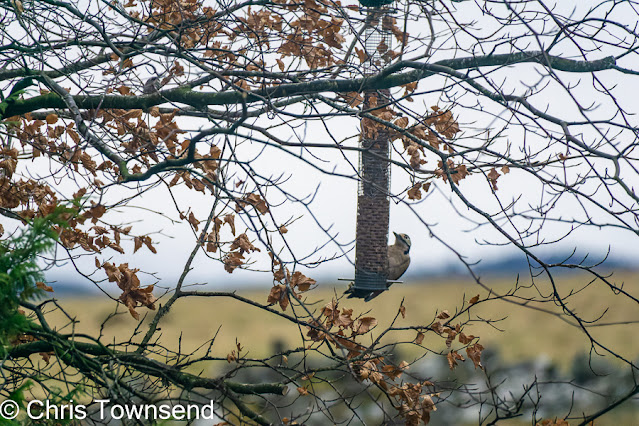
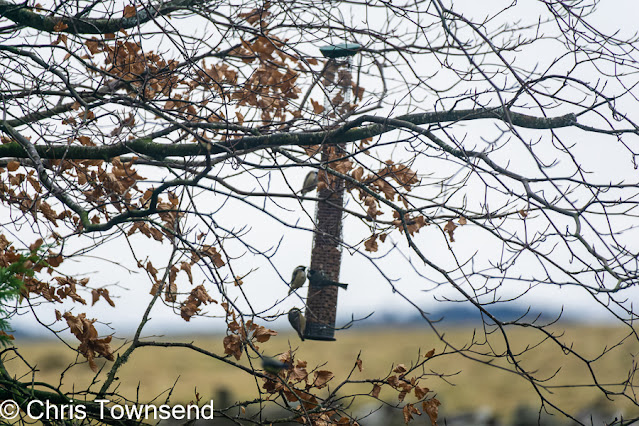
This year's Big Garden Birdwatch  took place with the thawing remnants of the last snowfall on the ground, a cold wind, cloudy sky with occasional hazy sunshine, and a temperature of 4.5C. 

There weren't as many birds as we've seen most days this winter. The total number was just one more than last year. There were with two more species this year but no greenfinches. Last year we didn't see house sparrows, blackbirds, or sparrowhawks. The first two of these we've seen almost every day this winter, often up to ten at a time. A sparrowhawk has often been around too. Other than the last all the species are ones we've seen every day this winter. Most days we also see greenfinches, goldfinches, siskins, and wood pigeons but none turned up during the hour of the birdwatch.

Here's the full list:

Coal Tit                                 9
Chaffinch                               5 
Blue Tit                                 4
Great Tit                               3
Great Spotted Woodpecker    3
Robin                                   2
Dunnock                               2
Blackbird                              1
House Sparrow                     1
Sparrowhawk                        1

Photo note: The picture was taken immediately before the birdwatch. It's not very good as the light was not ideal, being low on the feeders but bright in the background and quite flat overall. I should maybe have used a faster shutter speed than 1/250 sec and a higher ISO than 1250 (lens was the Sony E 70-350mm @ 120mm, f stop was 5.6.). Anyway, I wanted to show the birds and feeders at the time of the birdwatch rather than post a better photo taken at another time.

Monday, 11 December 2023

December Darkness

Grant Park Lochan - 'the skating pond', Grantown-on-Spey

Since the snow thawed last week darkness has fallen on the land. At least that's how it feels. I had forgotten just how much brightness snow brings to the short daylight hours and weak low sun of December. Not that the latter has been visible anyway. Dark clouds have covered the sky, adding to the gloom. At midday it has felt barely light, more like dawn or dusk than noon.

Heron & Mallard

The snow melting has been good for wildlife though.  Food is more easily available and nights are warmer. Lochs and lochans are no longer frozen, or only partially so. On a walk through Anagach Woods and beside the River Spey I watched a heron standing motionless in the faded reeds around Grant Park Lochan (known locally as the skating pond) while Mallard ducks swam and dabbled in the still ice-spattered water. 

River Spey

Along the Spey there was no sign of ice, the river dark, full, and fast, rushing snowmelt from the hills down to the sea. Out on the water there many ducks, Goldeneye as well as Mallard. I watched them through binoculars as they drifted with the current then flew low back to their start point. No photographs - I hadn't brought the big lens and they were all on the far side of the wide river. I saw dippers too, and a big raptor flying fast through the trees. Buzzard? Red Kite? Too brief and partial a glimpse to be sure.


At times I could see distant hills, still streaked with snow. High up the thaw will be slow. Walking beside the swirling river, watching the birds and the clouds, the trees and the hills, I felt peaceful. It may be December, it may be dark, but nature is still beautiful. There will be more snow.


Saturday, 9 December 2023

A Sparrowhawk Visits


Sparrowhawks regular raid the bird feeders in our garden, usually flashing round the side of the house and scattering the finches and tits. Sometimes they catch a bird, sometimes not, sometimes we're not sure as it all happens so fast. Then there is quiet for ten minutes or so before the first little bird, usually a Coal Tit, flies in and grabs a sunflower seed. Whilst we'd rather not see one of the birds killed we accept that this is how nature works and the Sparrowhawks need to eat.


Sometimes a Sparrowhawk fails to catch something and instead of flying off hangs around, sitting on the feeders and watching the trees and bushes where, I guess, it knows its prey is hiding. When this happens it's worse overall for the small birds than when the Sparrowhawk catches one of them as it prevents them returning to feed. This is especially so if the hawk spends much time doing so and also repeatedly fails to catch anything.


This happened a few times recently, during the cold spell when the garden was white with snow and the temperature never rose above freezing. For several days we saw a Sparrowhawk repeatedly fly in, catch nothing, and then perch on the feeders for a while.


One day it stayed for half an hour or so, occasionally shifting from one feeder to another and sometimes swooping rather slowly and lazily towards a bush and then returning to a perch. 

I think it's a young one, which probably explains its lack of success. Being able to watch it for so long and take some photographs was wonderful. With its beautiful plumage, yellow feet with long curved talons, and intense stare it's a magnificent bird. I hope it has enough success hunting to survive the winter.

Sunday, 5 February 2023

Excitement in the Garden! Sparrowhawks and long-tailed tits.


After last week's rather subdued Big Garden Birdwatch this Sunday produced some unexpected and unusual excitement.

It started with a male sparrowhawk perched in a bush just outside the kitchen window. We see sparrowhawks quite often but they rarely stay long. Usually they swoop in and either catch of chase a small bird and then fly off. Sometimes they may perch somewhere for a short while if they've failed to catch anything. This sparrowhawk was there for over half an hour before flying away so were able to admire it's beautiful plumage and brilliant yellow eye for much longer than usual.

Not long after the sparrowhawk left a flock of long-tailed tits appeared on one of the peanut feeders. This was exciting as we hadn't seen these beautiful little birds for many months and were wondering what had happened to them.

The long-tailed tits had barely arrived when a sparrowhawk flashed in and scattered them. It chased one into the wire netting enclosure protecting a crab apple tree from rabbits and roe deer and was flying round inside this after the long-tailed tit when another sparrowhawk flew in and attacked the first one. The two then rose into the air fighting before one flew away pursued by the other. We've never seen two sparrowhawks squabbling before. 

A few minutes later the long-tailed tits came back.

You can't beat garden birds for entertainment!

Sunday, 29 January 2023

RSPB Big Garden Birdwatch 2023


This winter has seen masses of birds at the feeders but not this weekend. The last bout of freezing weather with deep snow on the ground having gone a week ago the weather has turned warm and wet. Today it was 9C outside. 

We saw the same eight species as in the last two years, all birds we see every day, just in slightly slower numbers. During the cold weather there have been many blackbirds, sometimes ten at a time, but there were none today.

Thirty individual birds appeared, compared to forty-one in 2022 and forty-seven in 2021. Chaffinches topped the list with twelve. Only five coal tits were seen at a time but I think there were far more as they were darting out from shelter only briefly. There could have been dozens hidden in the trees.

Here's the full list:

Chaffinch      12
Coal tit           5 
Blue tit           3
Great tit         3
Greenfinch     3
Dunnock        2
Robin            1
Great Spotted Woodpecker    1


Sunday, 30 January 2022

RSPB Big Garden Birdwatch 2022


With Storm Malik just passed and Storm Corrie on the way this year's Big Garden Birdwatch took place on a cold, windy, dark, overcast day with a temperature of 3C. When the clouds lifted slightly fresh snow was visible on the Cairngorms. 

Last year there was snow on the ground and it was sunny and calm and a little colder. For the birds this difference in the weather made no significant difference. We saw the same eight species in almost the same numbers. As last year the bird we've seen regularly in previous years that was missing was the greenfinch. We haven't seen any of these for several weeks. As usual coal tits and chaffinches had by far the highest numbers. In both cases I think these are underestimates. It's hard to count small birds quickly darting in and out.


Here's the full list of this year's birds.

Chaffinch       12
Coal tit           10
Great tit           5
Blue tit            4
Blackbird        3
Robin              3
Dunnock         2
Great Spotted Woodpecker     2


Sunday, 9 May 2021

Photography Post: The Biggest Lens I've Ever Owned & Some Photographs Of Birds & More.

Bynack More, May 7, 2021. Sony a6000, Sony E 70-350mm @ 350mm, 1/1000 & f8, ISO 200


Until last year the longest zoom lens Sony made for its APS-C range of cameras was the 55-210 f4.5-6.3, a lightweight lens at 379 grams and one that produces reasonable quality images, especially given its low cost. I've had this lens for over ten years and have been generally happy with the results, even when cropped (quite a few have been published). However I have at times wished for a longer reach and several years ago I purchased a Sony 1.7x tele conversion lens that increases the long end of the 55-210 lens to 357mm, which is equivalent to 535.5mm in full frame/35mm terms. The combination works reasonably well in good light but is a bit clumsy and awkward to use and I haven't actually used it much.

Sony E 70-350 with lens hood reversed, Sony a6000


Then last year Sony issued one of it's rare new APS-C lenses, the 70-350 f4.5-f6.3. This received excellent reviews, as it should given the cost. As well as expensive I noted it was heavy and dismissed it from my thoughts. However during the lockdown periods of the last year I took many photos at home and on local walks and started using the 55-210 more often, both for wildlife and for a different perspective on familiar scenes. I got out the 1.7x tele conversion lens as well but found that the image quality really wasn't good enough for big crops. My thoughts returned to the 70-350. Maybe there would be secondhand versions around now. There were and I bought one described as in good condition for much less than the cost of a new one. It looks as good as new anyway.

From the top, Sony 18-135, 55-210, & 70-350

At 697 grams the lens is heavy. It's big too, by far the biggest lens I've ever owned. I doubt I'll be taking it on long backpacking trips. However it doesn't feel too clumsy on my little Sony a6000 and NEX 7 cameras even when fully extended.

It's a slow lens, which means combinations of low ISOs and very fast shutter speeds need bright light, as in the photo at the top of this post. However the lens has Sony's Optical Steady Shot stabilisation and with care I can get sharp shots at shutter speeds down to 1/100 second and lower if I lean on something. Of course with a tripod this isn't a problem, though the lightweight one I take on walks won't support the weight. I do have a much heavier tripod which I might end up taking out at times.

Sand Martin. Sony a 6000, Sony E 70-350mm lens at 70 mm, 1/400 @ f8, ISO 200. Cropped.      


After some initial trials I took the lens on a short walk beside the River Spey hoping to see some birds  photograph with the intention of cropping the images. The walk on a dull day beside the swollen river was a joy and I took photographs of pied wagtails, common sandpipers, goldeneye ducks, and, sand martins. The last were very difficult to photograph as they never stay still, except for fractions of a second as they hover above the water to seize an insect. Watching them was a delight - there were at least twenty - and I was quite happy to get one passable image, especially as it's a huge crop, as you can from the full image below.

Other photos that were much easier to take also cropped well. Here's a selection with the full originals, all taken the a6000 camera and all handheld, sometimes leaning on a bridge.

Common Sandpiper. 350mm, 1/40 @ f8, ISO 200

Willow. 93mm, 1/60 @ f8, ISO 200


Pied Wagtail. 350mm, 1/250 @ f8, ISO 200


Goldeneye. 350mm, 1/320 @ f8, ISO 200


Saturday, 30 January 2021

RSPB Big Garden Birdwatch 2021


With snow lying since late December and temperatures rarely rising above freezing for over a month our feeders have been emptying fast every day so I expected to see far more birds than last year when the weather was mild for this year's RSPB Big Garden Birdwatch. In fact though there were only three more birds than 2020 and one less species. 

Looking through previous years results I think this is because last year's numbers were high given the mild weather rather than this year's being low. 

The species missing this year that we saw last year and in previous years is the greenfinch. Until a few weeks ago we were seeing several every day but since then there hasn't been a single one. We also haven't seen any siskins for many weeks but these do come in waves - many for a few weeks then none for a while.

Coal tits were the commonest bird this year with sixteen individuals. As they dart in and out so fast counting them is difficult and I suspect the figure is an underestimate. Chaffinches are usually the commonest by far - twenty last year and only four of any other species - but this year there were only nine. 

Here's the full list of this year's birds.

Coal tit                                   16
Chaffinch                                  9
Blue tit                                     5
Great tit                                   4
Blackbird                                 4 
Great Spotted Woodpecker       3
Robin                                      3
Dunnock                                  2


Saturday, 29 February 2020

Book Review: Red Sixty Seven


This is a lovely, sad and important book. It's a series of essays and paintings about the sixty-seven British birds on the UK Red List. These are Birds of Conservation Concern, a polite way of saying they are seriously threatened with being wiped out.

Each bird has it's own writer and artist so the book has a wealth of styles in both words and pictures. 
It's a wonderful book to browse, reading about favourite birds, admiring the beautiful paintings. Lest you forget the message it's there on every page though, with details of the BOCC Status and the Red-List Criteria - globally threatened, decline, decline, decline repeated over and over.


There are birds here that are little known but what's shocking is how many are very familiar - starling, song thrush, herring gull, cuckoo, puffin, house sparrow and many more. That these birds are disappearing shows just what an appalling state our countryside and wild places are in.

Red Sixty Seven is the brainchild of Kit Jewitt (aka YOLObirder) who introduces and curates the book. All the writers and artists gave their work for free and all moneys raised from sales goes to Red-listed species conservation projects run by the British Trust for Ornithology and the RSPB. The book is published by the BTO from whom it can be purchased for £19.99 + postage. It deserves to be a big success.

Sunday, 26 January 2020

Big Garden Birdwatch 2020

The mild weather of the last few weeks has seen a reduction in the number of birds coming to the feeders in our garden, so I wasn't expecting to see many for this year's RSPB Big Garden Birdwatch. In fact though, there were forty-three birds and nine species, not as many as last year when it was colder, but far more than the sixteen birds and seven species of 2017. Maybe the change in the weather - it's a touch colder today with a dusting of snow on the hills and it's forecast to turn really wintry - has brought the birds out.

As usual there were far more chaffinches than anything else and counting them was difficult as they arrived in large flocks. I reckoned there were at least twenty at any one time. All the species were ones we see every day. Those we see often but not every week - long-tailed tits, goldfinches, siskins - didn't appear. Even so, doing the birdwatch was enjoyable, as it is every year. An hour spent watching birds is never wasted.


Here's what I saw this year:

Chaffinch               20
Blue Tit                   4
Coal Tit                   4
Greenfinch              4
Great Tit                 3
Dunnock                2
Robin                     2
Blackbird                2
Great Spotted Woodpecker    2

Sunday, 12 August 2018

Hen Harrier Day Highland 2018


August 12. The day red grouse are blasted out of the sky by people who enjoy killing small birds. And in the name of ensuring there are plenty of grouse to kill many other birds and animals that might eat the grouse are slaughtered year round. A wonderful graceful raptor, the hen harrier, has become the symbol of those of us who oppose this abuse of wildlife as there are far too few of these birds, especially on grouse moors.

In 2014 a new group, Birders Against Wildlife Crime, organised the first Hen Harrier Day as a way of raising awareness about hen harriers and their plight. Now Hen Harrier Day events are held all over Britain in the weeks leading up to the Inglorious Twelth. This year the one for the Scottish Highlands took place in the Grant Arms in Grantown-on-Spey on the twelth itself.

There were stalls from various groups including BAWC, the Scottish Raptor Study Group, OneKind,  and the RSPB, and six speakers, all of them interesting.  Andy Wightman MSP gave an excellent hard-hitting talk on land ownership and control, politics and power, the damage driven grouse shooting does to the land in general as well as to raptors, and the need for "a much more robust approach to those who break the law... If someone in another industry consistently breaks the law then they lose their licence to operate in that industry." 

Other speakers were raptor expert Brian Etheridge, who showed some wonderful pictures of hen harriers; zoologist and wildlife journalist Isla Hodgson, who spoke about her recent work on conservation conflict (it's much more complex than you might think); wildlife detective Alan Stewart, who offered some fascinating insights into wildlife crime investigations; OneKind director Harry Huyton, who talked about the campaign to stop mountain hare slaughter, and Grant Moir, CEO of the Cairngorm National Park, who talked about the park's work and what it hopes to achieve regarding wildlife.

I found the event invigorating, inspiring, and informative. I hope that this and all the other Hen Harrier Day events lead to a time when they're no longer needed.


Monday, 23 April 2018

In Praise of Ravens

Raven page from the excellent Collins BTO Guide To British Birds
A rush of air. I looked up. A raven. Flying low some fifty metres away. The bird turned effortlessly and flew back past me, having a good look. Ravens are curious birds and know that people often leave tasty scraps of food. Later I heard it's harsh 'crark' cutting through the windy air, one of the thrilling sounds of the mountains.

I was on the vast plateau of the Moine Mhor in the Cairngorms just two days ago when I encountered that raven. I returned home to learn that Scottish Natural Heritage (SNH) had issued a licence for a five-year mass cull of ravens in an area of Perthshire noted for wildlife crime. This is appalling and has led to an outcry, as it should. It's been covered thoroughly by Raptor Persecution UK and the RSPB has said it is outraged. There are two petitions to sign - one on the Petition Site and one on Change.org. More importantly letters of objection can be sent to Mike Cantlay, SNH Chair, calling on him to withdraw the licence with immediate effect. Emails to: chair@snh.gov.uk.

There seems to me no justification for this slaughter. It's noteworthy that SNH worked with gamekeepers, farmers and estates on this but no wildlife or bird organisations. Not the RSPB, or the Scottish Raptors Study Group, not the Scottish Wildlife Trust - no-one in fact who might have argued against the proposal.

The killing of birds of prey to protect other birds so they can be shot always sickens me. This proposal has upset and angered me more than most as ravens are a favourite of mine. One of the symbols of wild places their harsh cries always inspire me. They are brilliant fliers and I love watching them and find their behaviour fascinating. They are very curious and often unwary around people. Sit and watch and they'll perform superb aerobatics as they keep an eye on you in return. Look back and you'll often see them land where you've been sitting, hoping to find something edible.

Ravens are found in wild areas worldwide. I've seen them everywhere from the deserts of Arizona where I startled a flock of them feeding on a dead cow and Makalu base camp high in the Himalaya where another flock was enjoying teasing a dog. The last case showed just how much ravens like having fun and how clever they are. The dog had tagged along with us for several days, feeding on scraps chucked to it by the kitchen crew. At base camp I was sitting on a rock watching some ravens picking about on the ground when the dog suddenly appeared and ran at the ravens, which flew up in the air cackling loudly. They didn't just fly off though. Instead they settled on a boulder and watched the dog. Then one of them flew down onto the ground near the dog and turned its back to it. The dog duly charged the raven which flew off to the sound of loud cackling from the other ravens. Another raven then repeated the performance. Then another. The ravens were clearly finding the poor dog very entertaining.

In Scotland many mountain features are named for the raven. There's a Creag an Fhithich (rock of the raven) on Ben Lawers, a Biod an Fhithich (pointed top of the raven) in Kintail and an Eas an Fhithich (waterfall of the raven) in Strathglass plus many more. It was and is an important bird of mountains and wild places. It should remain so, unpersecuted.


Sunday, 28 January 2018

Big Garden Birdwatch: A Plethora of Coal Tits

This year's Big Garden Birdwatch saw far more birds than last year, probably because the weather has been cold and wintry where last year it had been unseasonally mild for many weeks. Today though it was mild, +7C, overcast and drizzly.

Coal tits were the dominant birds with so many flying in and out that it was hard to count them. I definitely saw eleven at one time though I reckon there were far more than this. These hyperactive tiny birds rarely stay on the feeders for long. Chaffinches, the commonest bird the last two years, were down to just four.

In total nine species appeared, two more than last year. Eight are ones I've seen every day for many weeks now so not a surprise. There was a siskin though - I haven't seen one of these for many months.

It's always a pleasure taking part in the Birdwatch and actually recording what I see. I always look forward to the results too. Bird watching was one of my first outdoor activities and I've never tired of it. Birds are such an essential part of nature. We need to look after them and recording numbers is part of doing that.

Sunday, 17 December 2017

By The River


Walking by rivers can be exhilarating, terrifying, tense, soothing. It all depends on the mood of the water and the mood of the walker. A few weeks ago during a big thaw the River Spey was wild and angry, full of surging snowmelt, overflowing its banks, submerging tree roots, crashing over rocks. I walked beside the water overawed by its power. The river seemed out of control, unpredictable, dangerous. 


Yesterday as the big freeze continued the river was in a completely different mood. Dark, sombre, deep, somehow sinister and calm at the same time. Black water swirled slowly against snowy banks. Distant hills shone white in bursts of sunshine. Reflections of trees shimmered in the glassy surface. Beside it I felt calm but also alert and observant. There was a feeling of waiting. For what? Anything, nothing. Whatever would happen next.

 
The flooding snowmelt river was bereft of bird life. Nothing moved on or above the tumultuous water. The river of the freeze was alive with life. Mallards paddled in the shallows by the banks. A pair of goosanders flew low over the water, long necks and bills outstretched, while a solitary female, her reddish-brown head distinct against the much darker river, bobbed on the slight swell. Another long-necked bird, black and cumbersome, flapped upstream. A cormorant. Rounding a bend I came on six more, floating in midstream. Five took off at my approach, skimming heavily away. The sixth remained, alone, slowly turning in the flow.

 
Three times I put up herons, watching them slowly and heavily fly along the banks before settling again in the shallows. On some snow-covered ice on the edge of a quiet pool out of the main flow I found the tracks of their large feet.


As I watched the constantly changing almost hypnotic complex patterns of the river a small dark dumpy-looking bird suddenly bobbed up, floated for a few seconds, then disappeared under the water again. A dabchick (as I learnt to call them many years ago, more formally a little grebe), the first I’ve seen on the Spey.

Other than the occasional splash of wings on water these birds were silent. The only sound was the crunch of my shoes in the snow. In the background there was the hum of traffic on the main road that lay not far away but I was able to fade this out, it only impinging on my hearing when a particularly noisy vehicle whined and roared.

Then a harsh cry rang out across the river, repeated again and again. I looked up from the water. A crow sat atop a birch tree, cawing loudly, before flying off to disappear into the woods, still calling.


Returning through the woods via an icy set of steps I admired the delicate tracery of snow, ice and frost on the birches, very temporary beauty that would be gone at the first touch of wind, or sun, or rising temperatures.


Tuesday, 19 September 2017

Where have all the pheasants gone?

A wet pheasant in the garden, June 2016

I saw a pheasant today. That would have been a commonplace statement six months ago, when I was seeing pheasants every day in the garden, as I had done for many years. But this pheasant, which burst out of the undergrowth on the edge of the woods as I was admiring the first touches of autumn in the leaves, was the first I've seen since late winter. I don't know the actual date of the last sighting as it took a few weeks before I began to notice their absence but it was sometime in March.

Pheasants are bred for shooting not far away and this time of year often sees dozens of released birds congregating on the roads looking confused and presumably wondering where the hell this big world has come from, if pheasants can wonder at all. Maybe these pheasants will appear soon.

But there have always been wild pheasants in the woods and fields anyway. On any walk I'd see several. And some of them just about lived in our garden, often nesting there, and feeding on seeds and nuts dropped from the bird feeders. Occasionally one would balance precariously on the mesh seed trays and manage to grab a few seeds from the feeder before falling off. The ground under the feeders was always bare dirt as the pheasants scratched up any plants. Now the ground is greening over.

The pheasants have gone. I have no idea why.

Saturday, 8 July 2017

Young wildlife in the garden


June and July are busy days in the garden for the local wildlife. First they're feeding their young in nests and dreys and burrows and need to eat plenty, then they're bringing their young to our feeders and trying to get them to feed themselves. The latter seems easy with the squirrels and rabbits - they don't appear until they can feed themselves - but not with some of the birds. Often fledglings will chase any adult of any species roughly the right size mouths wide open  - sometimes with success, we've seen coal tits feeding blue tits and greenfinches feeding siskins - or else sit and look at the food, peck at it tentatively and then stare again.

Young great spotted woodpecker wondering how to get at those peanuts

For the first time this year we've been delighted to have regular visits from young goldfinches and jays along with the usual siskins, chaffinches, greenfinches, blue tits, great tits, coal tits, robins and blackbirds. Missing this year are pheasants, which often nest in the garden. In fact there hasn't been an adult pheasant in the garden for many weeks and there are few in the fields and woods. There have been masses of rabbits but a few weeks ago there was a sudden bout of myxamatosis and after a few days of seeing ill ones there were none for a day or so before number started to build up again.

Young goldfinches
Young blue tits

Back in May several nursing squirrels were regular visitors so it wasn't a surprise when young squirrels started to appear. What is unusual is their choice of food and where they feed. We put out peanuts and mixed seed in different feeders and until this year the squirrels always went for the peanuts and generally fed hanging upside down. This years youngsters prefer the seeds and to either sit in the trays or feed on the ground - the birds scatter much seed. The older squirrels still choose the peanuts.