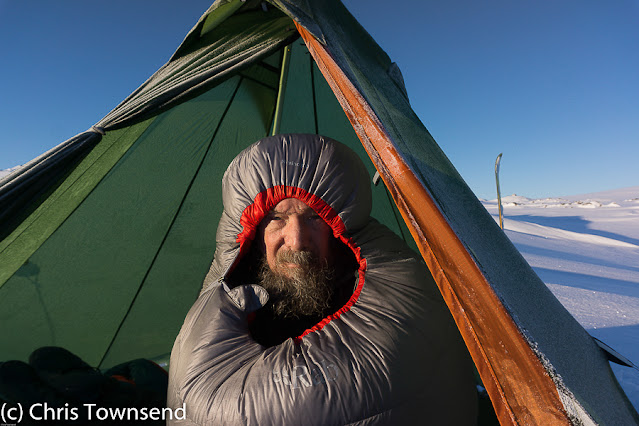
With snow settled on the Scottish hills I’m looking forward to a winter camp soon. It’ll
be my first camp of the year – later than usual due to waiting for my hand to recover
from an operation just before Christmas. Planning what to take I started thinking
about sleeping bags and decided to share my thoughts. I’ve combined parts of various
introductions to winter sleeping bags I’ve written for The Great Outdoors over
the years with some additional ideas to make what I hope is an interesting and
useful feature.
The lowest temperature ever
recorded in Britain is a chilly -27°C. That’s cold. Very cold. However, it is
an extreme and most winter nights don’t get anywhere near that. In fact,
temperatures below -10°C aren’t that common and most winter nights in the hills
are in the +5 to -5° range. So, whilst
you certainly need a warmer sleeping bag in winter than summer it needn’t be
one that can cope with sub -20 temperatures. For most winter nights a bag with
a rating of around -10C and 14-16cms of loft (thickness), should be adequate.
You could carry a -30°C bag just in case but it’ll be heavy and bulky and at zero
degrees probably too hot. Better to have a bag that will keep you comfortable
most nights and if the temperature does fall much lower wear warm clothing, which
can increase the warmth of a bag considerably. This said, those who sleep
really cold might well do better with a bag with a bit lower rating.
The weight
of a bag doesn’t necessarily determine its warmth. Heavier down bags may have more
down of a lower quality to achieve the same temperature rating as lighter bags
and often thicker shell fabrics as well. But if they’re as lofty as lighter
bags then they should be as warm. Their big advantage is much lower cost. Synthetic
bags are always heavier than down bags with equivalent ratings though the
difference is not as great as it used to be. Again, the cost is an advantage.
SEASONS
& RATINGS
The warmth
rating standard EN 13537 is useful for comparing bags but should only be taken
as an approximate guide. Those who sleep warm may find ratings understated,
those who sleep cold may find them disappointing. There are other factors that
determine how warm you sleep too, especially your sleeping mat. If this is
inadequate you might be cold even in higher temperatures than the bag’s rating
as much heat will be lost to cold ground. However good it is the fill of the
sleeping bag will be flattened under you and so much less effective.
Your
shelter plays a part too. A double-skin tent with a solid inner is much warmer
than a tarp. Which is not to say don’t use the latter – I often do, or else a
single-skin tent – just that you will probably need a warmer sleeping bag.
Also
important are the clothing you’re wearing (remove anything damp!), how cold you
are when youget in the bag (it’s easier to stay warm than to get warm), and
how recently you’ve eaten.
DESIGN
Winter
sleeping bags are usually mummy-shaped with hoods and a tapered body. Companies
usually show sleepers flat on their back in them, face framed in the hood. If
you sleep on your side or your front – I do both – lying in a mummy bag doesn’t
look so neat. If the bag is roomy enough for you to turn over in it you end up
with your face inside the hood. If the bag turns over with you the hood may end
up on top of your head. As mummy-shaped bags were the only ones available for
many decades I adapted to using them. One feature I did watch out for was bags
with less fill on the bottom on the assumption this would stay under you. After
waking chilly when testing such bags with the bottom on the side or above me I
now avoid such designs. In recent years different-shaped sleeping bags have appeared
from a few companies designed for side or front sleepers. I’ve tried a couple
and they are more comfortable.
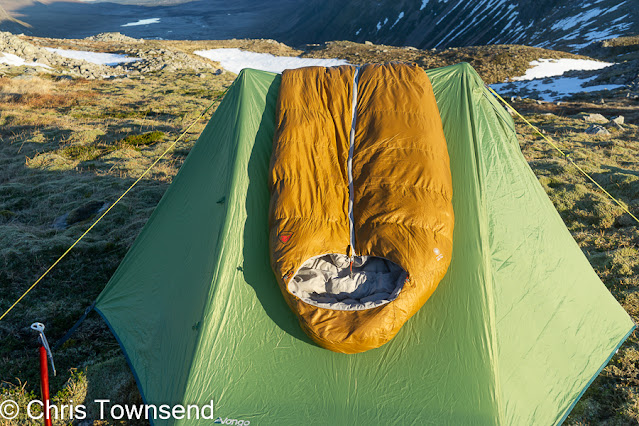
The right size bag should
fit reasonably closely while still allowing you freedom to move. Masses of room
may be comfortable, but it also means lots of dead air space that has to be
heated up and that can feel chilly when you turn over into a patch of it. Close-fitting
bags are the most thermally efficient but can feel restrictive. There won’t be
room for wearing thick warm clothing in them either – this can be draped over
the top if extra warmth is needed. Many bags come in different
sizes and it’s worth seeking out one that fits.
Hoods come in different
designs. Ones that can be opened fully are good for warm sleepers, like me, who
only use hoods when it’s really, really cold. If you always use a hood then
shaped ones that don’t open fully are very snug. With any hood, check you can
easily pull it in close around your head without any big gaps appearing as
these will let in cold air, and that the drawcords are easy to operate in the
dark – it’s not pleasant struggling to open a bag in the dark.
Rather than neck baffles
that operate separately from the hood many bags now have baffles, sometimes
called neck gaskets or collars, that run round the edge of the hood and pull in
round the face and neck. These work well and are easier to use than neck
baffles as only one drawcord is required.
Most sleeping bags have
full length zips. These need to have thick baffles behind them to prevent cold
air entering. Some bags have short zips, which saves weight but makes the bag a
little less versatile. It’s even possible to have a bag without a zip, which
makes for a light bag with no chance of cold air getting in at the zip but
which you can’t unzip if you feel too hot. Side zips are the most common, but
central ones make it easier to use your arms while sitting up in the bag.
FILL
Even the best synthetic
fills don’t approach down for warmth for weight or low packed bulk. -10°C rated
synthetic bags are big and heavy. For backpacking I think down is far better.
As well as being much lighter it’s comfortable over a wider temperature range
and far longer lasting. It does need to be kept dry but so do synthetics, as
sleeping in any wet bag will be very unpleasant in the cold. I’ve used down
bags on many winter camping trips, some up to 6 weeks long, and have never got
one more than slightly damp. I keep my bag in a stuffsack inside a waterproof
liner in the pack and air it whenever possible.
If you’re really concerned
about getting your bag wet one with water-resistant down could be worth
considering. I think this is more useful for jackets though. Or you could use a
bivi bag. I carry one but rarely use it as I find my bag gets damp from
condensation inside it.
Down is available in
different grades, measured by the fill power, which is the volume that thirty
grams of down in a cylinder will fill. The higher the fill power the higher the
quality of down and the warmer the bag will be for the same weight of down.
There are different machines for testing fill power and these produce slightly
different results. Generally American methods produce higher fill power figures
for the same down. Rab, for example, says that its top grade down has a
European fill power of 750 and an American one of 850.
SHELL FABRICS
Sleeping bag shells are
made from windproof, breathable, fast drying fabrics with a light water
repellent finish that sheds the odd drip but isn’t waterproof. More water-resistant
shells are available, but these aren’t fully waterproof either, as the seams
will leak. Bags with waterproof shells with sealed seams are very expensive,
and heavier than ones without such shells. I’d rather have a separate bivi bag
and only use it when essential.
FINALLY, DO YOU ACTUALLY NEED
A WINTER SLEEPING BAG?
Good winter sleeping bags
are expensive. There’s not a big market for them and the materials are costly.
So, do you really need a bag that’s probably too warm to use at least half the
year, the half when you’re likely to spend more time camping? If you camp
regularly in winter I’d say having a winter bag is worthwhile but for the
occasional winter camper there are other options.
The first is to use two
bags, one inside the other. Combine a three- season bag and a summer bag and
you have the equivalent of a winter bag plus you can use the bags separately at
other times. Two bags generally weigh a little more than one and may not be as
comfortable – the inside one can get quite twisted – but the system does work. If
you’re worried about damp the outer bag could be a thin synthetic one. A liner
bag made of fleece is an alternative but doesn’t add as much warmth and is even
more prone to tangling in my experience.
Rather than two bags you
could use a bag and a quilt. The latter can be tucked in round the edges of the
bag. I haven’t tried this combination, but it should be less prone to tangling
than two bags.
Next you could plan on
wearing warm clothing inside a three-season bag to boost the warmth. Insulated
jackets, trousers, and booties can all add many degrees to the rating. The main
drawback to this is that if the temperature is exceptionally low you’re already
wearing your insulated clothing and might feel chilly when you exit the bag.
A bivi bag also adds a
little warmth but as I said earlier condensation can be a problem.