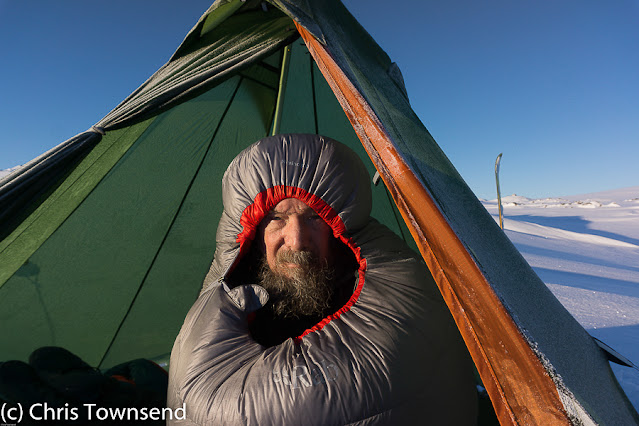
Wednesday, 9 March 2022

Igloos in Glen Affric and a magical winter mountain day, again

The igloos

Back in 2018 I went to Glen Affric with members of the Inverness Backcountry Snowsports Club (see this post). The weather had started stormy but finished glorious. Now some four years later we were returning and hoping for similar weather. There had been no igloos since 2018. Every weekend planned in 2019 was cancelled due to lack of snow or appalling weather and then came the pandemic.

This was my first overnight trip of the year due to the hand operation I had in December and the recovery time needed. As last time I decided to arrive the evening before everyone else and camp – I’ll do anything to avoid having to get up early! I was intending to camp anyway rather than sleep in an igloo. I’m still supposed to wear a splint on my hand at night and its Velcro attachments are noisy. In a tent on my own I’d have no concern about disturbing anyone.

Due to some last-minute magazine work I didn’t leave until late  for the two-hour drive and only started walking just before midnight. Since my last visit a new path had been built up through the woods and into Gleann nam Fiadh. Following this by headlamp as it wound up and down through shadowy trees made the initial walk rather more interesting than the expected trudge up the hydro road in the glen. There was no snow down here. The path eventually joined the road and soon afterwards I started looking round for somewhere to camp. Sodden boggy ground replete with big tussocks didn’t appeal and it was a while before I found somewhere that looked passably comfortable. I was so tired by now I didn’t think I’d have a problem sleeping.

Early morning mountains

And sleep I did. For about five hours. Not enough but there were igloos to build, and the mountains were shining in the early light. However, by the time I was dressed and breakfasted clouds were building and thickening. 

Rain approaching

A party approached up the track, carrying skis. The rest of the igloo group. An offer was made to carry my IceBox, that wonderful igloo-building tool from Grand Shelters and my friend Igloo Ed in far-off Colorado. I accepted. My pack, a test one that was heavy when empty, a tent that wasn’t that light, my snowshoes (I didn’t fancy carrying even heavier ski gear up to the high snowline), and other stuff meant a 22kg load when I set off. I couldn’t remember when I’d last carried such a weight and it was nearly three months since my last overnight trip anyway. 

Wet tent

Just after the others set off and I started packing it began to rain quite heavily. I was not pleased. This wasn’t forecast! It ceased as I started up the track though and although some clouds remained there was no more rain. Steep, rough, boggy, pathless slopes led into lower Coire an t-Sneachda – the corrie of the snows. Climbing these was hard work. The angle started to ease at a new deer fence. A rickety gate/ladder construction provided a way over. Beyond I could finally don the snowshoes and link big snow patches up to the others, who had just started building two igloos on a slope of deep snow.

The igloos begin to take shape

It's never easy to predict how long igloo building will take. Much depends on the snow. This time it took rather longer than we’d hoped. I think one reason was that there was a thick layer (maybe 50cms) of rock hard, icy old snow just below a much thinner layer of soft snow. Breaking through this hard layer and smashing it up so it could be used to make blocks was hard work and took time. But although it was quite late in the evening the two igloos were completed. 

Almost finished


I’d taken a break from shovelling snow to pitch my tent a short distance away on some boggy ground. Flatter and with a fine view it was a better site than the previous night’s and after the exertions of load carrying and igloo building I slept well, waking to a dark red dawn that soon gave way to a deep blue sky. The dawn temperature was -4°C. Within half and hour of the sun appearing it had risen by 10 degrees. 

Dawn begins

 
Dry tent

At the igloos the others were up too and breakfasting outside in the sunshine. One, Nicki, had already departed, rising long before dawn, just as she had in 2018. A mountain rescue team member, she was due in Torridon later in the day for training. That’s commitment! 

Igloo breakfast

Of the five of use left, Cat, Alan, and Chris were on skis, whilst Andy, like me, had brought snowshoes. We all headed up Toll Creagach, the Munro on whose slopes we’d spent the night, in the now warm sunshine. The snow was crusty and icy in places. If I hadn’t had snowshoes with crude crampons underfoot and serrated metal edges I’d have been wearing actual crampons. 

Summit view

Another summit view

On the summit we had a view that was just as spectacular as the one four years earlier, the mountains looking alpine under the blue sky. The only difference was the wind, which was cold. In 2018 we’d had no need for hats, gloves, or even jackets. This time I was glad to don my insulated jacket so I could keep warm whilst admiring the view.

A skier swoops

The skiers swooped down the slopes and vanished. We plodded slowly behind them. That was the only time I wished I’d brought my skis. I’d have hated carrying them though, for just a few minutes of descent. 

Returning to the igloos

Collecting all our gear Andy and I continued down to the forest fence on snowshoes, then on foot down the boggy slopes to the magnificent old pines of Glen Affric. In the sunshine in this green world spring didn’t seem so far away. Higher up it was still winter. But maybe not for long. 

The forest

After four years it felt tremendous to return to igloo building. Thanks to everyone who took part and especially Andy Ince, who organised the event, as always.

Another summit view

Tent view

Igloo

Friday, 4 March 2022

Clothing And Equipment Decisions On A Hill Walk


On the walk in the Cairngorms described in my last post I changed clothing and equipment a few times and eventually shortened my route. Here's what I did and why. 

I set off wearing a Paramo jacket over a thin fleece and base layer with mediumweight softshell trousers on my legs and a wool beanie on my head. I didn't wear gloves as there was only a light breeze and my hands didn't feel cold.The temperature was around freezing and there were patches of ice and hard old snow on the path. I hadn't climbed far before I felt too warm and stopped to remove the hat and fleece. 

Not long after that the terrain grew more slippery with frozen vegetation and an ice glaze on some of the rocks. The bare gravel sections of path and dry rocks were now few and far between. Realising I was slowing down and walking more carefully to avoid slipping I stopped to put on my crampons. A cool breeze had sprung up so I also donned a windproof peaked cap and some fairly thick liner gloves.

Continuing up confidently now - crampons make such a difference - I was soon nearing the broad ridge that runs north from Cairn Gorm. The wind was much stronger and colder here so I stopped again to don overtrousers as my legs were beginning to feel chilly. I should have done that before putting the crampons on! However my overtrouser legs unzip almost to the waist and by balancing carefully and using a boulder for support I managed to get them on over the crampons without tearing them. 

I also put my jacket hood up and swapped my windproof cap for the wool beanie and my liner gloves for slightly warmer ones with a windproof outer. Finally, as I now had big snowfields to climb where a slip could take me a long way I changed one of my trekking poles for my ice axe. The path had long disappeared under the snow.


Once I reached the ridge the wind eased and I lowered my hood. It was much colder though and I needed the overtrousers and the warm gloves. I stopped for a quick snack and a swig of hot ginger cordial. If it had been for more than a few minutes I'd have donned my insulated jacket.

My plan had been to wander up Cairn Gorm, now little more than a kilometre away, in the hope of a colourful sunset but the clear sky was rapidly clouding over and I could see the tops of peaks to the east slowly vanishing. Looking over the deep trench of Strath Nethy would be enough. I didn't feel like a navigation exercise in mist so I turned back, descending the same slopes I'd just come up.

I had a few stops on the way down as I started to feel warmer. The overtrousers came off, and then the gloves. As the snow patches shrank the ice axe became unnecessary and went back on the pack. I kept the crampons on though, all the way to where the path became mostly gravel rather than ice and snow.

This was only a relatively short four hour walk but it did take me to over 1000 metres in winter conditions. By adjusting my clothing several times I stayed comfortable without overheating. I never put my fleece back on but if I'd been wearing a standard waterproof jacket I would have needed it. Being two layer the Paramo jacket was warm enough while I was moving. As well as the insulated jacket I also had insulated trousers and a much thicker pair of gloves so I could have stayed warm in much colder and windier conditions.

The crampons were just about essential high up and the ice axe sensible on the steeper slopes. I'd have turned back if I hadn't had them.

Saturday, 26 February 2022

A Brief Respite From Storms and Thaw In The Cairngorms


Today the wind is howling in the trees again and the thaw that started last night has cleared the low level snow and reduced it on the Cromdale Hills to small patches. The pattern of the winter continues. Strong winds most days. Heavy snowfalls quickly followed by a thaw. One day a week seems to be calmer. This week that was yesterday so I set off to see what the snow and wind of the previous day had done to the Cairngorms.

The view of Meall a'Bhuachaille showed the wind direction during the snow fall. The north-western slopes were scoured. They were scoured too on the east ridge of Coire na Ciste. There were only small patches of snow but the ground was frozen and icy and I was soon wearing crampons.

As I approached the broad north ridge of Cairn Gorm the ice axe came out too as the snow was now extensive and a slip could have sent me a long way. Up here a chill wind picked up and I sought the shelter of boulders for brief stops.

The light was soft under rushing grey clouds, a feeling of the Arctic rather than the bright sharpness of the Alps. The Cairngorms can supply either. A bleak beauty today. And a feeling of remoteness and a different world even though I was only a few hours from the car. Height can make such a difference. 

I had thought I would wander up Cairn Gorm but the wind was strengthening and the clouds dropping. Gazing over Strath Nethy was enough. Turning back I retraced my steps. Lower down the air was warming. As I descended I slowly shed, crampons, ice axe, hat, gloves. The thaw was beginning.

Although the car park was busy I'd seen few people, as usual for this part of the Cairngorms despite its accessibility. On the ascent I watched a small group making their was up a wide swatch on snow on the side of Coire na Ciste. On the descent a lone walker crossed the ridge below me and headed off into Coire Laogh Mor.


Thursday, 24 February 2022

A Look At The April Issue Of The Great Outdoors

The April issue of The Great Outdoors has just been published. In it I have a review of Alex Roddie's The Farthest Shore, the story of a wild night in the Cairngorms, a comparison of three rugged smartphones, and reviews of the Rab Generator Alpine Jacket, Arc'teryx Beta LT jacket, and a couple of cold-weather Tilley Hats. Also in the gear pages Alex Roddie reviews seven smartphone navigation apps.

In the main features David Lintern walks the Cape Wrath Trail, James Forrest attempts the Dales High Way in winter, Hanna Lindon picks out ten UK long-distance hiking routes, and Mark Waring goes hammocking on the Finnish taiga. 

The issue opens with a tremendous double page spread of skiers on Braeriach in winter by James Roddie. In shorter pieces Alex Roddie describes a circuit of Kinder Scout, adventurer and expedition leader Chaz Powell shares stories of his trips in a Q&A, there's a look at oudoor clothing as fashion, mountaineering instructor Mike Raine gives his view on some controversial path repairs in Snowdonia, also in Snowdonia Jim Perrin praises Carnedd Elidir, and James Forrest gives some tips on blister prevention. 

In the Wild Walks section Keith Fergus climbs Stob Binnein in the Southern Highlands, Ian Battersby climbs Helm Crag and High Raise in the Lake District, Andrew Galloway has a coastal walk round Strumble Head in Pembrokeshire, James Deboo takes tracks to Malham Cove and Malham Tarn, and Vivienne Crow climbs Cold Fell in the North Pennines.


Tuesday, 22 February 2022

Thoughts on Winter Sleeping Bags


With snow settled on the Scottish hills I’m looking forward to a winter camp soon. It’ll be my first camp of the year – later than usual due to waiting for my hand to recover from an operation just before Christmas. Planning what to take I started thinking about sleeping bags and decided to share my thoughts. I’ve combined parts of various introductions to winter sleeping bags I’ve written for The Great Outdoors over the years with some additional ideas to make what I hope is an interesting and useful feature.

The lowest temperature ever recorded in Britain is a chilly -27°C. That’s cold. Very cold. However, it is an extreme and most winter nights don’t get anywhere near that. In fact, temperatures below -10°C aren’t that common and most winter nights in the hills are in the +5 to -5° range.  So, whilst you certainly need a warmer sleeping bag in winter than summer it needn’t be one that can cope with sub -20 temperatures. For most winter nights a bag with a rating of around -10C and 14-16cms of loft (thickness), should be adequate. You could carry a -30°C bag just in case but it’ll be heavy and bulky and at zero degrees probably too hot. Better to have a bag that will keep you comfortable most nights and if the temperature does fall much lower wear warm clothing, which can increase the warmth of a bag considerably. This said, those who sleep really cold might well do better with a bag with a bit lower rating.

The weight of a bag doesn’t necessarily determine its warmth. Heavier down bags may have more down of a lower quality to achieve the same temperature rating as lighter bags and often thicker shell fabrics as well. But if they’re as lofty as lighter bags then they should be as warm. Their big advantage is much lower cost. Synthetic bags are always heavier than down bags with equivalent ratings though the difference is not as great as it used to be. Again, the cost is an advantage.

SEASONS & RATINGS

The warmth rating standard EN 13537 is useful for comparing bags but should only be taken as an approximate guide. Those who sleep warm may find ratings understated, those who sleep cold may find them disappointing. There are other factors that determine how warm you sleep too, especially your sleeping mat. If this is inadequate you might be cold even in higher temperatures than the bag’s rating as much heat will be lost to cold ground. However good it is the fill of the sleeping bag will be flattened under you and so much less effective.

Your shelter plays a part too. A double-skin tent with a solid inner is much warmer than a tarp. Which is not to say don’t use the latter – I often do, or else a single-skin tent – just that you will probably need a warmer sleeping bag. 

 
Also important are the clothing you’re wearing (remove anything damp!), how cold you are when youget in the bag (it’s easier to stay warm than to get warm), and how recently you’ve eaten.

DESIGN

Winter sleeping bags are usually mummy-shaped with hoods and a tapered body. Companies usually show sleepers flat on their back in them, face framed in the hood. If you sleep on your side or your front – I do both – lying in a mummy bag doesn’t look so neat. If the bag is roomy enough for you to turn over in it you end up with your face inside the hood. If the bag turns over with you the hood may end up on top of your head. As mummy-shaped bags were the only ones available for many decades I adapted to using them. One feature I did watch out for was bags with less fill on the bottom on the assumption this would stay under you. After waking chilly when testing such bags with the bottom on the side or above me I now avoid such designs. In recent years different-shaped sleeping bags have appeared from a few companies designed for side or front sleepers. I’ve tried a couple and they are more comfortable.
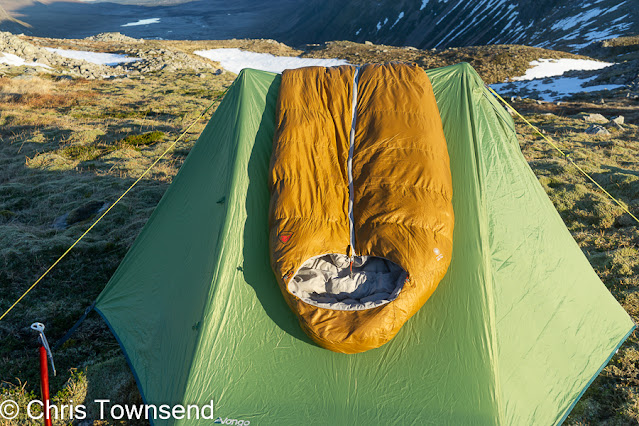

The right size bag should fit reasonably closely while still allowing you freedom to move. Masses of room may be comfortable, but it also means lots of dead air space that has to be heated up and that can feel chilly when you turn over into a patch of it. Close-fitting bags are the most thermally efficient but can feel restrictive. There won’t be room for wearing thick warm clothing in them either – this can be draped over the top if extra warmth is needed.  Many bags come in different sizes and it’s worth seeking out one that fits.

Hoods come in different designs. Ones that can be opened fully are good for warm sleepers, like me, who only use hoods when it’s really, really cold. If you always use a hood then shaped ones that don’t open fully are very snug. With any hood, check you can easily pull it in close around your head without any big gaps appearing as these will let in cold air, and that the drawcords are easy to operate in the dark – it’s not pleasant struggling to open a bag in the dark.

Rather than neck baffles that operate separately from the hood many bags now have baffles, sometimes called neck gaskets or collars, that run round the edge of the hood and pull in round the face and neck. These work well and are easier to use than neck baffles as only one drawcord is required.

Most sleeping bags have full length zips. These need to have thick baffles behind them to prevent cold air entering. Some bags have short zips, which saves weight but makes the bag a little less versatile. It’s even possible to have a bag without a zip, which makes for a light bag with no chance of cold air getting in at the zip but which you can’t unzip if you feel too hot. Side zips are the most common, but central ones make it easier to use your arms while sitting up in the bag.

FILL

Even the best synthetic fills don’t approach down for warmth for weight or low packed bulk. -10°C rated synthetic bags are big and heavy. For backpacking I think down is far better. As well as being much lighter it’s comfortable over a wider temperature range and far longer lasting. It does need to be kept dry but so do synthetics, as sleeping in any wet bag will be very unpleasant in the cold. I’ve used down bags on many winter camping trips, some up to 6 weeks long, and have never got one more than slightly damp. I keep my bag in a stuffsack inside a waterproof liner in the pack and air it whenever possible. 

 
If you’re really concerned about getting your bag wet one with water-resistant down could be worth considering. I think this is more useful for jackets though. Or you could use a bivi bag. I carry one but rarely use it as I find my bag gets damp from condensation inside it.

Down is available in different grades, measured by the fill power, which is the volume that thirty grams of down in a cylinder will fill. The higher the fill power the higher the quality of down and the warmer the bag will be for the same weight of down. There are different machines for testing fill power and these produce slightly different results. Generally American methods produce higher fill power figures for the same down. Rab, for example, says that its top grade down has a European fill power of 750 and an American one of 850.

SHELL FABRICS

Sleeping bag shells are made from windproof, breathable, fast drying fabrics with a light water repellent finish that sheds the odd drip but isn’t waterproof. More water-resistant shells are available, but these aren’t fully waterproof either, as the seams will leak. Bags with waterproof shells with sealed seams are very expensive, and heavier than ones without such shells. I’d rather have a separate bivi bag and only use it when essential.

FINALLY, DO YOU ACTUALLY NEED A WINTER SLEEPING BAG?

Good winter sleeping bags are expensive. There’s not a big market for them and the materials are costly. So, do you really need a bag that’s probably too warm to use at least half the year, the half when you’re likely to spend more time camping? If you camp regularly in winter I’d say having a winter bag is worthwhile but for the occasional winter camper there are other options.

The first is to use two bags, one inside the other. Combine a three- season bag and a summer bag and you have the equivalent of a winter bag plus you can use the bags separately at other times. Two bags generally weigh a little more than one and may not be as comfortable – the inside one can get quite twisted – but the system does work. If you’re worried about damp the outer bag could be a thin synthetic one. A liner bag made of fleece is an alternative but doesn’t add as much warmth and is even more prone to tangling in my experience.

Rather than two bags you could use a bag and a quilt. The latter can be tucked in round the edges of the bag. I haven’t tried this combination, but it should be less prone to tangling than two bags.

 
Next you could plan on wearing warm clothing inside a three-season bag to boost the warmth. Insulated jackets, trousers, and booties can all add many degrees to the rating. The main drawback to this is that if the temperature is exceptionally low you’re already wearing your insulated clothing and might feel chilly when you exit the bag.

A bivi bag also adds a little warmth but as I said earlier condensation can be a problem.


Sunday, 20 February 2022

Contrasts: same place, different days

February 18

February 19

Following my last post here are two selfies. Sums up the conditions on each day!

Today is a mix of thaw, rain, sleet, snow.


Storm & Sun: The first big snow fall of the winter arrives with Storm Eunice and gives two contrasting days.


For once the high winds brought by the latest big storm stayed well south of the Highlands. Up here on its northern edge we had a day of snow - heavy snow, by far the heaviest of the winter so far. It fell steadily hour after hour, plastering the fields and the woods. Out in the big meadows it was almost white-out conditions. In the the forest the trees were hazy and mysterious.

I ventured out into the blizzard. The snow was soft and deeper than I expected and the walking laborious. I should have had my skis or snowshoes. As so often the snow levelled out the bumps and dips, the rocks and rabbit burrows, so they couldn't be seen, but wasn't deep or dense enough to stop your feet finding them. I came close to breaking a leg in a rabbit hole a few times. My local fields had become dangerous terrain!

I returned home via a track with a bit firmer surface. The snow continued to fall. Sometime during the night it ceased. Day came with a clear sky, soon blue and bright. Time for the skis. 


The snow was still soft. I didn't get much glide. But the skis evened out the terrain, sliding over holes and bumps. It was a joy to be on skis for the first time this winter too. The fields felt like vast arctic tundra, so much bigger and wilder than when snowless. In the distance the white Cairngorms rippled.

The sun was warm and I'd soon stripped off gloves and undone jacket. The snow glare and bright sun made dark glasses essential. Under the blue sky the Cromdale Hills looked fine, the horrible scars of muirburn well hidden.

As the afternoon started to fade into dusk thin high clouds increased in the west. Tomorrow is forecast to be stormy again, with high winds, rain, sleet, and snow. But this was a perfect day.