

Familiarity breeds acceptance. At least with cameras and me. They may not work as well as I’d like but I adapt and learn to put up with their idiosyncrasies. Annoyance fades away. This is just how they are. There may be better alternatives but the hassle of a whole new system is just too much so I don’t change.
Then the system is altered and suddenly improves, and I wonder why I didn’t realise how bad the old one was and why it’s taken this long for it to change. That’s happened with the Sony a6700 camera, which I have just bought, having persuaded myself to do so in this post from the 5th August. My reasons for doing so was because it uses the same battery as my Sony a6600 (which I only bought in May this year because my a6000 was failing) and like that camera is weather-sealed and has stabilisation so when I carry both on a long walk (I always take two cameras in case of failure – it has happened) they are interchangeable.
I did note in the August 5 post that the a6700 “has a few advantages over the a6600 - the controls look easier to use, the screen flips out to the side, the eye tracking focus sounds astonishing - but nothing like those of the latter over the a6000”. I was completely wrong. The advantages over the a6600 are vastly greater than the latter over the a6000, so great in fact that they’ve opened my eyes to how poor much of the design of the a6000 and a6600 actually is.
The a6000 dates from 2014. I bought mine in 2016 to go with the Sony NEX 7 I bought in 2012 (NEX being the original name of Sony’s APS-C camera line) as both had the same 24mp sensors and I wanted to use them on a long walk with different lenses on each without the image quality being different. I really like the NEX 7 and think its controls are better than the very similar ones on the a6000 and a6600 (though nowhere near as good as the a6700). The menu system is also better than those of the later a6000 series cameras though still clumsy and not very intuitive.
I stuck with the NEX/a6000 cameras because I became familiar with them and found them reliable if somewhat quirky and awkward. I started with them when mirrorless cameras were new and there were only a few models. Of those I thought the NEX 5 the best, as explained in this post, so I bought it. I then started buying lenses and learning how the system worked. I had and have no intention of changing. Once I had the NEX 5 I never considered any other range. I’d found a system that worked for me and that was fine.
 |
| Menus: a6700 left, a6600 right |
Until the a6700. Now I wonder how I put up with the earlier cameras! The a6700 has much better controls (even better than the NEX 7) and a much easier to use and more intuitive menu system. It’s been easy to set it up so I can access everything I want very quickly. I admit that a touchscreen, which wasn’t around for the NEX and a6000, also makes a difference (the a6600 has one that doesn’t do much), but it’s the overall layout of the menus that’s the real improvement.
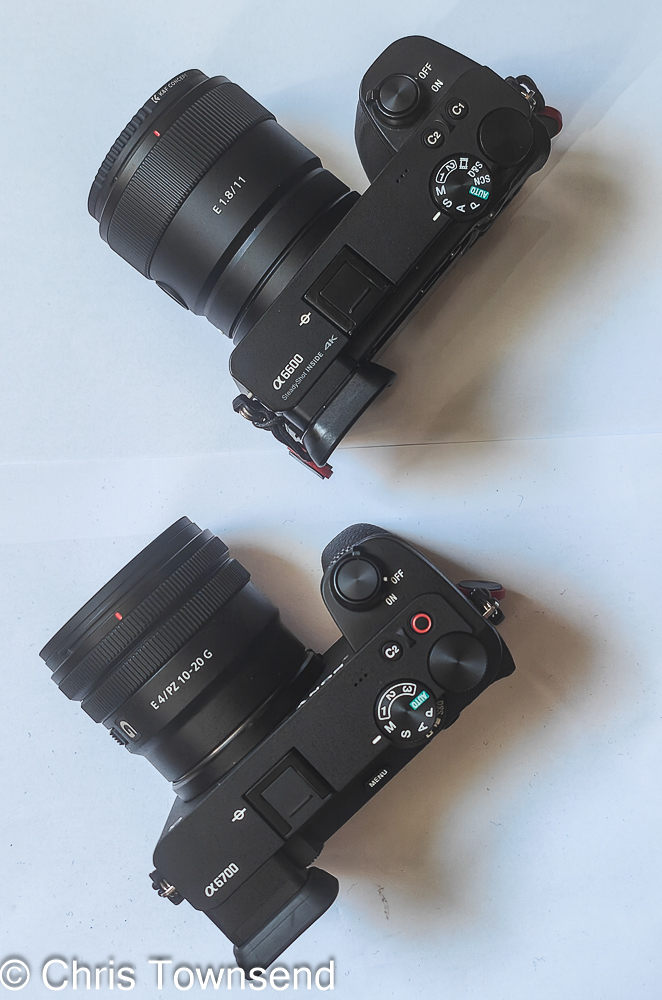 |
| Top plates: a6600 top, a6700 bottom |
With the controls it’s the addition of a scroll wheel in front of the on/off switch that I really like. I can alter aperture and shutter speed easily with this and the top dial without taking my eye from the viewfinder. A simple positive change is the movement of the video button from the side to the top of the camera, where it can’t be inadvertently switched on, as it can with the NEX and earlier a6000 cameras. Not a big deal but part of the overall improvement in design.
 |
| Great spotted woodpecker. Sony a 6700, Sony E 70-350 lens, f8 at 1/400, ISO 500. Cropped |
I don’t know yet if the recognition auto-focus is better than on the a6600. It’s certainly easier to use and has many more options – seven instead of two, including insects, which I almost certainly will use, and cars, trains, and planes, which I probably won’t.
 |
| Screens: a6700 top, a6600 bottom |
The screen is another big improvement. On the NEX 7 and the a6000 it just angles up and down. On the a6600 it can be flipped up so you can see yourself for selfies and videos. On the a6700 it can be opened to the side and angled up and down and front and back facing. It’s bigger and brighter too.
I am delighted with the a6700. It is so easy to use compared with the earlier cameras. But why has it taken Sony so long to do this? And why have I put up with the earlier designs?
The answer to the last is because I didn’t know any better and realising this started me thinking about the difference between being a reviewer and a user. I’ve been testing hiking and backpacking gear for over forty years. When I try a new item I can compare it to alternatives old and new. I know which features work well and I know which features I like (they’re not necessarily the same). I can see how well an item fits into the whole range of similar products. I can’t do that with cameras. I’m a user not a reviewer. I’ve never used a mirrorless camera not in the Sony APS-C line. I don’t know how much better other brands may be, if at all. I’m not in a position to try many different cameras to see which one works best for me (and I mean really try them not just play with them briefly in a store). Maybe if I was I’d have changed from Sony long ago. As it is I’m glad Sony has changed. I haven’t felt as excited about a camera since the NEX 7.
I rely on reviewers who know camera gear like I know backpacking gear. But I only read reviews of Sony APS-C cameras and compatible lenses in detail. The rest I just glance at. I have no idea how other brands compare. It doesn’t mean the camera reviews aren’t important though. They’re the reason I never considered the a6100, a6300, a6400 or a6500 cameras – none seemed to offer any significant advantage over the a6000 – and only considered the a6600 when the a6000 began to fail. Lenses were a different matter and good reports by reviewers I trust has convinced me to buy several of them, and they’ve all been worthwhile purchases.
The reasons I decided on the a6700 – the battery compatibility with the a6600, the weather-sealing, the stabilisation – are still important but they’re overshadowed by the changes to the menus and the controls.
 |
| Rainbow at dusk. Sony a6700, Sony E 18-135 at 37mm, F8 at 1/25, ISO 100 |
You may have noticed I haven’t mentioned image quality once. That’s because I doubt it will be much different to the a6600 or the a6000 or even the NEX 7. The a6700 does have a 26mp sensor rather than the 24mp one of the other three cameras but I don’t expect that to make a significant difference. So far I’ve only taken 30 photos and haven’t yet done a direct comparison using the same lens and settings. Maybe low light high ISO performance will be a little better, but I think the improvements in processing software, especially DxO PhotoLab, are far more significant. And of course lenses matter too when it comes to image quality.


