
Monday, 13 June 2022

Sunday, 12 June 2022
Forty Years Ago On The Pacific Crest Trail: The Thaw Starts
 |
| The Tuolumne River |
On the 12th June 1982 I arrived in Tuolumne Meadows after a 29 day crossing of the snowbound High Sierra. The first 23 days had taken me and my three companions to Mammoth Lakes, where we sent home our snowshoes, skis and crampons as the snow was softening and the spring thaw starting. After two days in Mammoth Lakes, mostly spent eating, we spent four days walking to Tuolumne Meadows and encountered a taste of what was to come with a thigh-deep ford of Rush Creek.
 |
| Soft snow between Reds Meadow and Tuolumne Meadows |
At Tuolumne Meadows we found the store had opened two days previously. As no-one in Mammoth Lakes was sure when it would open we'd left with 17 days food so our packs were still heavy despite ditching the snow and ice gear. I was shocked on weighing mine at a store - 92lbs/42kg! How I carried it I now have no idea. It had weighed even more for the 23 days to Mammoth Lakes.
 |
| Lembert Dome & the Tuolumne River |
Crossing the High Sierra to Mammoth Lakes had been an exciting big adventure. I'd never done anything like it before. Now, I thought, I could start to relax and return to trail hiking. In fact the most dangerous part of the whole walk was about to start.
I'll tell some tales of the next section soon. The full story is told in my book.

Saturday, 11 June 2022
A Look At The July Issue Of The Great Outdoors

The June issue of The Great Outdoors is out now. My contribution is a trip and gear report of a two-day venture in the Cairngorms where the weather was windier than expected, much windier.
Also in the gear section David Lintern reviews five big family/group tents, and Alex Roddie tries five specialist dehydrated backpacking meals. On the subject of food there's also a piece by Lucy Wallace on nutrition for successful days on the hill.
In the main features Carey Davies undertakes the Lochaber Traverse in glorious weather; Iona Andean chats to some members of her Edinburgh-based walking group; Norman Hadley has a 'nano-adventure' on the Wasdale fells with his no-rucksack overnight running kit; and Jenny Tough describes how she fastpacked across six mountain ranges on six continents
The issue opens with a magnificent evening image of the Torridon hills from Beinn Alligin by James Roddie.
Elswehere in the magazine the Creator of the Month is Abbie Barnes for her Spend More Time In The Wild YouTube channel. Route of the Month is the Ben Lawers group, described by Stefan Durkacz. Hanna Lindon looks at the rebirth of England's right to roam movement. Naturalist and presenter Lucy Lapwing talks about the concerns of women when alone in the outdoors. Ecologist Lee Schofield, author of Wild Fell, talks to Hanna Lindon about how the Lake District could have much richer biodiversity. Jen Benson describes how she and her family spent a year on the road living in a bell tent, a story told in full in her book The Wild Year. Jim Perrin's Mountain Portrait covers Moel Famau and the Clwydian Hills.
In Wild Walks Stefan Durkacz does a round of the Ochil Hills; Vivienne Crow avoids the crowds on Great Dodd and Clough Head in the Lake District; Roger Butler walks round Monk's Dale and Chee Dale in the Peak District; James Forrest scrambles along the Snowdon Horseshoe; and Fiona Barltrop walks round the Rame Peninsula in Cornwall.

Monday, 6 June 2022
Glorious Days In The Cairngorms
 |
| Early morning light on Carn Etchachan & the Shelter Stone Crag |
Early June has seen glorious weather in the Cairngorms with bright sunshine, clear skies and sharp views, a north-east breeze keeping away the haze that often bedevils fine summer weather. With four days on trains and in exhibition halls coming up I decided a few days of high camps and high summits was called for, not that I ever need an excuse to head for the hills.
 |
| Evening view over the Allt a 'Choire Dheirg gorge |
I crossed the long north ridge of Cairn Gorm early in the evening as the sun started to turn the rocks red and gold. Strath Nethy was wet and boggy, as usual. On the ascent of Bynack Beg the ravine of the Allt a ’Choire Dheirg looked wild and rugged, its details picked out by the low sun. The north side of Cairn Gorm was already in shadow.
 |
| After sunset |
Higher up I camped near the stream where the land flattened out. Bynack More rose above, a black wedge against the darkening sky. Later in the evening I wandered outside, lured from my sleeping bag by searing red after-sunset colour in the sky to the north. A crescent moon hung in the sky. At 11pm it wasn’t fully dark and I had no need of a headtorch. The long days of summer in the Highlands. I never tire of them. Every year it’s magical.
 |
| A sliver of moon |
The night was chilly with a frost. My summer sleeping bag was barely adequate and I was soon sleeping fully clothed. The late night and waking several times to add clothing meant I missed the dawn. I was in the shadow of Bynack More too and it was some time before the sun started to dry the tent and warm up camp. By then I was up and had climbed Bynack More to gaze at the Cairngorms coming to life in the sunshine.
 |
| Loch Avon |
Heading into the heart of the hills I crossed the rounded mossy bump of A’ Choinneach, a Munro in the original Tables but long since demoted to a Top of Bynack More, then descended its rockier south-west ridge, which gives superb views along Loch Avon to the great cliffs at its head, to The Saddle, the col between Strath Nethy and Loch Avon. I descended to the loch and followed the path along the north side, a path that always seems rougher, rockier, and muddier than I remember. The magnificent cliffs rising ahead pulled me on. I was tired though, the broken sleep of the previous night along with the hot sun having a lethargic effect.
Finding the area beyond the head of the loch deserted – surprising on a bank holiday with superb weather – I decided to camp. This is one of my favourite places in the Cairngorms. Passing by in such glorious weather was not to be considered, especially in such glorious weather.
 |
| View from the tent |
The rising sun woke me, shining straight down the glen and into the tent. The huge cliffs of Carn Etchachan and the Shelter Stone Crag were magnificently golden. A dawn of brilliance and intensity.
I lingered long watching the mountains and the roaring white waters of the streams crashing down broken slabs and rocks from the Cairngorm Plateau high above. As the sun rose rapidly into the sky and the light turned less intense, though the sharp views were still superb, I finally left on the path up to Loch Etchachan and onto Ben Macdui. Many streams were rushing with snowmelt from the remnant snow patches high above and the ground was sodden around the loch. Buttercups lined the many overflow streams and springs, glowing yellow.
 |
| Loch Etchachan |
Higher up the ground was stony and pale with the almost desert-like look the Cairngorm Plateau has under a hot summer sun. Coarse granite gravel rolled under my trail shoes. A few people were about. I had expected far more. Ben Macdui came and went, the views across the Lairig Ghru as splendid as ever, and it was across the Plateau to Cairn Gorm. The shallow corries above the hidden Loch Avon basin were alive with countless shimmering streams.
 |
| Coire Domhain |
A long descent down Coire na Ciste and I was back at the car. The weather had been wonderful, the trip had been wonderful. Familiar hills, familiar places, but always different, always with something to offer.

Thursday, 2 June 2022
Scottish Wild Land Group 40th Anniversary

This issue contains the background and main findings of a new and important report – The State of Wild Land in the Scottish Highlands – that’s been prepared for the Scottish Wild Land Group in association with the Scottish Mountaineering Trust and the Cairngorms Campaign.
The full report can be downloaded from the News page on the SWLG website, where it was published in February. There is much detail and many visuals in the 140 pages, and I haven’t finished taking it all in yet. Suffice to say that this is a sobering analysis that shows that wild land is being steadily diminished.
The SWLG is Scotland’s oldest and only volunteer-run wild land charity. That it’s still going after forty years deserves praise and is also sad. Such a group shouldn’t be needed. Let’s hope it isn’t for too much longer.
Tuesday, 31 May 2022
Book Review: The Munros A History by Andrew Dempster.
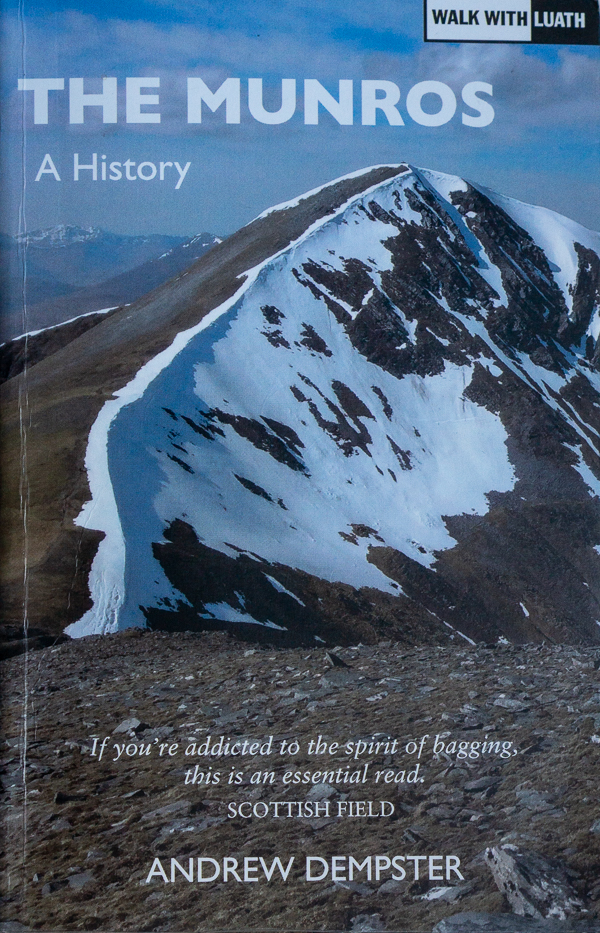
Last year the follow-up to The Munro Phenomenon was published and The Munros A History is just as fascinating as the original book. In the twenty-six years since 1995 much has changed, including the numbers who’ve completed the Munros, up from a little over 1,000 to around 7,000. The Scottish Parliament has come into being, the first National Parks in Scotland have been created, there are legal access rights, hills lists have been updated and new ones produced, Munro records have been broken, there’s now a Munro Society.
Andrew Dempster includes all this and more in The Munros A History. It’s not an update of The Munro Phenomenon but a new book that goes far more deeply into the whole subject. The history of the lists (Munro’s was not the first), the first Munroists (I’m pleased to see so much attention given to the Rev ARG Burn, the first to complete the Munros and Tops), the post-war surge in Munro bagging, and continuous rounds and records (I’m mentioned here) are all covered. There’s also a look at the mass of Munro baggers who don’t do continuous rounds or run round the hills in record times with a consideration of why they do it.
Readers will also learn about the early map-makers, the first tourists, the 1930s working class outdoor revolution, the topography and topology of the Munros, and other hill lists like the Corbetts. The author, a two-time Munroist himself, describes some his favourite Munros in a chapter that really shows his deep love and attachment to the hills. A final chapter covers the crucial issues of conservation, re-wilding, and well-being.
I think this is a marvellous book (and not just because I have brief mention!). It contains a huge amount of research presented in an entertaining and readable style. The author isn’t afraid to give his own opinions either, which I always like even if I don’t necessarily agree with them. Whilst those who have climbed or are climbing the Munros are the obvious audience it should appeal to anyone interested in the Scottish hills and hillwalking. Highly recommended.
The Munros A History is published by Luath Press at £11.99 .
Friday, 27 May 2022
Storms & Rainbows: A Walk Over Meall a' Bhuachaille

May has been a stormy month with high winds, cloudy skies and rain. Sunshine has been rare. I had planned a long walk, two weeks or more, in the Cairngorms, as part of immersing myself in the right frame of mind for writing a book about the area. I was almost ready to set off when an appointment suddenly appeared. As I’d been waiting well over a year for this I wasn’t going to turn it down. The long walk would have to wait. Instead I headed out for three days, as described in this post, with the intention of starting the walk later in the month, after the appointment. I also thought I’d wait for a change in the weather. I’m still waiting.
No long walk doesn’t mean no walks of course and I have been ambling round the local area, admiring the lushness of early summer, the brilliant green of new leaves, the spreading wild flowers. Nature doesn’t mind the wind and rain. A few days ago, wanting to stretch my legs a bit more, I went on a favourite short hill walk – Meall a’Bhuachaille. The forecast suggested, as so often this month, high winds and low cloud on the highest summits. On Meall a’Bhuachaille I’d be some 400 metres lower and wouldn’t be up high very long anyway so I hoped conditions wouldn’t be too severe. I went in the late afternoon too, as the weather was supposed to improve then. I do love the long hours of daylight at this time of year.

Rain was falling lightly as I set off through the forest to Ryvoan Pass and An Lochan Uaine – the Green Loachan. I could hear the wind in the treetops. The wind-rippled lochan was green, blue and white, reflecting the trees, sky and clouds.
As the path led up out of the trees the rain grew heavier and the wind stronger. By the time I reached little Ryvoan Bothy the storm was fierce and I decided some shelter would be welcome. Inside a figure in a sleeping bag greeted me. From Germany, he told me he’d been coming to the Highlands for two weeks walking in May for many years. This year, the pandemic having prevented him visiting since 2019, he’d decided to be ambitious and walk the Cape Wrath Trail. The weather had been appalling though and after several days he’d abandoned the walk and headed east. “This is my holiday after all!”. Now he was wandering through the Cairngorms from bothy to bothy, mostly staying low because of the weather.

Outside the rain turned to hail, a deafening roar hammering on the bothy roof. I wondered about continuing. Soon it eased though and there was a touch of sunshine. Meall a’Bhuachaille beckoned. During the ascent I turned and looked back frequently to see rainbows curving over the wet hills.

The sun was suddenly blindingly in my eyes. I hadn’t expected to need sunglasses. Not for long, the sky soon darkening again. Across Glenmore Forest the high Cairngorms were briefly out of the clouds.

The first drops of rain fell. I raced the storm to the summit and lost, of course. The wind up here was strong, the rain hard. I didn’t linger but was soon heading down, the rain keeping me company all the way back to the car.
In ten days I’m going south to spend three days wandering round bright halls packed with outdoor gear at a trade show. I expect the weather will be lovely.
Next month the long walk.