Showing posts with label wildlife. Show all posts

Saturday, 4 May 2024

Deer Drama: A Joust In The Fields

Approach and retreat

Roe deer are a common sight in the fields in front of our house. Sometimes they wander into the garden. Usually they just amble around browsing, entering and leaving the garden with a graceful flowing curve over the fence. Lovely to see but nothing dramatic. That changed yesterday. A pair have been visiting the garden quite often recently. Yesterday a second buck appeared. The first buck chased it out in the field where they stopped and faced each other.

Clash!

A tense battle then ensued. The two bucks faced each other, often lowering their heads, and several times charged and locked antlers. Slowly one backed away, losing a little ground with each tussle. Eventually they moved out of sight.

Standoff

We watched all this through the kitchen window, a privilege of living here. Then I went up to my study for a better view as they moved further away and took some photos through the window.

We’d never seen this exciting and dramatic behaviour before. Hopefully neither of the bucks was seriously injured.

Photo note: I took the photos through my closed study window with the Sony 70-350mm lens at 350mm (equivalent to 525mm full frame). I was shooting handheld but as the day was quite bright I didn’t have to up the ISO much to keep a high shutter speed. Settings were ISO 400 and 1/1600 second at f6.3. I cropped the photos as the deer were far enough away that they were still small in the pictures. The raw images were processed in DXO PhotoLab 7

Uncropped image


Thursday, 29 February 2024

Badger Tracking Success!


Wandering across the snow-covered fields near our house a few weeks ago we came across some tracks. Consulting identification books back home we reckoned they were made by a badger. We followed the tracks across the field until they faded away where the snow was sparse near a fenced spruce plantation. There was no way a badger could get through the mesh of the fence, but the tracks led towards a hole in the wire that was big enough. Maybe the badger went into the wood here? And if so, maybe badgers did so regularly. Hazel suggested putting my trail camera in the wood pointing at the hole in the fence to find out.

Crawling through the spiky, densely packed trees was not easy but I managed to fix the trail cam round a tree trunk. Several days later we retrieved it and were disappointed. No badgers. Or maybe there was. One very blurred image suggested something had gone right up to the camera. Hazel reckoned it was a badger.

We tried again. This time Hazel set the camera up and did a better job than me as it was lower down and angled to cover a fair amount of the ground. The images from my placement had shown the fence and tree branches clearly but not much ground. Another week or so and we went back to get the camera, hoping this time we’d see something.


Success! There was a badger. Or possibly a few as one appeared in nine images over four days. We were delighted! Very simple tracking but it was pleasing to know we were right. And that there were badgers.


There was also another blurred image that looked like the badger’s head was right up against the camera. The following pictures were at an angle. The camera had been knocked out of position. 


Then, after some more badger pictures, there was another very, very  blurred image, possibly showing fur. After that there were no more badgers as the camera  was now pointing up into the branches and over the fence, too high to capture any animals on the ground though there was a shot of me approaching the fence.


We’ve know for years there were badgers in the area and had seen them very occasionally so their presence wasn’t a surprise. Following the track and then confirming where they entered the wood was interesting and satisfying though. It was also interesting that they seemed to be curious about the camera and investigated it closely enough to knock it out of position more than once.

The trail cam is somewhere else now. We’re excited to know what it will reveal.

Friday, 26 November 2021

Wildcats in the garden?


There was great excitement in early November when the trail cam in the garden captured the above image in our garden. Could this be a wildcat? I posted the image on social media and was contacted by Saving Wildcats who wanted to know more. Since then I've been in touch with Jamie Sneddon, the Saving Wildcats Project Officer. I told him that we have woods on three sides of the house and feed birds, red squirrels, and rabbits in the garden. He was particularly interested in the rabbits. "Rabbits usually equal cats". 

Twelve days later the trail cam captured more cat images. I sent these to Jamie who reckons it's a different cat - "if you have rabbits you’re likely to have multiple cats" - and definitely a hybrid wildcat/domestic cat. 


I then moved the trail cam to see if I could get any larger pictures. I didn't but I did get cats on more nights, three in succession. 


I'm very interested to see what Jamie Sneddon makes of these. And what the trail cam picks up next.

Friday, 9 July 2021

Roe Deer in the rain


The last few days the weather has been, frankly, dismal. Low cloud, drizzle and rain, no wind. The hills are hidden, the woods and meadows damp and dripping. Walks need to be brisk with few stops to look at flowers or wildlife as any pause or slowness brings out midges. Oh for a breeze or a gale to blow them away along with the clouds!

The best place to observe nature has been from inside the house and I've spent probably too much time (I do have books to write) watching birds, squirrels, rabbits, and, today, a roe deer in the garden. This doe has been around a few times today, wandering around grazing in the rain. She's a beautiful animal with a sleek coat the same colour as that of the red squirrels and that combination of delicacy and strength that typifies roe deer with her slim but powerful legs and long neck. 

The photos were all taken from my study window with my old Sony NEX 7 camera and new Sony 70-350mm lens. Given that they're taken through glass that I must admit isn't as clean as it could be I'm quite pleased with the results. Below is a crop from the top picture.

I'm checking the forecasts every day waiting to get back to the hills when I can see something (and take some needed photographs for a book) but until that happens I am enjoying the garden wildlife. Standing looking out of the window doesn't constitute exercise or work though. I really ought to be at the PC or out for a walk!


Wednesday, 24 March 2021

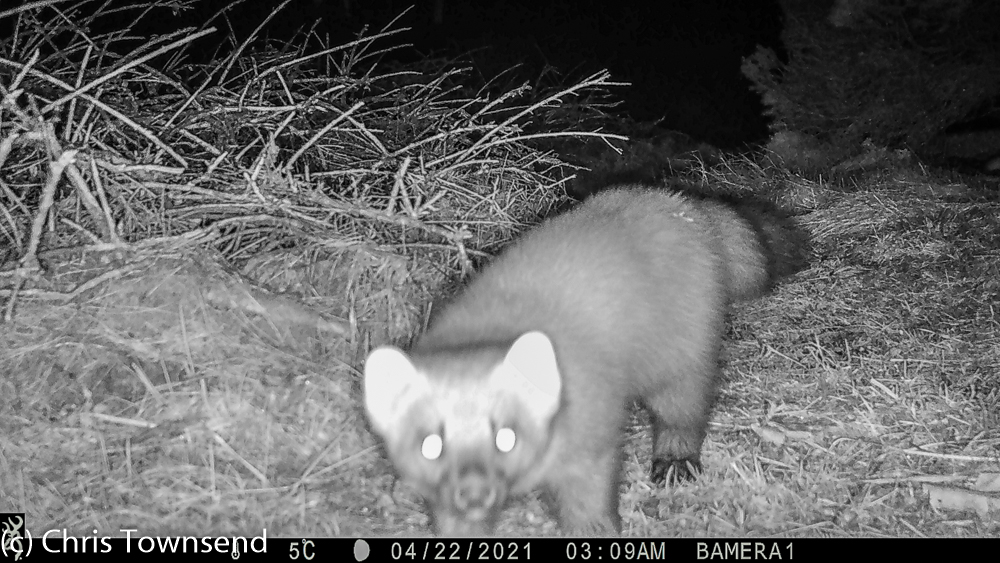
First camera trap wildlife: a pine marten.


Having seen an increasing number of camera trap wildlife images online in recent years I decided to try this myself and ordered a trail cam. It arrived a few days ago and I set up in the garden and left it overnight as a test. The first morning revealed a good shot of the first chaffinch arriving on a bird feeder and something very blurred at the edge of some bushes. At least it was working.

The second night I was surprised and delighted to see the above image of a pine marten having a good look at the trail cam. This was exciting!

We had seen a pine marten in the garden once, quite a few years ago, and occasionally seen droppings, so kew they were around. I suspected they were rare visitors to the garden though and if I did get a picture of one it might take weeks or months. To get one so quickly suggests that they might visit quite often. This one is only a few feet from the house too.

My plan had been to see what a few nights in the garden captured and then move the camera into nearby woods. I'm going to keep it in the garden a bit longer now. I want to see if a pine marten comes round again. I'll try video soon too.

For those interested I bought my trail cam from NatureSpy, which I found via a web search. Knowing nothing about these cameras I used the camera chooser on the site, looked at ones that had good image quality, read a few reviews, and selected the Browning Recon Force Elite HP4. It proved easy to set up (though I got the date wrong at first, as you can see in the image) and comes with a wide locking strap to attach it to posts and tree trunks.

Thursday, 13 August 2020

Save Beavers In Scotland - Please Sign The Petition

Image from @scotlandtbp (c)

The return of beavers to Scotland has been of the great conservation stories of recent years (and we really need positive stories). They are now a protected species, as they should be. However, despite this, last year one in five Scottish beavers were killed.

As well as being beautiful animals in their own right beavers create habitats, boost biodiversity, and help prevent floods. They are becoming a tourist attraction too. I haven't seen beavers in Scotland myself yet, though I have been to one of their habitats and seen gnawed tree stumps, but I have watched them in North America and Scandinavia. I've marvelled at their dams and the series of ponds they create, which support a wealth of wildlife, regulate water flow, and improve water quality.

Beavers cause few problems but they can damage crops, which leads some farmers to kill them. Until beavers received legal protection last year farmers could do this as they wished. That protection isn't complete however and licences to kill beavers can be obtained from Scottish Natural Heritage. 87 were shot in the last year.

Rather than shooting beavers they should be relocated. There are many suitable areas in Scotland. I'd love to see them here in Strathspey. However the Scottish Government does not permit this.

Trees for Life and the Scottish Rewilding Alliance have started a petition calling on the Scottish Government to allow the relocation of beavers. At the time of writing this has 7,593 signatures. Many more are needed. Please sign if you care about wildlife. Beavers could have a great future in Scotland.


Thursday, 16 January 2020

The need to reduce deer numbers in Scotland


Deer are not the problem. We are the problem.

That deer numbers in the Scottish hills are far too high to allow forest regeneration has been known for many decades. The extermination of predators followed by the rise of deer stalking as a leisure pursuit of the wealthy are the causes. Stalking estates require large numbers of deer for their clients. With no predators other than humans it’s up to us to control the deer population. And we’ve failed, with numbers of red deer rising steadily from an estimated 150,000 in 1959 to 400,000 today. In 1955 in his  West Highland Survey the great naturalist Frank Fraser Darling, then official adviser to the Deer Commission, wrote that the optimum number might be 64,000. In the same book he also wrote “The bald unpalatable fact is emphasized that the Highlands and Islands are largely a devastated terrain, and that any policy which ignores this fact cannot hope to achieve rehabilitation.” 


Overgrazing by red deer is one of the main causes, perhaps the main cause, of this.
Deer didn’t destroy the forests. We did that. But deer are preventing their return because of their numbers. This is no fault of the deer. Red deer are magnificent animals. I love seeing them. But I don’t love seeing the devasted land they create. In Scotland red deer are creatures of the open hills and empty glens, but only because the forests where they would naturally live have gone. A balance is needed. Deer and forests. Deer in forests. There’s currently only one way to achieve this, sadly. Kill more deer. Fencing out deer can let some areas regenerate but not that many. Squeezing the deer into smaller and smaller areas that become increasingly damaged cannot be the answer. Fences are expensive, unsightly, a barrier to access, and damaging to wildlife and habitats. Reintroducing wolves would be the ideal solution but I can’t see this happening for many years. In the meantime it’s up to us. I strongly dislike the idea of shooting deer but I can see no other answer.


This issue has come to the fore now because of a report, Managing Deer for Climate, Communities and Conservation, compiled by eighteen conservation and recreation organisations* and published by Scottish Environment LINK that calls for major changes to the way deer are managed. The report gives ten reasons why change is needed. Apart from more trees these include healthier peatlands (trampling and grazing dry the peat), more rural jobs (landowning environmental NGOs employ five times more FTE staff per square kilometre than the commercial deer stalking estate), fewer ticks (it’s highly likely the rise in tick numbers is connected to the rise in deer numbers), and a cut in greenhouse gases (a 20 per cent reduction in deer numbers would save the carbon equivalent of around 15 million car miles on Scotland’s roads each year).

*Badenoch & Strathspey Conservation Group, Butterfly Conservation Scotland, Cairngorms Campaign, Froglife, John Muir Trust, National Trust for Scotland, Nourish Scotland, Ramblers Scotland, RSPB Scotland, Scottish Badgers, Scottish Raptor Study Group, Scottish Wild Land Group, Scottish Wildlife Trust, Trees for Life, Woodland Trust Scotland. Plus support from non Link members Forest Policy Group, North Harris Trust, Reforesting Scotland.

I’m a member of seven of these groups, and a Trustee of the John Muir Trust.

Friday, 10 January 2020

A New Year, A New Decade: the challenge for nature

A few trees cling to the sides of a burn, out of reach of deer. There should be a forest here.

Last year saw a sudden upsurge in concern about the intertwined problems of climate change and wildlife extinction. This is heartening but only if it leads to action. Nature is being depleted rapidly world wide. Here in Britain each State of Nature report shows a steadily worsening situation, one that has been going on for many decades. Something has to be done and we should all be involved.

I've written many pieces on conservation and rewilding over the years (links here). I think I should write more. I'll also continue to support many organisations doing what they can (another list here) and write letters and emails to politicians and businesses. It's not much but if everyone does a little ...

I'm reading Mark Cocker's excellent but rather discouraging Our Place: Can We Save Britain's Wildlife Before It Is Too Late? In it the author tells the story of nature and landscape conservation since it began in the nineteenth century. All those organisations, all those dedicated people, all those government bodies, reports, councils, acts of Parliament. And still nature declines. Was it all for nothing? Surely not, surely, sadly, it would be even worse without all that work. But clearly it was not enough.

The reasons why this is so are complex. But I think in part it lies in duplication, in the plethora of organisations and designations. And also in what Mark Cocker calls the 'great divide' between landscape protection and wildlife conservation. A healthy environment needs both. Simplifying appoaches and goals, working together on big landscape and wildlife projects, involving local people, avoiding mystification. These are all needed. And they are starting to happen. There are great opportunities.

The 2020s are before us. Let's work to make the world a better place for nature, which means a better place for us.

Saturday, 14 December 2019

Recent Reading Online No.13

River Spey, December 13

Here's what I've enjoyed reading online recently.

Let Loose The Lynx!
We should reintroduce the lynx, says science writer Tom Chivers, and "if lynx work out, wolves. And then, maybe, if wolves work out, one day we could be really brave, and reintroduce bears."

L2H day 0-1: full moon in Aries
First of Carrot Quin's accounts of a hike from the lowest point in the contiguous USA in Death Valley to the highest, Mount Whitney. A walk I did in reverse a few years ago.

The Wisdom of Bears and the Perfidy of Bureaucracy
Review of an interesting-sounding book on bears, One of Us by Barrie K. Gilbert, by bear biologist Stephen F. Stringham.

What can Scotland learn from Australia's national parks?
Thoughts from Nick Kempe of Parkswatch Scotland on what can be learned from Australia.

A pillaged ecology in the Scottish Highlands: 'I am angry beyond words'
Alex Roddie receives an email from an environmental consultant about the "habitat degradation that is leading to vast negative changes in ecosystems, biodiversity loss on an indefinable scale."

Grouse moors, tracks and the protection of peat bogs - Banchor again!
Back in Scotland Nick Kempe considers grouse moors and bulldozed tracks, with one of the latter in the Monadhliath as an example.

The future of skiing in the Alps? Rainer Pfluger and Ali Knappe, Innsbruck
Rosie Watson talks about sustainable skiing with two outdoor activists in the Alps.

Refilling the Carbon Sink
Sharon Levy looks at the restoration of Scotland's bogs. Lovely photos by Peter Cairns.

Escape Back to Reality. Is the outdoor community hostile to minorities?
Controversial and thought-provoking opinion from Andy Kirkpatrick.

The race to lay claim on the Bering Strait as Arctic ice retreats 
On a journey through the Northwest Passage Kieran Mulvaney looks at the history of this much sought after passage and the competition for it now climate change has made it more accessible.


Sunday, 8 December 2019

'Untold Suffering' a disturbing report by OneKind and the League Against Cruel Sports Scotland (LACSS) as part of the REVIVE coalition


That maintaining driven grouse moors involves killing predators (and other creatures by accident) isn't news. However this new report reveals the vast numbers slaughtered in cruel and inhumane ways. It's depressing reading but the shameful reality needs to be known. Spring traps, crow traps, and snares are all used regularly. As well as targeted species they can catch other species too - the report mentions cats, dogs, raptors and badgers and shows pictures of a hedgehog and a pine marten caught in spring traps.

The Untold Suffering report has many grim case studies and discusses why current welfare regulations don't work. The report also calls on the Scottish government to take action and has these recommendations:

An independent review of the welfare implications of all traps, conducted by animal
welfare scientists

A ban on snares, stink pits, Larsen traps, the use of decoy birds and mountain hare culls.
Driven grouse shooting should end.
 

A system of mandatory proficiency tests and licences for all shooters
 

All wildlife management carried out in Scotland to conform to the Seven Principles for
Ethical Wildlife Control


This is an important report. That thousands of wild animals suffer in this way is a disgrace. Change is needed now.

Friday, 27 September 2019

Wildlife in the Colorado Rockies


Encountering wildlife is always one of the joys of any walk. This summer's walk in the Colorado Rockies was exceptional for the amount of wildlife, large and small. Few days went by without my seeing many birds and animals plus signs of more. As well as being a pleasure in itself the variety and quantity of wildlife suggested a healthy and flourishing environment. I contrasted this with the Scottish Highlands, where, sadly, I generally see far fewer numbers of fewer species.


The land was often alive with crickets chirping. There were many other insects too, including a wealth of butterflies, especially these orange ones, which I saw every day. They're fritillaries but I'm not sure which species.


Another common creature was the beaver, though I only caught one glimpse of an actual animal. I did see many beaver dams, often in series and filling a whole valley.


In the forests I saw squirrels, chipmunks and gray jays regularly and they often seemed quite unafraid. Taking photos of these lively, constantly moving creatures wasn't easy though. Walking and staying in one place waiting patiently don't go together.


Above the trees marmots and pikas (a small animal related to rabbits) proved equally difficult to photograph, both whistling loudly at my approach and diving for cover into the rocks where they live, the pikas often with mouths full of vegetation for lining the dens where they'll spend the winter. I did get this one picture of a pika that hadn't noticed me passing by.


In the forest there were many small birds, most of which I didn't identify, and high above there were eagles and hawks. On the tundra ptarmigan reminded me of home in the Cairngorms.

Of the larger mammals I saw many signs of black bears, including fresh droppings on the trail, and I'm sure some bears must have seen me. They kept out of sight though.


I only caught glimpses of elk too and only once had a good view of mule deer, from near the camp I had with Andrew Terrill.


I did though have a splendid view of two bull moose and was able to watch them for quite a while. This came about due to a thunderstorm! I was on the edge of a big meadow and wondering whether to venture out into the open when there was a flash of lightning right in front of me followed almost instantly by a tremendous crack of thunder. I was staying in the trees. Indeed, I felt I'd be safer deeper in the forest. Below the trail I could see a dense clump of small subalpine fir that looked a secure shelter. I descended steep slopes and crawled in between the trees. A movement caught my eye and there, not far away, was a moose looking in my direction. I stayed quiet and still and the animal soon went back to browsing the grass. I'd found a natural hide. Soon afterwards a second bull joined it and for half an hour I forgot the thunderstorm and just watched these magnificent animals. Then their heads went up and they were running off into the trees. A hiker passed along the trail above. The storm over I followed.


Also fortuitous was my only sighting of a porcupine. I'd crossed a creek, heading for a spur that looked like it might provide a good camp site. Realising the spot was a bit further away than I'd at first thought I decided I'd better pick up some water now rather than come back for it. I dropped my pack and wandered back to the creek. There on the trail was a porcupine. It looked at me, turned away, spines bristling, and ambled off along the trail.


The final big mammals I saw were some female rocky mountain sheep. Crossing a steep rocky slope I first noticed movement above me and looked up to see a flock high above. I watched them for a while then continued along the trail as it ran over a slight rise. As I reached the top of this another half dozen sheep scattered right in front of me before regrouping and heading up to join the others.

Photographic Note:

I'm not a wildlife photographer. I have few wildlife photos from other walks because I generally didn't have a telephoto lens on my camera or even with me. I never approach a creature to get a photo in case I disturb it so usually animals are too far away for a worthwhile picture. On some walks I have carried a telephoto zoom lens but as this isn't usually on the camera I never used it much. Last year on the GR5 Through the Alps I didn't take it. I saw much wildlife and was frustrated I couldn't get many pictures. That's one reason that earlier this year I bought (second-hand) a Sony E 18-135mm zoom to use as my standard lens. Reviews suggested this was at least as good as the 16-50mm lens that's been my most-used for many years (some suggested the 18-135 was actually much better). With a reach of just over 200mm (35mm/full frame equivalent) this wide angle to telephoto zoom looked ideal for long walks and so it proved, for landscape shots as well as wildlife. I wouldn't have got most of the pictures above without it.

Saturday, 27 July 2019

Wildlife is wildlife, never 'vermin'


The indefatigable conservation campaigner Chris Packham has written an excellent piece on Vermin. He's also offering a t-shirt design. I might well get one made as this is something I feel very strongly about. Words are so powerful. Here's what I wrote about these destructive words in Along The Divide. 
 
'I shudder when I hear anyone refer to ‘vermin’ or ‘pests’ in reference to any creature that might eat other creatures that hunters and gamekeepers want to kill. These negative words essentially say that such creatures aren’t worth anything and it’s fine to slaughter them, indeed it may be a duty to do so. That way hen harriers, eagles, red kites, foxes, stoats, pine martens and more can all be dismissed. Often those saying this claim their aim is to protect wildlife. This is to divide wildlife into good wildlife and bad wildlife, rather like the deserving and undeserving poor of the nineteenth century (and a view that hasn’t gone away unfortunately). Wildlife is wildlife. All wildlife. No species is more deserving than another.' 

Photograph of the fox taken in my garden earlier this month.

Sunday, 31 March 2019

Seals, Swans & Sun: A Walk At Findhorn


Too long has passed since I last visited Findhorn on the Moray coast. Not since August, I think. That was remedied on the last day of March when it looked as though summer was back again, with sunshine, a blue sky and a calm sea. Only an occasional cold wind was a reminder of the time of year.


The tide was out, leaving vast expanses of rippled sand. We zigzagged along the beach, seeking out the firmer ground for walking. Flocks of gulls floated offshore and rested on sandbanks, only rising when a dog came too close. Oystercatchers flashed black and white along the sea's edge, almost brushing the gentle waves with their wings.


Across the mouth of the River Findhorn a dark band lay along the water's edge. Raising my binoculars I saw it was made up of seals packed closely together. Wandering to the river's edge I could see there were a hundred or more lying on the sand. A few were in the water, calling softly.


A dozen swans floated past, serene and graceful. In the distance were oil rigs and the snow-splashed slopes of Ben Wyvis. Findhorn Bay was more sand than water. Few boats had yet been launched and it seemed strangely empty. We sat outside at The Captain's Table with coffee and tea and watched the water and the sand and the gulls. It felt like the first day of summer.